
Nexo Earn with Nexo
US government budget deficit projected at $2T this year, and crypto markets are paying attention

US government budget deficit projected at $2T this year, and crypto markets are paying attention

The federal government is on track to borrow more than $2 trillion in a single fiscal year, a peacetime deficit that dwarfs what economists consider sustainable.

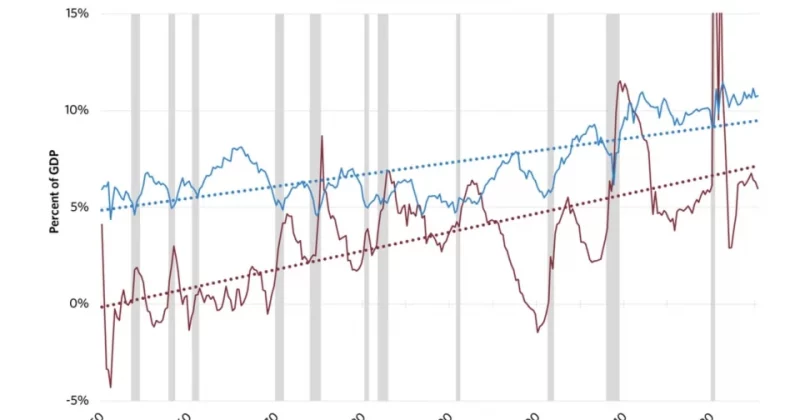
The US federal budget deficit is projected to hit roughly $2 trillion this fiscal year. That’s over 6% of GDP, more than double the 3% threshold that economists generally consider sustainable for a developed economy.

To put that number in perspective: the government is spending $2 trillion more than it takes in during a period of relative economic stability. This isn’t wartime spending or emergency pandemic relief. This is just the normal operating budget running at a pace that would make most household accountants faint.

How we got here

The Congressional Budget Office revised its FY2024 deficit estimate to $1.9 trillion, a 27% increase from its earlier projections. The culprit is a familiar one-two punch: spending is rising while revenues are falling.

The structural math is not complicated, just depressing. Mandatory spending programs, specifically Social Security, Medicare, and Medicaid, are growing faster than the government’s ability to collect revenue. These aren’t line items Congress votes on each year. They run on autopilot, and the passenger count keeps growing as the population ages.

Then there’s the interest bill. When you carry this much debt, the cost of servicing it becomes its own spending category, one that crowds out everything else. Rising interest costs have become a major contributor to the deficit, creating a feedback loop where borrowing more money costs more money, which requires more borrowing.

The Tax Cuts and Jobs Act has also left its mark on the ledger. The legislation is projected to add between $1.1 trillion and $1.9 trillion to federal deficits over its first decade, a range so wide it tells you even the experts aren’t sure how much damage it’s doing. What they do agree on is that it meaningfully reduced the revenue baseline without a corresponding reduction in spending.

Advertisement

On the discretionary side, the cuts that budget hawks dream about remain politically elusive. Defense spending has bipartisan support. Non-defense discretionary spending, while technically cuttable, represents a shrinking share of the overall budget. You could zero out entire agencies and still not close a gap this large.

The CBO projects deficits of around 6-7% of GDP for FY2026 as well, suggesting this isn’t a one-year blip. It’s the new normal.

The Treasury’s borrowing binge

To fund this gap, the US Treasury is expected to issue more than $2 trillion in debt this year. That’s a staggering amount of government paper that needs to find buyers in global markets.

Here’s the thing. The question isn’t whether the US can sell that much debt. It’s what happens to yields when you flood the market with supply. Budget hawks have raised legitimate concerns about whether markets can absorb this volume without pushing interest rates higher, which would, in turn, increase the cost of servicing the debt. The snake eating its own tail, in bond market form.

For years, the US benefited from seemingly insatiable global demand for Treasuries. Foreign central banks, pension funds, and institutional investors treated US government bonds as the closest thing to a risk-free asset. But at some point, even the most loyal buyers start asking questions about a borrower who consistently spends a trillion or two more than they earn.

The dollar’s reserve currency status provides a cushion that no other country enjoys. But cushions wear thin. And the pace of borrowing is testing assumptions that have held for decades.

What this means for crypto investors

Persistent multi-trillion-dollar deficits feed directly into one of crypto’s foundational narratives: dollar debasement. When a government consistently spends far beyond its means, the long-term value of its currency comes under pressure. This is the thesis that helped push Bitcoin past $100K and keeps institutional allocators adding digital assets to their portfolios.

Look, Bitcoin was literally designed as a response to the kind of monetary environment we’re now living in. Satoshi’s Genesis Block famously embedded a headline about bank bailouts. Fifteen years later, the fiscal picture has gotten dramatically worse, and the asset class born from that frustration has matured into a trillion-dollar market.

The practical implication is straightforward. As deficits stay elevated and debt issuance accelerates, real yields on Treasuries need to stay attractive enough to find buyers. If they don’t, the Federal Reserve may eventually face pressure to step in as a buyer of last resort, effectively monetizing the debt. That scenario is the bull case for hard-cap assets like Bitcoin distilled to its purest form.

The risk, of course, runs in the other direction too. If policymakers get serious about fiscal discipline, whether through spending cuts, tax increases, or both, the urgency behind the debasement narrative fades. But given the political reality of cutting Social Security or raising taxes in an election-heavy era, that outcome feels about as likely as Congress agreeing on lunch.

For investors watching this space, the $2 trillion deficit number isn’t just a fiscal statistic. It’s a macro backdrop that makes the case for portfolio diversification into non-sovereign assets harder to ignore with each passing budget cycle.

Disclosure: This article was edited by Editorial Team. For more information on how we create and review content, see our Editorial Policy.

US government budget deficit projected at $2T this year, and crypto markets are paying attention

US government budget deficit projected at $2T this year, and crypto markets are paying attention

The federal government is on track to borrow more than $2 trillion in a single fiscal year, a peacetime deficit that dwarfs what economists consider sustainable.

The US federal budget deficit is projected to hit roughly $2 trillion this fiscal year. That’s over 6% of GDP, more than double the 3% threshold that economists generally consider sustainable for a developed economy.

To put that number in perspective: the government is spending $2 trillion more than it takes in during a period of relative economic stability. This isn’t wartime spending or emergency pandemic relief. This is just the normal operating budget running at a pace that would make most household accountants faint.

How we got here

The Congressional Budget Office revised its FY2024 deficit estimate to $1.9 trillion, a 27% increase from its earlier projections. The culprit is a familiar one-two punch: spending is rising while revenues are falling.

The structural math is not complicated, just depressing. Mandatory spending programs, specifically Social Security, Medicare, and Medicaid, are growing faster than the government’s ability to collect revenue. These aren’t line items Congress votes on each year. They run on autopilot, and the passenger count keeps growing as the population ages.

Then there’s the interest bill. When you carry this much debt, the cost of servicing it becomes its own spending category, one that crowds out everything else. Rising interest costs have become a major contributor to the deficit, creating a feedback loop where borrowing more money costs more money, which requires more borrowing.

The Tax Cuts and Jobs Act has also left its mark on the ledger. The legislation is projected to add between $1.1 trillion and $1.9 trillion to federal deficits over its first decade, a range so wide it tells you even the experts aren’t sure how much damage it’s doing. What they do agree on is that it meaningfully reduced the revenue baseline without a corresponding reduction in spending.

Advertisement

On the discretionary side, the cuts that budget hawks dream about remain politically elusive. Defense spending has bipartisan support. Non-defense discretionary spending, while technically cuttable, represents a shrinking share of the overall budget. You could zero out entire agencies and still not close a gap this large.

The CBO projects deficits of around 6-7% of GDP for FY2026 as well, suggesting this isn’t a one-year blip. It’s the new normal.

The Treasury’s borrowing binge

To fund this gap, the US Treasury is expected to issue more than $2 trillion in debt this year. That’s a staggering amount of government paper that needs to find buyers in global markets.

Here’s the thing. The question isn’t whether the US can sell that much debt. It’s what happens to yields when you flood the market with supply. Budget hawks have raised legitimate concerns about whether markets can absorb this volume without pushing interest rates higher, which would, in turn, increase the cost of servicing the debt. The snake eating its own tail, in bond market form.

For years, the US benefited from seemingly insatiable global demand for Treasuries. Foreign central banks, pension funds, and institutional investors treated US government bonds as the closest thing to a risk-free asset. But at some point, even the most loyal buyers start asking questions about a borrower who consistently spends a trillion or two more than they earn.

The dollar’s reserve currency status provides a cushion that no other country enjoys. But cushions wear thin. And the pace of borrowing is testing assumptions that have held for decades.

What this means for crypto investors

Persistent multi-trillion-dollar deficits feed directly into one of crypto’s foundational narratives: dollar debasement. When a government consistently spends far beyond its means, the long-term value of its currency comes under pressure. This is the thesis that helped push Bitcoin past $100K and keeps institutional allocators adding digital assets to their portfolios.

Look, Bitcoin was literally designed as a response to the kind of monetary environment we’re now living in. Satoshi’s Genesis Block famously embedded a headline about bank bailouts. Fifteen years later, the fiscal picture has gotten dramatically worse, and the asset class born from that frustration has matured into a trillion-dollar market.

The practical implication is straightforward. As deficits stay elevated and debt issuance accelerates, real yields on Treasuries need to stay attractive enough to find buyers. If they don’t, the Federal Reserve may eventually face pressure to step in as a buyer of last resort, effectively monetizing the debt. That scenario is the bull case for hard-cap assets like Bitcoin distilled to its purest form.

The risk, of course, runs in the other direction too. If policymakers get serious about fiscal discipline, whether through spending cuts, tax increases, or both, the urgency behind the debasement narrative fades. But given the political reality of cutting Social Security or raising taxes in an election-heavy era, that outcome feels about as likely as Congress agreeing on lunch.

For investors watching this space, the $2 trillion deficit number isn’t just a fiscal statistic. It’s a macro backdrop that makes the case for portfolio diversification into non-sovereign assets harder to ignore with each passing budget cycle.

Disclosure: This article was edited by Editorial Team. For more information on how we create and review content, see our Editorial Policy.