
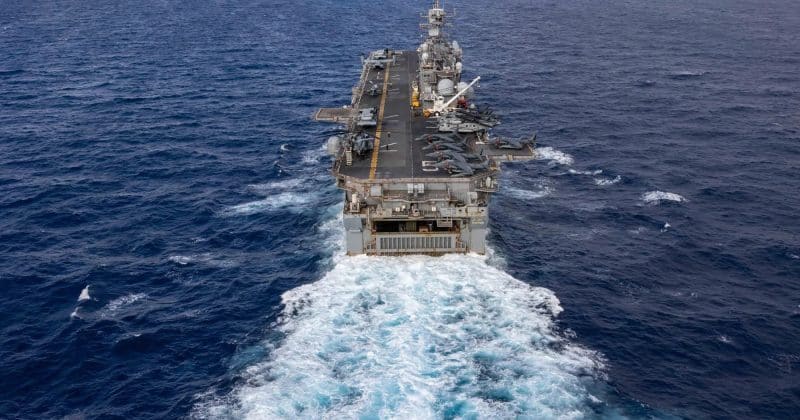
US government vows to target Iranian military infrastructure if shipping threatened in Strait of Hormuz

US government vows to target Iranian military infrastructure if shipping threatened in Strait of Hormuz

Escalating tensions over the world's most critical oil chokepoint are pushing Iran toward Bitcoin-settled trade and reshaping how sanctioned nations interact with global markets.

The United States has committed to striking Iranian military infrastructure if Iran threatens shipping through the Strait of Hormuz, the narrow waterway that carries roughly 20% of the world’s oil trade.

Operation Epic Fury and the 48-hour ultimatum

US forces launched Operation Epic Fury on February 28, 2026, targeting Iranian naval and military sites in what marked a significant escalation of hostilities. The operation was conducted alongside Israeli military assets, making it a coordinated campaign against Iranian infrastructure.

Iran responded by asserting control over the Strait of Hormuz and threatening attacks on vessels transiting the waterway.

Advertisement

President Trump raised the stakes further on March 22, 2026, threatening to “obliterate” Iranian power plants unless shipping routes were reopened within 48 hours.

The US Navy has ramped up its presence in the region, and war risk insurance premiums for vessels transiting the strait have climbed dramatically since the tensions began escalating in late February.

Bitcoin enters the Persian Gulf

Faced with crushing sanctions that limit its access to traditional financial rails, Iran has turned to cryptocurrency as a workaround for maintaining trade through the strait.

Iran has begun accepting Bitcoin payments for tanker transit fees, reportedly pricing them at approximately $1 per barrel.

Perhaps more notable is the emergence of “Hormuz Safe,” a Bitcoin-settled marine insurance platform that Iran has reportedly established to facilitate trade despite sanctions. As of May 2026, the platform was aiming for $10 billion in trade volume. The platform provides coverage for vessels transiting the strait, settling claims and premiums in Bitcoin rather than dollars or euros, directly responding to the fact that Western insurers have largely pulled back from covering Iran-linked shipments.

Why this matters beyond oil

The $10 billion trade volume target for Hormuz Safe, if even partially achieved, would represent one of the largest real-world Bitcoin settlement use cases outside of pure financial speculation.

For traditional markets, any prolonged closure or restriction of the waterway would send energy prices surging, given that roughly one in five barrels of oil traded globally passes through it. Some shippers are rerouting around the Cape of Good Hope, adding weeks and millions of dollars to voyage costs.

Disclosure: This article was edited by Editorial Team. For more information on how we create and review content, see our Editorial Policy.

US government vows to target Iranian military infrastructure if shipping threatened in Strait of Hormuz

US government vows to target Iranian military infrastructure if shipping threatened in Strait of Hormuz

Escalating tensions over the world's most critical oil chokepoint are pushing Iran toward Bitcoin-settled trade and reshaping how sanctioned nations interact with global markets.

The United States has committed to striking Iranian military infrastructure if Iran threatens shipping through the Strait of Hormuz, the narrow waterway that carries roughly 20% of the world’s oil trade.

Operation Epic Fury and the 48-hour ultimatum

US forces launched Operation Epic Fury on February 28, 2026, targeting Iranian naval and military sites in what marked a significant escalation of hostilities. The operation was conducted alongside Israeli military assets, making it a coordinated campaign against Iranian infrastructure.

Iran responded by asserting control over the Strait of Hormuz and threatening attacks on vessels transiting the waterway.

Advertisement

President Trump raised the stakes further on March 22, 2026, threatening to “obliterate” Iranian power plants unless shipping routes were reopened within 48 hours.

The US Navy has ramped up its presence in the region, and war risk insurance premiums for vessels transiting the strait have climbed dramatically since the tensions began escalating in late February.

Bitcoin enters the Persian Gulf

Faced with crushing sanctions that limit its access to traditional financial rails, Iran has turned to cryptocurrency as a workaround for maintaining trade through the strait.

Iran has begun accepting Bitcoin payments for tanker transit fees, reportedly pricing them at approximately $1 per barrel.

Perhaps more notable is the emergence of “Hormuz Safe,” a Bitcoin-settled marine insurance platform that Iran has reportedly established to facilitate trade despite sanctions. As of May 2026, the platform was aiming for $10 billion in trade volume. The platform provides coverage for vessels transiting the strait, settling claims and premiums in Bitcoin rather than dollars or euros, directly responding to the fact that Western insurers have largely pulled back from covering Iran-linked shipments.

Why this matters beyond oil

The $10 billion trade volume target for Hormuz Safe, if even partially achieved, would represent one of the largest real-world Bitcoin settlement use cases outside of pure financial speculation.

For traditional markets, any prolonged closure or restriction of the waterway would send energy prices surging, given that roughly one in five barrels of oil traded globally passes through it. Some shippers are rerouting around the Cape of Good Hope, adding weeks and millions of dollars to voyage costs.

Disclosure: This article was edited by Editorial Team. For more information on how we create and review content, see our Editorial Policy.