
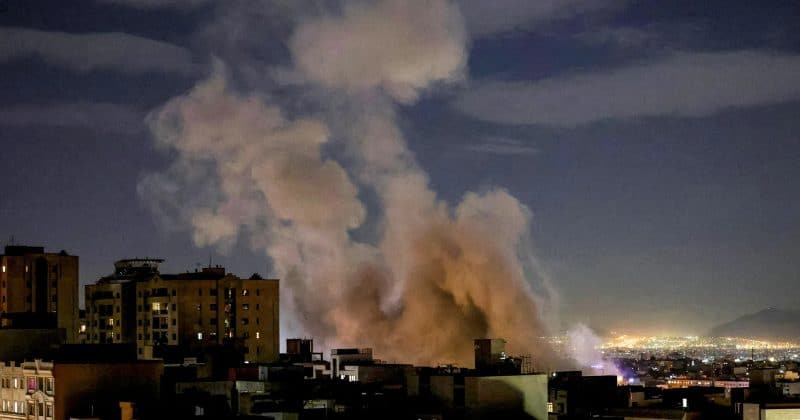
US strikes on southern Iran send oil markets into turmoil as crypto emerges as regional safe haven
Iranian President Pezeshkian cut short his Iraq visit after US military action during Ayatollah Khamenei's funeral observances, escalating tensions that are rippling across every asset class.
While Iranian President Masoud Pezeshkian and Foreign Minister Abbas Araghchi were attending funeral prayers for former Supreme Leader Ayatollah Ali Khamenei at the Imam Ali shrine in Najaf, Iraq, the US military was conducting strikes on targets in southern Iran.
Pezeshkian immediately cut his Iraq visit short and returned to Tehran. Iranian officials have condemned the strikes as an act of aggression during a national mourning period and promised retaliation, marking what may be the most significant escalation in US-Iran hostilities since the initial strikes that killed Khamenei in late February and early March 2026.
What happened and why it matters for markets
The US characterized the July 7 strikes as defensive operations targeting missile sites and minelaying boats in southern Iran. Washington’s framing suggests a focus on neutralizing threats in the Persian Gulf and the Strait of Hormuz.
Roughly 20% of the world’s oil passes through the Strait of Hormuz on any given day.
Both Pezeshkian and Araghchi have vowed retaliation against US actions, and diplomatic talks between the two nations have been formally paused until after Khamenei’s funeral and burial are complete.
Macro, rates, and crypto—what moved markets and what matters next.
Daily. Free. Join 34,000+ readers across crypto, finance, and policy.
The fact that US strikes occurred while senior Iranian leaders were on Iraqi soil adds a layer of diplomatic complexity to Iran’s relationship with Iraq.
The crypto angle investors should not ignore
Iran has a well-documented history of Bitcoin mining operations, partly driven by cheap subsidized energy and partly by the need to circumvent international sanctions. When tensions escalate, the incentive structure for Iranian citizens and businesses to hold value in decentralized assets only intensifies.
The UAE has positioned itself as a digital asset hub, Bahrain has licensed crypto exchanges, and Saudi Arabia has explored blockchain applications for state functions.
What to watch from here
For crypto investors specifically, three signals matter most. First, watch stablecoin volumes in the Middle East and Central Asia. A spike in USDT or USDC trading volumes on regional exchanges would indicate capital flight into dollar-denominated digital assets. Second, monitor Bitcoin’s correlation with gold. Third, pay attention to hashrate data. Iranian mining operations have historically fluctuated with the country’s internal stability, and any disruption to power infrastructure from military strikes could temporarily reduce global hashrate, affecting mining economics worldwide.
With no direct negotiations between Washington and Tehran, and both sides publicly committed to escalatory postures, the geopolitical risk premium embedded in every asset class is likely to widen before it narrows.