
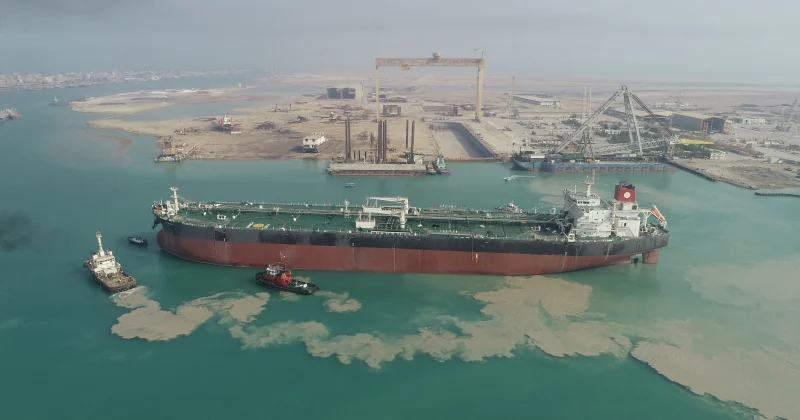
US Marines board Iranian oil tanker in Gulf of Oman as blockade enforcement intensifies
The boarding of the M/T Celestial Sea is part of a broader crackdown on Iranian shipping that has implications for oil markets and crypto-based sanctions evasion.
US Marines boarded an Iranian-flagged commercial oil tanker in the Gulf of Oman this week, suspecting the vessel of trying to breach the Trump administration’s blockade on Iranian ports. The ship, identified as the M/T Celestial Sea, was searched and then released after its crew was directed to change course away from Iran.
US Central Command confirmed the operation in a statement, noting that American forces “released the vessel after searching and directing the ship’s crew to alter course.” It was not an isolated event. CENTCOM also reported disabling a separate Iranian-flagged tanker, the M/T Hasna, on May 6, using 20mm cannon rounds to damage its rudder after it ignored repeated warnings.
A pattern, not an incident
Two Iranian-flagged tankers disabled or diverted in quick succession tells a clear story. The US is running coordinated enforcement operations in one of the world’s most strategically sensitive waterways, not just issuing warnings from the sidelines.
The Gulf of Oman sits at the mouth of the Strait of Hormuz, through which roughly a fifth of the world’s oil supply passes on any given day. When military activity picks up in this corridor, energy markets tend to notice immediately.
Historically, confrontations in the Strait of Hormuz have triggered short-term oil price spikes. The logic is straightforward: any disruption, or even the threat of disruption, to that chokepoint introduces a risk premium into crude pricing. Traders start pricing in the possibility that things could escalate further, and that possibility alone moves markets.
The broader context here is the Trump administration’s renewed maximum pressure campaign against Iran. The blockade is designed to choke off Iranian oil exports, which remain a critical revenue source for Tehran. Boarding vessels and physically disabling tankers represents a significant escalation from the diplomatic saber-rattling and secondary sanctions that characterized earlier phases of this approach.
Iran’s crypto workaround
Here’s where it gets relevant for crypto markets. Iran has a long and well-documented history of using alternative financial channels to circumvent sanctions, and digital assets have become an increasingly important part of that toolkit.
At its 2021 peak, Iran-based Bitcoin mining generated an estimated $1B in annual BTC value. The country leveraged its subsidized electricity to power mining operations, effectively converting cheap energy into a sanctions-resistant form of money that could move across borders without touching the traditional banking system.
Macro, rates, and crypto—what moved markets and what matters next.
Daily. Free. Join 34,000+ readers across crypto, finance, and policy.
In English: Iran figured out it could turn its oil and gas into Bitcoin without actually selling oil and gas on the open market. When the front door gets blocked, you find the side entrance.
The practice drew attention from US regulators and led to increased scrutiny of mining operations with ties to sanctioned jurisdictions. It also fueled broader conversations about whether proof-of-work mining creates inherent vulnerabilities in the sanctions enforcement framework, a debate that remains unresolved.
As physical enforcement of the blockade intensifies, the incentive for Iran to lean harder into digital asset channels only grows. Every tanker that gets boarded or disabled is another reminder that the conventional oil export route is becoming increasingly unreliable for Tehran.
What this means for investors
The immediate market impact of a single tanker boarding is modest. But the pattern matters more than any individual incident. A sustained US enforcement campaign in the Gulf of Oman introduces persistent uncertainty into energy markets, and that uncertainty ripples outward.
Oil prices carry a geopolitical risk premium when military operations are actively underway in the Strait of Hormuz region. That premium tends to support prices even when fundamental supply-demand dynamics might otherwise push them lower. For crypto investors, the connection is less direct but still worth tracking.
Bitcoin and gold have both historically attracted safe-haven flows during periods of heightened Middle Eastern tension, though the relationship for crypto is far less consistent than for gold. The more interesting dynamic is on the regulatory side. Escalations like these tend to accelerate policy discussions around sanctions enforcement in the digital asset space.
If the US blockade succeeds in further restricting Iran’s conventional oil exports, expect renewed attention on crypto mining operations in sanctioned countries. Treasury and OFAC have previously targeted wallet addresses and entities linked to Iranian sanctions evasion, and a tighter physical blockade creates the conditions for a corresponding tightening in the digital domain.
The wildcard is escalation risk. If Iran retaliates against the boarding and disabling of its tankers, whether through proxy attacks, direct naval confrontation, or disruption of other vessels transiting the Strait, the market reaction would be significantly larger. Oil could spike sharply, and the flight-to-safety trade, including into Bitcoin, would likely accelerate. That scenario remains speculative, but the trajectory of enforcement actions suggests the temperature in the Gulf of Oman is rising, not cooling.
For now, the crypto-specific takeaway is narrow but important: physical blockades and digital sanctions enforcement are two sides of the same coin. When one tightens, the other tends to follow. Investors holding positions in mining-adjacent companies or tokens with exposure to sanctioned jurisdictions should be paying close attention to what happens next in the Gulf of Oman, because the ripple effects won’t stay in the water.