
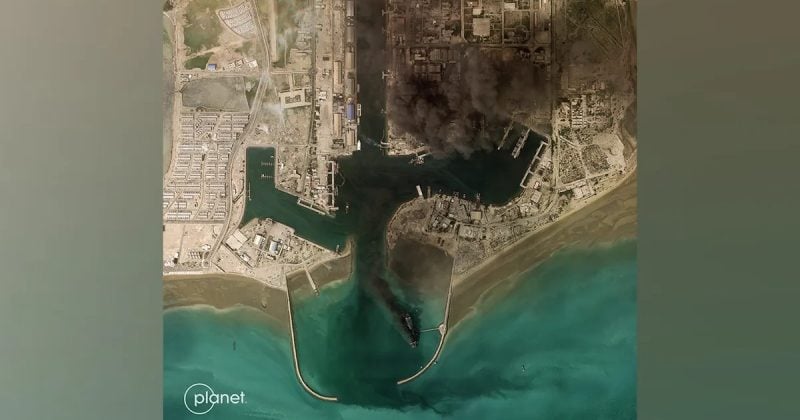
US military completes strikes on Iran targeting Bandar Abbas, raising oil supply fears that could ripple through crypto markets

US military completes strikes on Iran targeting Bandar Abbas, raising oil supply fears that could ripple through crypto markets

A five-hour CENTCOM operation hit Iranian military sites across six locations after attacks on commercial tankers in the Strait of Hormuz

The US military confirmed it completed a comprehensive strike operation against Iranian military facilities on July 13, wrapping up around 10:15 p.m. ET after roughly five hours of sustained action. Targets included sites in Bandar Abbas, Bushehr, Chabahar, Jask, Konarak, and Abu Musa, hitting coastal defense systems, missile and drone facilities, and maritime capabilities across Iran’s southern coast.

The strikes were a direct response to Iranian attacks on commercial vessels navigating the Strait of Hormuz, including two Emirati tankers.

What happened and why it matters

US Central Command carried out the operation after a fragile ceasefire, established in early July, collapsed around July 8. Iran’s decision to target commercial shipping, particularly Emirati-flagged vessels, effectively killed any diplomatic breathing room. The US response was broad in scope, striking six separate locations rather than a single symbolic target.

Advertisement

President Trump has since referenced the possibility of reinstating a US naval blockade on Iran. A blockade would represent a significant escalation beyond targeted strikes, potentially choking off Iranian oil exports entirely and creating sustained pressure on global energy markets.

The oil-to-crypto pipeline

Disruptions to oil supply through the Strait of Hormuz push energy prices higher. Higher energy prices feed directly into inflation data. And inflation data is the single biggest variable driving central bank policy, which in turn drives risk asset pricing, crypto included.

Crypto markets didn’t immediately react to the July 13 strikes with any notable price movement. That calculus changes if Trump follows through on blockade rhetoric and Iranian crude gets taken off the global market, as the inflationary impulse could force the Fed into a more hawkish posture precisely when markets are pricing in rate cuts.

What crypto investors should watch

The immediate variable is whether Iran retaliates further or absorbs the strikes without escalation. A retaliatory cycle that continues to target commercial shipping would almost certainly push oil prices higher and inject volatility into macro markets.

The second variable is the blockade question. There’s a meaningful difference between targeted military strikes and a sustained naval blockade. Strikes are a one-time shock. A blockade creates ongoing supply disruption that reprices energy markets for weeks or months. Trump’s comments suggest the administration views a blockade as a live option, not just rhetoric.

Third, watch the dollar. Military escalation in the Middle East has historically strengthened the US dollar as a safe haven, and a stronger dollar typically creates headwinds for Bitcoin and other crypto assets priced in dollar terms.

Disclosure: This article was edited by Editorial Team. For more information on how we create and review content, see our Editorial Policy.

US military completes strikes on Iran targeting Bandar Abbas, raising oil supply fears that could ripple through crypto markets

US military completes strikes on Iran targeting Bandar Abbas, raising oil supply fears that could ripple through crypto markets

A five-hour CENTCOM operation hit Iranian military sites across six locations after attacks on commercial tankers in the Strait of Hormuz

The US military confirmed it completed a comprehensive strike operation against Iranian military facilities on July 13, wrapping up around 10:15 p.m. ET after roughly five hours of sustained action. Targets included sites in Bandar Abbas, Bushehr, Chabahar, Jask, Konarak, and Abu Musa, hitting coastal defense systems, missile and drone facilities, and maritime capabilities across Iran’s southern coast.

The strikes were a direct response to Iranian attacks on commercial vessels navigating the Strait of Hormuz, including two Emirati tankers.

What happened and why it matters

US Central Command carried out the operation after a fragile ceasefire, established in early July, collapsed around July 8. Iran’s decision to target commercial shipping, particularly Emirati-flagged vessels, effectively killed any diplomatic breathing room. The US response was broad in scope, striking six separate locations rather than a single symbolic target.

Advertisement

President Trump has since referenced the possibility of reinstating a US naval blockade on Iran. A blockade would represent a significant escalation beyond targeted strikes, potentially choking off Iranian oil exports entirely and creating sustained pressure on global energy markets.

The oil-to-crypto pipeline

Disruptions to oil supply through the Strait of Hormuz push energy prices higher. Higher energy prices feed directly into inflation data. And inflation data is the single biggest variable driving central bank policy, which in turn drives risk asset pricing, crypto included.

Crypto markets didn’t immediately react to the July 13 strikes with any notable price movement. That calculus changes if Trump follows through on blockade rhetoric and Iranian crude gets taken off the global market, as the inflationary impulse could force the Fed into a more hawkish posture precisely when markets are pricing in rate cuts.

What crypto investors should watch

The immediate variable is whether Iran retaliates further or absorbs the strikes without escalation. A retaliatory cycle that continues to target commercial shipping would almost certainly push oil prices higher and inject volatility into macro markets.

The second variable is the blockade question. There’s a meaningful difference between targeted military strikes and a sustained naval blockade. Strikes are a one-time shock. A blockade creates ongoing supply disruption that reprices energy markets for weeks or months. Trump’s comments suggest the administration views a blockade as a live option, not just rhetoric.

Third, watch the dollar. Military escalation in the Middle East has historically strengthened the US dollar as a safe haven, and a stronger dollar typically creates headwinds for Bitcoin and other crypto assets priced in dollar terms.

Disclosure: This article was edited by Editorial Team. For more information on how we create and review content, see our Editorial Policy.