
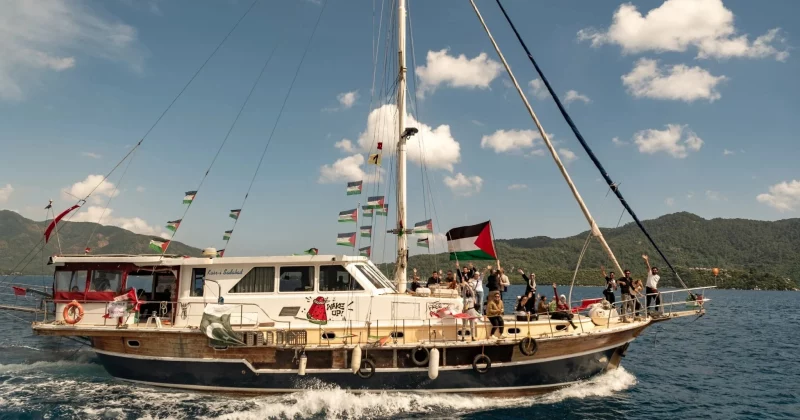
US sanctions four activists linked to Gaza flotilla campaigns
The Treasury Department alleges the Global Sumud Flotilla organizers serve as a support network for Hamas, freezing their US-held assets and threatening secondary sanctions on foreign banks.
The US Department of the Treasury has designated four individuals tied to a Turkish-led humanitarian flotilla campaign, accusing them of operating within Hamas support networks. The move marks yet another expansion of Washington’s sanctions apparatus into the contested space where humanitarian aid and alleged militant financing overlap.
The four activists, Saif Hashim Kamel Abukishek, Hisham Abdallah Sulayman Abu Mahfuz, Mohammed Khatib, and Jaldia Abubakra Aueda, are all associated with the Global Sumud Flotilla. That campaign has sought to deliver aid to Gaza amid Israel’s longstanding naval blockade of the territory.
What the Treasury is alleging
According to the Treasury’s Office of Foreign Assets Control (OFAC), the flotilla is not simply a humanitarian endeavor. The department claims it is organized by the Popular Conference for Palestinians Abroad, known as PCPA, which Treasury says maintains ties to Hamas’s International Relations Bureau and is connected to Muslim Brotherhood networks.
The PCPA itself was previously sanctioned by the US in January 2026. So from the Treasury’s perspective, these four individuals were operating within an organizational structure that Washington had already flagged.
The Treasury also describes Samidoun, a Palestinian prisoner solidarity network, as a front for the Popular Front for the Liberation of Palestine (PFLP). The department alleges Samidoun has aided fundraising activities on behalf of the PFLP, which the US has designated as a terrorist organization.
Here’s the thing: flotilla campaigns targeting the Gaza blockade have been a flashpoint for over a decade. The most infamous incident occurred in 2010, when Israeli commandos raided the Mavi Marmara, a Turkish vessel attempting to breach the blockade, killing ten activists aboard. That episode nearly severed Turkey-Israel diplomatic relations and turned the flotilla concept into one of the most polarizing symbols in the Israeli-Palestinian conflict.
The Global Sumud Flotilla exists in that same lineage, a direct-action campaign that its organizers frame as a challenge to what they call an illegal blockade, and that Israeli and American officials frame as a vector for material support to designated groups.
What the sanctions actually do
The practical mechanics of OFAC designations are straightforward but far-reaching. Any assets the four individuals hold under US jurisdiction are now frozen. US persons, meaning citizens, residents, and entities organized under American law, are prohibited from conducting transactions with them.
But the more consequential piece is the secondary sanctions threat. Foreign financial institutions that engage in significant transactions with the designated individuals risk being cut off from the US financial system. In English: even banks in Turkey, Jordan, or Europe now have to think twice before processing anything connected to these four people.
This secondary sanctions mechanism is the same tool Washington has used against Iranian oil networks, Russian oligarchs, and North Korean front companies. Applying it to humanitarian flotilla activists represents a particular escalation in how the US is treating the broader Palestinian solidarity movement.
Look, sanctions designations of this nature are not new. The US has steadily expanded its list of Hamas-linked entities and individuals since October 2023. But targeting people associated with a flotilla campaign, which its proponents describe as a maritime aid convoy, crosses into territory that civil liberties and humanitarian organizations will likely challenge.
What this means for the broader landscape
The designations arrive at a moment when the legal and financial infrastructure around Palestinian solidarity work is being tested globally. Canada designated Samidoun as a terrorist entity, and Germany banned the group’s activities. The US sanctions against these four activists fit within that broader Western government posture of treating certain advocacy and direct-action networks as extensions of designated militant organizations.
For activists and NGOs operating in this space, the implications are chilling in the most literal, legal sense. Once you are on an OFAC list, your ability to use the global financial system essentially evaporates. Banks practice over-compliance, meaning they often refuse transactions even tangentially connected to sanctioned individuals, well beyond what the law technically requires.
The counterargument, made by flotilla organizers and their supporters, is that the Gaza blockade itself violates international law, and that delivering humanitarian supplies to a civilian population under siege is protected activity. The International Committee of the Red Cross has previously described the blockade as collective punishment. Whether that legal framing offers any practical protection against US sanctions is, to put it mildly, a different question.
For anyone watching the intersection of financial regulation and geopolitics, these designations reinforce a trend. Washington is increasingly willing to use its financial dominance, the fact that the dollar underpins global trade, as a lever against individuals and small organizations, not just nation-states. The four activists named this week likely do not hold significant US assets. The real impact is reputational and systemic: their names are now in the same database as arms traffickers and sanctions evaders, and every bank in the world that touches the dollar has to treat them accordingly.
Whether that tool is proportionate to the alleged conduct is a debate that won’t be settled by the Treasury Department. It will play out in courts, in diplomatic channels, and in the broader court of public opinion, where flotilla campaigns have always generated far more heat than the modest vessels they deploy.