
Nexo Earn with Nexo
US government bets on stablecoins to enhance dollar dominance

US government bets on stablecoins to enhance dollar dominance

The GENIUS Act creates a federal framework for stablecoin issuers, but skeptics question whether digital dollars can truly counter de-dollarization pressures.

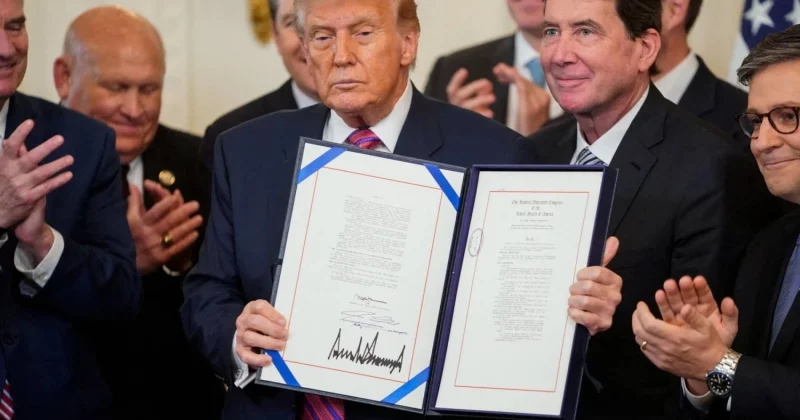
Washington has a new strategy for keeping the dollar on top, and it involves the very technology that was supposed to disrupt traditional finance. The GENIUS Act, enacted on July 18, 2025, establishes the first comprehensive federal framework for payment stablecoin issuers in the US, mandating that they hold 1:1 reserves in high-quality, liquid dollar-denominated assets.

The logic is straightforward: if stablecoins are going to proliferate globally, make sure every single one of them needs a pile of US Treasuries to back it up. That is a bet on manufactured demand for dollar assets at a scale that could reshape parts of the bond market.

The numbers behind the bet

As of early 2026, the stablecoin market sits at roughly $300 to $320 billion in total capitalization. Over 98% of that market is pegged to the US dollar. By April 2026, USD-backed tokens account for 99.76% of the entire stablecoin universe, leaving non-dollar coins with a threadbare 0.24% share.

The GENIUS Act specifies what qualifies as acceptable reserves: bank deposits, short-term Treasury bills, repurchase agreements, and government money market funds.

Advertisement

Standard Chartered projects the stablecoin market could balloon to $2 trillion by the end of 2028. If that forecast materializes, it could generate up to $1 trillion in additional demand for Treasury bills alone.

Tether and Circle, the two dominant stablecoin issuers, are already among the largest holders of short-term US Treasuries in their category. The GENIUS Act essentially codifies what these companies were already doing, while pulling smaller and future issuers into the same compliance orbit.

The regulatory architecture taking shape

The US Treasury, FinCEN, and OFAC proposed anti-money laundering and sanctions regulations on April 8, 2026. These rules target the compliance infrastructure that permitted payment stablecoin issuers, or PPSIs as the Act designates them, must build and maintain.

The OCC proposed its own rules related to capital and liquidity requirements for stablecoin issuers back in late February 2026.

The skeptic’s case

The optimistic projections are met with skepticism from experts who argue that stablecoins cannot fully counteract the structural forces driving de-dollarization. BRICS nations are actively developing alternative payment systems and bilateral currency arrangements designed to reduce dependence on dollar-denominated trade.

Stablecoins might extend the dollar’s reach at the retail and remittance level, but sovereign reserves, commodities pricing, and central bank swap lines operate on a different plane entirely.

What this means for investors

The GENIUS Act redraws the competitive landscape for stablecoin issuers. Compliance costs will rise, favoring well-capitalized incumbents like Tether and Circle over smaller players who may struggle to meet the new reserve and reporting requirements.

For traditional finance, the projected $1 trillion in additional Treasury bill demand is not trivial. If Standard Chartered’s forecast proves even directionally correct, it could put downward pressure on short-term yields, which has implications for money market funds, bank funding costs, and the broader fixed-income market.

But clarity cuts both ways. OFAC’s involvement means that sanctioned entities and jurisdictions could find themselves cut off from dollar-pegged stablecoins more effectively than before, which introduces political risk for issuers operating globally.

Disclosure: This article was edited by Editorial Team. For more information on how we create and review content, see our Editorial Policy.

US government bets on stablecoins to enhance dollar dominance

US government bets on stablecoins to enhance dollar dominance

The GENIUS Act creates a federal framework for stablecoin issuers, but skeptics question whether digital dollars can truly counter de-dollarization pressures.

Washington has a new strategy for keeping the dollar on top, and it involves the very technology that was supposed to disrupt traditional finance. The GENIUS Act, enacted on July 18, 2025, establishes the first comprehensive federal framework for payment stablecoin issuers in the US, mandating that they hold 1:1 reserves in high-quality, liquid dollar-denominated assets.

The logic is straightforward: if stablecoins are going to proliferate globally, make sure every single one of them needs a pile of US Treasuries to back it up. That is a bet on manufactured demand for dollar assets at a scale that could reshape parts of the bond market.

The numbers behind the bet

As of early 2026, the stablecoin market sits at roughly $300 to $320 billion in total capitalization. Over 98% of that market is pegged to the US dollar. By April 2026, USD-backed tokens account for 99.76% of the entire stablecoin universe, leaving non-dollar coins with a threadbare 0.24% share.

The GENIUS Act specifies what qualifies as acceptable reserves: bank deposits, short-term Treasury bills, repurchase agreements, and government money market funds.

Advertisement

Standard Chartered projects the stablecoin market could balloon to $2 trillion by the end of 2028. If that forecast materializes, it could generate up to $1 trillion in additional demand for Treasury bills alone.

Tether and Circle, the two dominant stablecoin issuers, are already among the largest holders of short-term US Treasuries in their category. The GENIUS Act essentially codifies what these companies were already doing, while pulling smaller and future issuers into the same compliance orbit.

The regulatory architecture taking shape

The US Treasury, FinCEN, and OFAC proposed anti-money laundering and sanctions regulations on April 8, 2026. These rules target the compliance infrastructure that permitted payment stablecoin issuers, or PPSIs as the Act designates them, must build and maintain.

The OCC proposed its own rules related to capital and liquidity requirements for stablecoin issuers back in late February 2026.

The skeptic’s case

The optimistic projections are met with skepticism from experts who argue that stablecoins cannot fully counteract the structural forces driving de-dollarization. BRICS nations are actively developing alternative payment systems and bilateral currency arrangements designed to reduce dependence on dollar-denominated trade.

Stablecoins might extend the dollar’s reach at the retail and remittance level, but sovereign reserves, commodities pricing, and central bank swap lines operate on a different plane entirely.

What this means for investors

The GENIUS Act redraws the competitive landscape for stablecoin issuers. Compliance costs will rise, favoring well-capitalized incumbents like Tether and Circle over smaller players who may struggle to meet the new reserve and reporting requirements.

For traditional finance, the projected $1 trillion in additional Treasury bill demand is not trivial. If Standard Chartered’s forecast proves even directionally correct, it could put downward pressure on short-term yields, which has implications for money market funds, bank funding costs, and the broader fixed-income market.

But clarity cuts both ways. OFAC’s involvement means that sanctioned entities and jurisdictions could find themselves cut off from dollar-pegged stablecoins more effectively than before, which introduces political risk for issuers operating globally.

Disclosure: This article was edited by Editorial Team. For more information on how we create and review content, see our Editorial Policy.