
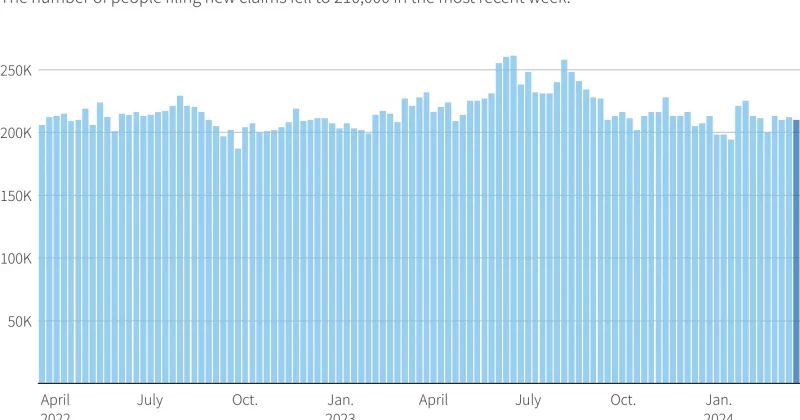
US weekly jobless claims fall to 209,000, below estimates
A labor market that refuses to crack keeps the Fed in wait-and-see mode, with ripple effects across crypto and risk assets.
The US labor market continues to do its best impression of a brick wall. Initial jobless claims for the week ending May 16 came in at 209,000, just below the consensus estimate of 210,000 and down from the prior week’s 211,000.
It’s not a dramatic beat. But in a market obsessed with parsing every data point for clues about the Federal Reserve’s next move, even a 1,000-claim undershoot matters.
The numbers in context
Here’s the thing about jobless claims: they’re one of the most real-time indicators of economic health we have. Every week, the Department of Labor tallies up how many Americans filed for unemployment benefits for the first time. A rising number signals layoffs are picking up. A falling number means employers are, for the most part, holding on to their workers.
At 209,000, the current reading sits comfortably in what economists would call “healthy” territory. The insured unemployment rate holds steady at 1.2%, with continuing claims totaling 1.70 million. Neither figure suggests any meaningful stress in the labor market.
For those who prefer the raw data: unadjusted initial state claims came in at 190,571. That’s a 5.7% increase from the prior week, but seasonal adjustments smooth out those fluctuations. The adjusted number, 209,000, is what markets actually trade on.
The week-over-week decline from 211,000 to 209,000 is modest by any standard. But the direction matters more than the magnitude here. Claims are trending sideways to slightly lower, not creeping higher. That’s the pattern you’d expect from a labor market that’s cooling gently rather than cracking under pressure.
Economists have spent the better part of two years waiting for the job market to buckle under the weight of the Fed’s aggressive rate-hiking campaign. It hasn’t. The “soft landing” narrative, once treated as wishful thinking, looks increasingly like the base case.
What this means for the Fed
The Federal Reserve has a dual mandate: stable prices and maximum employment. When both sides of that equation are relatively calm, the central bank has the luxury of patience. And patience is exactly what this data supports.
Macro, rates, and crypto—what moved markets and what matters next.
Daily. Free. Join 34,000+ readers across crypto, finance, and policy.
A labor market that’s still generating demand for workers, with claims below estimates, gives Fed officials little urgency to cut interest rates. The logic is straightforward: if people are employed, they’re spending money, and if they’re spending money, inflation pressures don’t disappear overnight.
Rate cut expectations have been a roller coaster this year. Markets have repeatedly gotten ahead of themselves, pricing in aggressive easing that the Fed then walks back through speeches and dot plots. This claims print, while not a blockbuster, reinforces the cautious stance Fed Chair Jerome Powell and his colleagues have been telegraphing.
Look, nobody at the Fed is going to change their policy outlook because claims came in 1,000 below forecast. But this data point adds to a growing stack of evidence that the economy isn’t deteriorating fast enough to justify early intervention. The bar for rate cuts remains high.
That has direct implications for dollar liquidity. When rates stay elevated, money stays expensive. The dollar tends to hold its ground. And assets that thrive on cheap liquidity, from growth stocks to crypto, have to find other catalysts to rally on.
What crypto investors should watch
For Bitcoin and Ethereum holders, weekly jobless claims aren’t exactly appointment viewing. But they should be on the radar, because they feed into the macro narrative that drives institutional capital flows.
The relationship works like this: strong labor data reduces the probability of rate cuts, which keeps the dollar relatively strong and tightens financial conditions. Tighter financial conditions generally act as a headwind for risk assets, including crypto. Conversely, if claims started spiking toward 250,000 or 300,000, rate cut bets would surge, liquidity expectations would shift, and risk assets would likely catch a bid.
At 209,000, we’re nowhere near that scenario. The crypto market is essentially getting a “hold steady” signal from the labor market. No panic, but no fuel injection either.
The more important question for crypto investors is whether this single data point moves the needle at all. Honestly, probably not much on its own. The proximity of the actual number to the estimate, just 1,000 claims apart, means this is about as uneventful as economic data gets.
What matters more is the trend. If claims continue to hover in the 200,000 to 215,000 range over the coming weeks, it solidifies the soft landing story and keeps the Fed on the sidelines. That scenario is neither bullish nor bearish for crypto in isolation. It’s neutral, with the real price action likely driven by broader inflation readings, GDP data, and crypto-specific catalysts like ETF flows and regulatory developments.
The risk scenario to monitor would be a sudden and sustained jump in claims. That would signal the labor market is finally feeling the cumulative impact of high interest rates, potentially accelerating the timeline for rate cuts. In that world, Bitcoin’s correlation with liquidity expectations would likely reassert itself aggressively.
For now, the labor market is telling a boring story. And in economics, boring is usually good. It just doesn’t give traders much to work with.