
Nexo Earn with Nexo
Wall Street banks trade more credit derivatives amid big tech’s massive AI debt surge

Wall Street banks trade more credit derivatives amid big tech’s massive AI debt surge

CDS volumes tied to US tech firms jumped 90% since September as hyperscalers borrowed $121 billion in 2025 to fund AI infrastructure.

Big Tech’s appetite for debt has gotten so large that Wall Street had to build entirely new markets just to manage the risk. Credit default swap volumes tied to US technology companies have surged 90% since early September 2025, driven by an unprecedented wave of borrowing aimed at funding AI infrastructure and data centers.

The scale here is hard to overstate. Hyperscalers collectively accumulated $121 billion in new debt during 2025, a figure that’s more than quadruple the average borrowing pace of the past five years. Meta alone raised $30 billion, while Alphabet contributed $25 billion to that total. And this might just be the warm-up act, with analysts projecting an additional $1.5 trillion in tech sector borrowing through 2028 for AI-related projects.

Advertisement

Why Wall Street is scrambling for hedges

Banks that are packaging and selling these massive offerings need a way to protect themselves during the distribution window, and credit default swaps are the tool of choice. When you’re suddenly underwriting debt at four times the historical pace, your demand for that insurance goes through the roof.

The result is that entirely new single-name CDS markets have materialized for high-grade tech firms that lacked any meaningful liquidity just a year ago. Some of these contracts now rank among the most actively traded US CDS outside of the financial sector. Data from the Depository Trust & Clearing Corp. confirms a notable rise in non-financial sector CDS transactions, underscoring how dramatically the landscape has shifted.

Oracle’s CDS tells the whole story

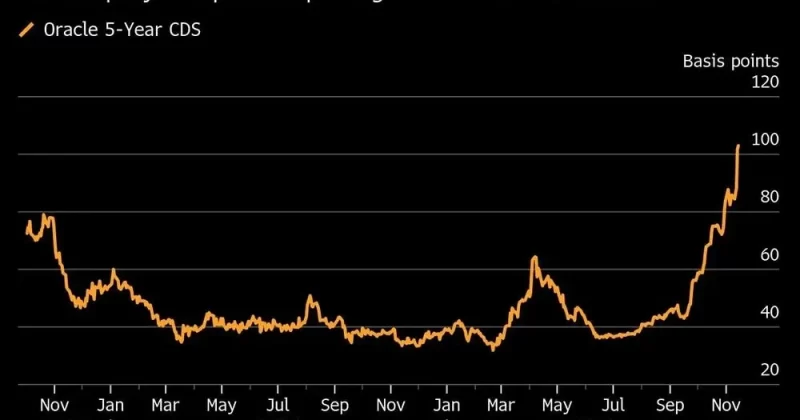
Oracle’s five-year CDS spread widened from roughly 40 basis points to between 151 and 160 basis points by the end of 2025. Trading volume tells an even more dramatic story. Oracle CDS activity surged over 20-fold year-over-year, reaching $9.2 billion over a ten-week stretch.

Banks like JPMorgan Chase have reportedly faced challenges distributing multi-billion-dollar loans tied to AI projects, which partially explains why the hedging activity has been so intense.

What this means for investors

The $121 billion borrowed in 2025 is already a historical anomaly. The projected $1.5 trillion in additional tech borrowing through 2028 raises an obvious question: at what point does the debt load become unsustainable, even for companies with the cash flows of Meta and Alphabet? The spread widening on Oracle’s CDS is a preview of what happens when leverage exceeds market expectations.

Disclosure: This article was edited by Editorial Team. For more information on how we create and review content, see our Editorial Policy.

Wall Street banks trade more credit derivatives amid big tech’s massive AI debt surge

Wall Street banks trade more credit derivatives amid big tech’s massive AI debt surge

CDS volumes tied to US tech firms jumped 90% since September as hyperscalers borrowed $121 billion in 2025 to fund AI infrastructure.

Big Tech’s appetite for debt has gotten so large that Wall Street had to build entirely new markets just to manage the risk. Credit default swap volumes tied to US technology companies have surged 90% since early September 2025, driven by an unprecedented wave of borrowing aimed at funding AI infrastructure and data centers.

The scale here is hard to overstate. Hyperscalers collectively accumulated $121 billion in new debt during 2025, a figure that’s more than quadruple the average borrowing pace of the past five years. Meta alone raised $30 billion, while Alphabet contributed $25 billion to that total. And this might just be the warm-up act, with analysts projecting an additional $1.5 trillion in tech sector borrowing through 2028 for AI-related projects.

Advertisement

Why Wall Street is scrambling for hedges

Banks that are packaging and selling these massive offerings need a way to protect themselves during the distribution window, and credit default swaps are the tool of choice. When you’re suddenly underwriting debt at four times the historical pace, your demand for that insurance goes through the roof.

The result is that entirely new single-name CDS markets have materialized for high-grade tech firms that lacked any meaningful liquidity just a year ago. Some of these contracts now rank among the most actively traded US CDS outside of the financial sector. Data from the Depository Trust & Clearing Corp. confirms a notable rise in non-financial sector CDS transactions, underscoring how dramatically the landscape has shifted.

Oracle’s CDS tells the whole story

Oracle’s five-year CDS spread widened from roughly 40 basis points to between 151 and 160 basis points by the end of 2025. Trading volume tells an even more dramatic story. Oracle CDS activity surged over 20-fold year-over-year, reaching $9.2 billion over a ten-week stretch.

Banks like JPMorgan Chase have reportedly faced challenges distributing multi-billion-dollar loans tied to AI projects, which partially explains why the hedging activity has been so intense.

What this means for investors

The $121 billion borrowed in 2025 is already a historical anomaly. The projected $1.5 trillion in additional tech borrowing through 2028 raises an obvious question: at what point does the debt load become unsustainable, even for companies with the cash flows of Meta and Alphabet? The spread widening on Oracle’s CDS is a preview of what happens when leverage exceeds market expectations.

Disclosure: This article was edited by Editorial Team. For more information on how we create and review content, see our Editorial Policy.