
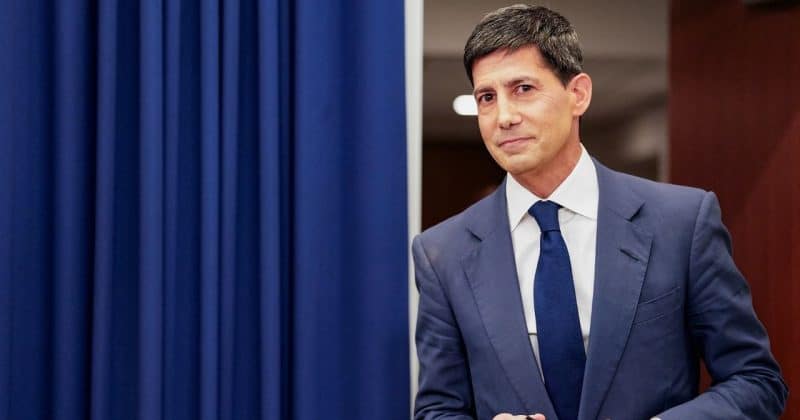
Warsh says central bank won’t tolerate high inflation in first press conference as Fed chair

Warsh says central bank won’t tolerate high inflation in first press conference as Fed chair

New Fed chair holds rates steady while signaling potential hikes ahead, calling persistent inflation above 3% 'a choice' the central bank intends to reverse

Kevin Warsh just gave his first press conference as Federal Reserve Chair, and the message was about as subtle as a sledgehammer. The central bank will not accept high inflation. Period.

Speaking after the Federal Open Market Committee’s June 17 meeting, Warsh made clear that the Fed’s 2% inflation target isn’t aspirational. It’s a deadline the institution has been missing for more than five years running.

Rates held steady, but the hawkish undertone is hard to miss

The FOMC voted to keep interest rates at 3.5-3.75%, marking the fourth consecutive pause. Updated projections from the committee show core inflation staying at roughly 2.5% through 2027, still meaningfully above the Fed’s 2% target. The forecasts also left the door open for potential rate hikes of 0.25% later in 2026.

Warsh described the persistence of inflation above 3% for over half a decade as “a choice,” a pointed framing that suggests he views the prior Fed leadership’s approach as insufficiently aggressive.

Advertisement

“The commitment to deliver [on 2% inflation] is strong, unanimous, and unambiguous.”

A new playbook for measuring and fighting inflation

Warsh didn’t just talk tough. He announced structural changes to how the Fed operates.

New task forces will reevaluate three critical areas: the Fed’s communication strategies, its data sources, and its broader monetary policy framework.

One notable shift involves how the Fed measures inflation itself. Warsh indicated a strategic pivot toward focusing on underlying inflation trends rather than reacting to sporadic price fluctuations. Recent inflationary pressure has been partly driven by elevated energy prices tied to geopolitical events, the kind of external shocks that can distort headline inflation numbers without reflecting genuine demand-driven price increases.

Warsh served as a Fed governor from 2006 to 2011, a period that included the global financial crisis, during which he built a reputation as one of the more hawkish voices on the board.

What this means for investors and crypto markets

With rates already at 3.5-3.75% and the possibility of additional hikes on the table, the cost of borrowing stays elevated. Consumer spending slows, corporate earnings face pressure, and investors may rotate out of speculative positions into Treasury bonds that now offer meaningful yields.

Warsh made no mention of crypto or digital assets during his press conference. The new Fed chair appears entirely focused on traditional monetary policy levers.

Discussions around productivity gains from AI were mentioned alongside alternative inflation measures as possible factors that could help bring down price pressures over time.

For crypto traders specifically, the key variable to watch isn’t Bitcoin’s price action in isolation. It’s the real yield on US Treasuries. As long as government bonds offer attractive inflation-adjusted returns, capital will continue flowing toward safety rather than speculation.

Disclosure: This article was edited by Editorial Team. For more information on how we create and review content, see our Editorial Policy.

Warsh says central bank won’t tolerate high inflation in first press conference as Fed chair

Warsh says central bank won’t tolerate high inflation in first press conference as Fed chair

New Fed chair holds rates steady while signaling potential hikes ahead, calling persistent inflation above 3% 'a choice' the central bank intends to reverse

Kevin Warsh just gave his first press conference as Federal Reserve Chair, and the message was about as subtle as a sledgehammer. The central bank will not accept high inflation. Period.

Speaking after the Federal Open Market Committee’s June 17 meeting, Warsh made clear that the Fed’s 2% inflation target isn’t aspirational. It’s a deadline the institution has been missing for more than five years running.

Rates held steady, but the hawkish undertone is hard to miss

The FOMC voted to keep interest rates at 3.5-3.75%, marking the fourth consecutive pause. Updated projections from the committee show core inflation staying at roughly 2.5% through 2027, still meaningfully above the Fed’s 2% target. The forecasts also left the door open for potential rate hikes of 0.25% later in 2026.

Warsh described the persistence of inflation above 3% for over half a decade as “a choice,” a pointed framing that suggests he views the prior Fed leadership’s approach as insufficiently aggressive.

Advertisement

“The commitment to deliver [on 2% inflation] is strong, unanimous, and unambiguous.”

A new playbook for measuring and fighting inflation

Warsh didn’t just talk tough. He announced structural changes to how the Fed operates.

New task forces will reevaluate three critical areas: the Fed’s communication strategies, its data sources, and its broader monetary policy framework.

One notable shift involves how the Fed measures inflation itself. Warsh indicated a strategic pivot toward focusing on underlying inflation trends rather than reacting to sporadic price fluctuations. Recent inflationary pressure has been partly driven by elevated energy prices tied to geopolitical events, the kind of external shocks that can distort headline inflation numbers without reflecting genuine demand-driven price increases.

Warsh served as a Fed governor from 2006 to 2011, a period that included the global financial crisis, during which he built a reputation as one of the more hawkish voices on the board.

What this means for investors and crypto markets

With rates already at 3.5-3.75% and the possibility of additional hikes on the table, the cost of borrowing stays elevated. Consumer spending slows, corporate earnings face pressure, and investors may rotate out of speculative positions into Treasury bonds that now offer meaningful yields.

Warsh made no mention of crypto or digital assets during his press conference. The new Fed chair appears entirely focused on traditional monetary policy levers.

Discussions around productivity gains from AI were mentioned alongside alternative inflation measures as possible factors that could help bring down price pressures over time.

For crypto traders specifically, the key variable to watch isn’t Bitcoin’s price action in isolation. It’s the real yield on US Treasuries. As long as government bonds offer attractive inflation-adjusted returns, capital will continue flowing toward safety rather than speculation.

Disclosure: This article was edited by Editorial Team. For more information on how we create and review content, see our Editorial Policy.