
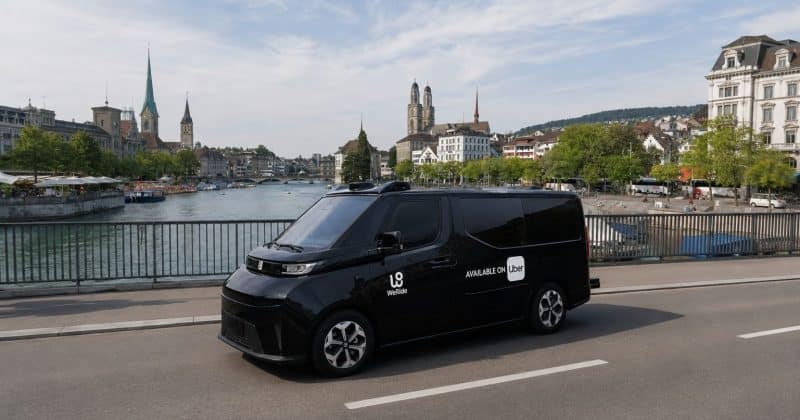
WeRide and Uber launch commercial robotaxi service in Zurich, expanding autonomous vehicle push across Europe
The Guangzhou-based autonomous driving company and ride-hailing giant are targeting fully driverless operations in Zurich and Madrid by mid-2027
WeRide and Uber are bringing robotaxis to Switzerland. The two companies announced on June 17 that they plan to launch commercial autonomous ride-hailing services in the Greater Zurich Region later this year, pending regulatory approval from Switzerland’s Federal Roads Office, known as FEDRO.
Zurich becomes the fifth city activated under a broader partnership agreement that spans 15 cities globally.
From Guangzhou to Zurich
WeRide, which trades on NASDAQ under the ticker WRD after going public in October 2024, has been building Level 4 autonomous driving technology since its founding in 2017. Level 4, in plain terms, means the car can handle all driving tasks in specific conditions without any human intervention.
The Guangzhou-headquartered company has already notched deployments in locations like Dubai. Zurich represents the second European city in its pipeline, following an earlier announcement about launching in Madrid.
Both cities are on track for fully driverless operations by mid-2027. That’s a meaningful distinction: the initial Zurich launch will likely feature safety operators in the vehicles, with the training wheels coming off roughly a year later.
Riders will book these autonomous trips exclusively through the Uber app. That’s the core logic of the partnership: WeRide builds the self-driving brains, Uber supplies the demand network and consumer interface.
AI, tech, and the markets they move—in one daily briefing.
Daily. Free. Join 34,000+ readers across crypto, finance, and policy.
Why Switzerland, and why now
For Uber, the calculus is different but complementary. The company has been steadily positioning itself as the platform layer for autonomous mobility rather than building its own self-driving tech. After burning through billions on its in-house autonomous program before selling it to Aurora in 2020, Uber pivoted to the partnership model.
The 15-city framework with WeRide alone suggests Uber is serious about making robotaxis a meaningful share of its ride volume over the next several years.
What this means for investors watching tech and markets
For WRD shareholders, the Zurich announcement validates the company’s ability to secure international partnerships and navigate foreign regulatory regimes. Five cities active out of 15 contracted means the next 10 represent a pipeline of potential catalysts.
For Uber, robotaxis address a fundamental cost problem. Human drivers take a significant cut of every fare. Autonomous vehicles, once the upfront capital is deployed, dramatically change the unit economics of ride-hailing.
The regulatory dimension matters enormously here. FEDRO approval isn’t guaranteed, and any delays could push timelines. The mid-2027 target for fully driverless operations in both Zurich and Madrid will serve as a real-world test of whether European regulatory caution translates into extended timelines.