
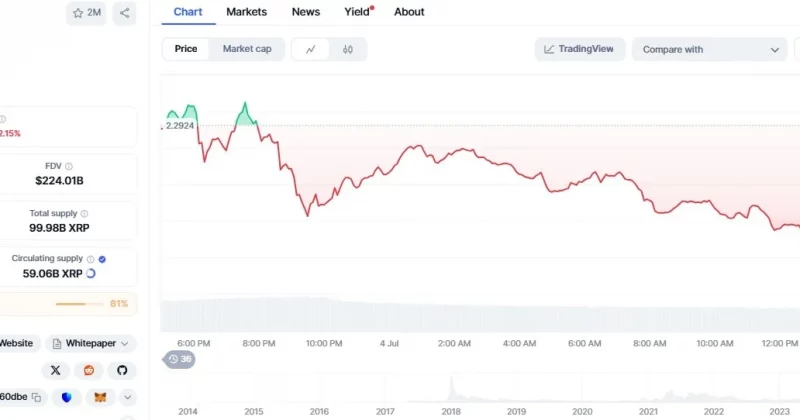
Crypto whale bets $224,000 on XRP price stability through June
A large holder is wagering six figures that XRP goes absolutely nowhere for the next several weeks, a contrarian play in a market obsessed with moonshots.
In a market where everyone seems to have a directional opinion on XRP, one whale is betting on the most boring outcome possible: nothing happens.
A major XRP holder has deployed roughly $224,000 on a strategy designed to profit if XRP’s price stays flat through the end of June. No rally. No crash. Just sideways action. In a corner of crypto that tends to attract the loudest predictions, this is the equivalent of walking into a casino and betting on a tie.
The strategy behind the stagnation bet
The position appears to be an options-based play structured around range-bound trading rather than a simple long or short. In English: the whale likely sold options on both sides of the current price, collecting premium upfront while betting that XRP won’t move far enough in either direction to trigger losses.
This kind of trade, often called a short strangle or iron condor depending on the exact structure, is a volatility play. The whale isn’t saying XRP is good or bad. They’re saying it’s going to be quiet.
And that’s a meaningful signal. Options strategies that profit from low volatility require conviction. If XRP makes a sharp move in either direction, this position could bleed. A $224,000 commitment suggests the trader has done their homework, or at least believes they have.
Here’s the thing. This bet runs directly against the dominant narratives in the XRP ecosystem, where retail analysts routinely project targets ranging from $5 to as high as $75 in the coming years. Those projections are typically fueled by bullish storylines around ETF demand and cross-border payment adoption. The whale apparently isn’t buying any of it, at least not on a June timeline.
What the technicals and forecasts actually say
The flat-price thesis isn’t entirely unfounded when you look at the data. CoinCodex projects XRP hovering around $1.35 by June 18, 2026, with a neutral RSI reading. That’s the kind of forecast that screams consolidation, not fireworks.
On the bearish side, some technical analysts have flagged a potential drop to $1.25 if XRP breaks below key support levels. That’s not a catastrophic decline, but it would likely be enough to put pressure on a stability-focused options position depending on how tightly the trade is structured.
The news moving money, markets, and the world—before your day starts.
Daily. Free. Join 34,000+ readers across crypto, finance, and policy.
The longer-term outlook is where opinions diverge sharply. Standard Chartered has estimated XRP could reach approximately $2.80 in 2026, a meaningful gain from current levels but not the kind of parabolic move that retail speculators tend to fantasize about. More aggressive projections from various sectors push as high as $10.18 by 2026, with some speculative models forecasting as much as $48 by 2030.
Those bigger numbers make for great social media content. They also tend to evaporate when subjected to anything resembling scrutiny. The whale’s bet suggests they’re siding with the more conservative consensus, at least for the near term.
Why a boring bet matters in a loud market
Crypto markets have a well-documented bias toward directional conviction. Traders love to declare that something is going to the moon or to zero. The infrastructure of crypto social media, from prediction threads to influencer calls, rewards bold stances and punishes nuance.
A $224,000 bet on flatness is, in that context, a minor act of rebellion. It suggests that at least one large market participant believes the current price already reflects available information, and that the catalysts bulls and bears are citing won’t materialize before summer ends.
Look, this isn’t unprecedented in traditional finance. Volatility-selling strategies are a staple of institutional options trading. Hedge funds have been collecting premium on range-bound assets for decades. But in crypto, where implied volatility tends to be dramatically higher than in equities, selling volatility is riskier and therefore potentially more rewarding when the bet pays off.
The trade also serves as a useful temperature check. When whales start betting on stability, it can indicate that a period of price discovery has ended and that the market is settling into a new equilibrium. Whether that equilibrium holds through June is the $224,000 question.
For XRP holders watching from the sidelines, this bet carries a few implications worth considering. First, it suggests that near-term catalysts, whether regulatory clarity, ETF approvals, or partnership announcements, may already be priced in. If a major player with six figures on the line doesn’t expect movement, the market might be in a holding pattern.
Second, it highlights the growing sophistication of crypto derivatives markets. A few years ago, placing a structured options bet of this size on XRP would have been difficult or impossible. The fact that it’s now routine enough to attract whale-sized capital is itself a sign of market maturation.
Third, and most practically: if the whale is right, the next several weeks could be frustrating for momentum traders. Range-bound markets chop up directional positions. Traders betting on breakouts or breakdowns could find themselves stopped out repeatedly while the stability bet quietly accrues profit.
The risk, of course, is that crypto doesn’t stay boring for long. A surprise regulatory development, an unexpected partnership, or a broader market shock could send XRP flying past the boundaries of whatever range this whale has defined. At $224,000, they can probably absorb a loss. But it would still sting. Markets have a way of humbling the most confident predictions, even the ones that predict nothing will happen at all.