
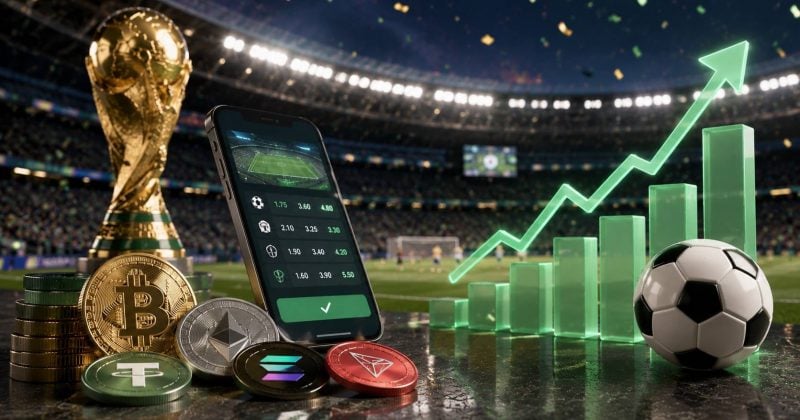
World Cup drama highlights untapped crypto opportunity in global sports betting and fan engagement

World Cup drama highlights untapped crypto opportunity in global sports betting and fan engagement

Argentina's comeback win over England in the 2026 World Cup semifinal drew billions of eyeballs, but the crypto industry was largely absent from the conversation.

Argentina knocked England out of the 2026 FIFA World Cup on July 15, rallying from a 1-0 deficit to win 2-1 in a semifinal that will be replayed on highlight reels for decades. England coach Thomas Tuchel praised the defending champions’ willingness to take risks when trailing, accepting responsibility for late substitutions that cost his side momentum.

It was exactly the kind of high-stakes, globally watched drama that crypto companies have spent years trying to attach themselves to. And yet, the entire narrative played out without a single meaningful intersection with digital assets.

What happened on the pitch

England took an early lead and, by Tuchel’s own account, played their best match of the tournament. Then Argentina did what Argentina does under pressure: they pushed forward with an aggressive, risk-on approach that flipped the scoreline.

Advertisement

Tuchel pointed to his decision to withdraw Declan Rice and Reece James late in the match as a turning point. Those substitutions, he admitted, contributed to a shift in his team’s posture from assertive to passive.

Tuchel gave full credit to Argentina for mounting the comeback when the match seemed to be slipping away from them, calling the defending champions’ approach a masterclass in calculated risk-taking.

The billion-dollar blank spot

Rewind to 2022 and early 2023. Crypto exchanges were plastered across jerseys, stadiums, and broadcast sponsorships. FTX had naming rights to arenas. Crypto.com had its logo on the UFC octagon and Formula 1 cars. Binance partnered with Cristiano Ronaldo on NFT collections.

None of the major reporting around the England-Argentina semifinal referenced any token, blockchain protocol, or digital asset initiative tied to the match or the tournament. No fan tokens trended. No prediction market spiked into mainstream sports coverage. No NFT moment captured the zeitgeist.

This is notable because the infrastructure exists. Fan tokens from platforms like Socios have been issued for national teams and major clubs. Prediction markets like Polymarket have proven they can generate meaningful volume around binary-outcome events.

Why this matters for the industry

The 2026 World Cup is being hosted across the US, Mexico, and Canada. The fan token market offers a useful case study. After an initial surge of interest in 2021 and 2022, trading volumes for most sports-related tokens declined significantly. The value proposition for holders, typically voting on minor club decisions like bus designs or warm-up playlists, never quite justified the speculative premium.

Polymarket’s success during the 2024 US presidential election showed that crypto-native prediction platforms can generate real liquidity and cultural relevance around major events. But traditional sportsbooks still dominate that space, with platforms like DraftKings or Bet365 maintaining dominance over on-chain alternatives.

Disclosure: This article was edited by Editorial Team. For more information on how we create and review content, see our Editorial Policy.

World Cup drama highlights untapped crypto opportunity in global sports betting and fan engagement

World Cup drama highlights untapped crypto opportunity in global sports betting and fan engagement

Argentina's comeback win over England in the 2026 World Cup semifinal drew billions of eyeballs, but the crypto industry was largely absent from the conversation.

Argentina knocked England out of the 2026 FIFA World Cup on July 15, rallying from a 1-0 deficit to win 2-1 in a semifinal that will be replayed on highlight reels for decades. England coach Thomas Tuchel praised the defending champions’ willingness to take risks when trailing, accepting responsibility for late substitutions that cost his side momentum.

It was exactly the kind of high-stakes, globally watched drama that crypto companies have spent years trying to attach themselves to. And yet, the entire narrative played out without a single meaningful intersection with digital assets.

What happened on the pitch

England took an early lead and, by Tuchel’s own account, played their best match of the tournament. Then Argentina did what Argentina does under pressure: they pushed forward with an aggressive, risk-on approach that flipped the scoreline.

Advertisement

Tuchel pointed to his decision to withdraw Declan Rice and Reece James late in the match as a turning point. Those substitutions, he admitted, contributed to a shift in his team’s posture from assertive to passive.

Tuchel gave full credit to Argentina for mounting the comeback when the match seemed to be slipping away from them, calling the defending champions’ approach a masterclass in calculated risk-taking.

The billion-dollar blank spot

Rewind to 2022 and early 2023. Crypto exchanges were plastered across jerseys, stadiums, and broadcast sponsorships. FTX had naming rights to arenas. Crypto.com had its logo on the UFC octagon and Formula 1 cars. Binance partnered with Cristiano Ronaldo on NFT collections.

None of the major reporting around the England-Argentina semifinal referenced any token, blockchain protocol, or digital asset initiative tied to the match or the tournament. No fan tokens trended. No prediction market spiked into mainstream sports coverage. No NFT moment captured the zeitgeist.

This is notable because the infrastructure exists. Fan tokens from platforms like Socios have been issued for national teams and major clubs. Prediction markets like Polymarket have proven they can generate meaningful volume around binary-outcome events.

Why this matters for the industry

The 2026 World Cup is being hosted across the US, Mexico, and Canada. The fan token market offers a useful case study. After an initial surge of interest in 2021 and 2022, trading volumes for most sports-related tokens declined significantly. The value proposition for holders, typically voting on minor club decisions like bus designs or warm-up playlists, never quite justified the speculative premium.

Polymarket’s success during the 2024 US presidential election showed that crypto-native prediction platforms can generate real liquidity and cultural relevance around major events. But traditional sportsbooks still dominate that space, with platforms like DraftKings or Bet365 maintaining dominance over on-chain alternatives.

Disclosure: This article was edited by Editorial Team. For more information on how we create and review content, see our Editorial Policy.