
 Earn with Nexo
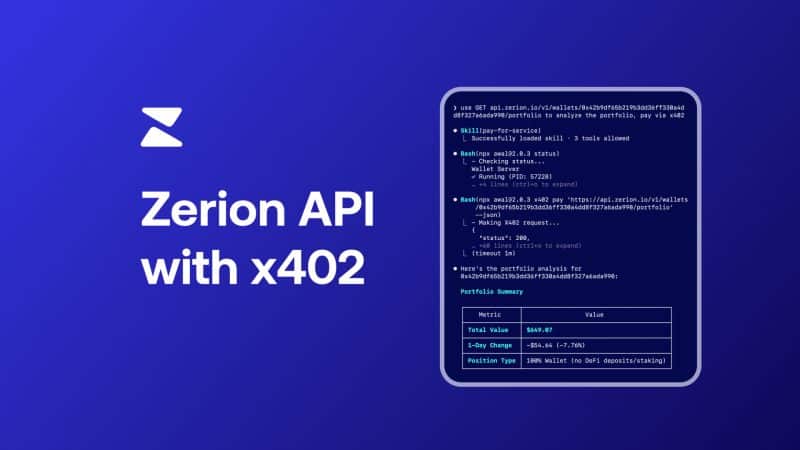
Zerion API now supports x402 payments on Base
San Francisco, CA, USA, March 19th, 2026, Chainwire
Zerion API integrated the x402 protocol. Any AI agent with a crypto wallet can now make an API call, pay 0.01 USDC on Base, and get back structured wallet data: portfolio balances, DeFi positions, token prices, PnL, and more. It’s the first step toward an API economy where agents pay for data the same way humans pay for software.
The x402 protocol brings the long-dormant HTTP 402 (Payment Required) status code to life. When a client makes an API request, the server responds with payment instructions. The client sends an onchain payment on Base, the server verifies it, and the data comes back.
Zerion used the Coinbase Developer Platform to start accepting x402 payments for its data. Payments are done in USDC on Base, an Ethereum Layer-2 network incubated by Coinbase.
For Zerion API, this supplements the traditional human-centered onboarding flow (signup, API key, billing setup) with a single AI-native step: pay and receive data.
“Most API providers assume there’s a human signing up with a credit card. That doesn’t work when your user is an AI agent. x402 lets us meet agents where they are. They pay and immediately get a response back with the data. Same portfolio, positions, and PnL data that powers the Zerion app, is now available to any agent on Base for a cent per call.” — Abi Dharshan, Product Lead, Zerion API
“Agents need to spend money, and right now that’s harder than it should be. x402 on Base gives agents a way to pay for services like Zerion’s API without a human in the loop. In turn, Zerion API gives agents a way to take part in the onchain economy. They can use this API to watch their own trading wallets, generate value-added analysis, or provide other services.” — Kevin Leffew, GTM Lead, Coinbase Developer Platform
Normalized Blockchain Data Output
Raw blockchain data is hard to use. A token transfer on Ethereum looks nothing like a Solana swap. Neither comes with human-readable labels, USD values, or protocol context. Building that normalization layer from scratch takes months.
Zerion API returns interpreted, normalized data. It’s the same data that powers the Zerion portfolio tracker app. Token names, prices, and other metadata are included in every response. This makes the data directly usable in dashboards, reports, and agent workflows without additional processing.
For AI agents, this matters because LLMs work best with structured data. An agent that receives a clean JSON response with token symbols, USD values, and position types can immediately reason about it. An agent that receives raw calldata cannot.
Agent-Oriented Payment Access
Traditional API access models assume a human on the other end. Someone creates an account, enters a credit card, and manages a subscription. AI agents can’t do that.
x402 enables a better agent-first payment experience. An agent discovers a Zerion endpoint, pays from its own wallet, and receives structured data. The flat pricing gives agents a clear budget constraint, so they can reason about the marginal cost before making requests.
Agents need structured wallet state, portfolio truth, and reliable pricing to act autonomously. With x402 access to Zerion’s data, an agent can check its own portfolio, track PnL on positions it holds, and layer Zerion queries into more complex workflows.
Existing AI Agent Usage
Zerion API already powers leading AI agents, which collectively are making millions of API calls. x402 support extends this access to any agent with a wallet, no contract or integration required.
Onchain Data Coverage
Zerion for agents offers the same onchain wallet data available in Zerion:
- Wallet portfolio and token balances across chains
- DeFi positions (staking, lending, LP, and more)
- Token prices and historical charts
- PnL for any token
- Transaction history
Getting Started with x402 Access
- Fast path: try it in 10 seconds
- Immediate testing is available with any wallet that supports Base. No setup is required, as access is provided by calling a pay-gated endpoint and reviewing the returned response.
- A live endpoint is available to retrieve transaction data for vitalik.eth at api.zerion.io/v1/wallets/0xd8da…/transactions/
Production Setup for AI Agents
This setup provides an agent with a wallet and the ability to call Zerion endpoints.
- A wallet is assigned to the agent by installing Coinbase Agentic Wallet or CDP Server Wallet, enabling the creation of a crypto wallet on Base.
- The Zerion API CLI is added, providing structured descriptions of available endpoints and data types so the agent can determine appropriate calls.
- The agent is prompted to fetch a portfolio for a given wallet address. Each request is processed through x402 on Base at a fixed cost of $0.01, returning structured JSON responses.
Full instructions and a complete list of available endpoints are available on the dedicated documentation page: GitHub repository for Zerion API with AI.
Zerion Agent Infrastructure Overview
x402 support is one piece of a broader effort to make Zerion’s data accessible to autonomous systems. Three layers are coming together:
- x402 payments — permissionless, pay-per-request access (live now)
- Zerion CLI — structured access to Zerion endpoints that agents can discover and use
- MCP server — a standardized way for AI to access Zerion API data
Together, these components enable agents to discover, interpret, and pay for blockchain data without manual setup.
About Zerion
Zerion is a wallet infrastructure company that powers its own non-custodial crypto wallet and provides developer APIs for real-time token, NFT, and DeFi data. Known for its intuitive user experience and reliable data, Zerion supports both developers building wallet-based apps and users managing assets across Ethereum, Solana, and 50+ EVM-compatible networks.
Contact
Vladimir Shamanov
Zerion
[email protected]