
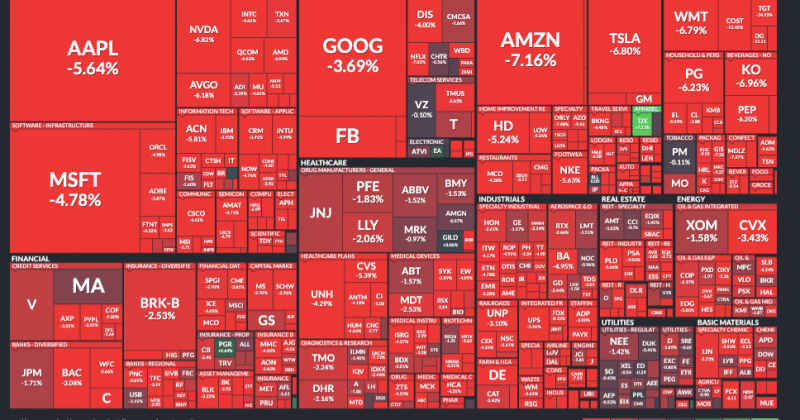
Zweig-DiMenna warns S&P 500 could drop 15% amid inflation threat
The hedge fund's proprietary inflation gauge just hit a level last seen in 2022, and its historical model points to ugly annualized returns for stocks.
Zweig-DiMenna, one of Wall Street’s longer-running hedge funds, is telling clients to brace for a potential 15% annualized decline in the S&P 500. The culprit: a “toxic cocktail” of rising consumer-price inflation colliding with an economy that refuses to slow down.
In a client newsletter dated May 20, the firm’s strategists Michael Schaus and Matthew Finkelstein laid out a case built on 50 years of market data. When inflation accelerates alongside strong economic growth, the S&P 500 has historically delivered a negative 15% annualized return. That’s not a forecast pulled from vibes. It’s pattern recognition from half a century of data.
The inflation gauge nobody’s talking about
At the center of Zweig-DiMenna’s thesis is a proprietary inflation-indicator model that just surged to a reading of 72. For context, the last time it hit comparable levels was in 2022, 2018, and 2012. Each of those years brought meaningful market turbulence.
In 2022, the S&P 500 fell roughly 19% for the year as the Federal Reserve embarked on its most aggressive rate-hiking cycle in decades. The 2018 reading preceded a near-20% correction in the fourth quarter. And 2012, while less dramatic on the surface, saw significant mid-year volatility before central bank intervention calmed markets.
Here’s the thing: a reading of 72 doesn’t mean the market drops tomorrow. It means the conditions that have historically preceded serious equity declines are present right now. Think of it like a weather barometer dropping fast. The storm might not arrive for weeks, but ignoring the signal entirely seems unwise.
The Treasury yield problem
The bond market is where Zweig-DiMenna’s argument gets especially interesting. Current 10-year Treasury yields sit around 4.6%, which sounds respectable until you dig into historical norms.
The firm points out that yields are only about 80 basis points above the latest CPI reading. In English: the premium investors earn for holding government bonds over inflation is razor-thin. Historically, the gap between 10-year yields and consumer prices has averaged around 2 percentage points.
To close that gap, Zweig-DiMenna estimates yields would need to climb to roughly 5.8%. That’s a 1.2 percentage point increase from current levels, which would represent a significant move in fixed income markets.
A 10-year yield approaching 6% would ripple through virtually every asset class. Mortgage rates would climb further. Corporate borrowing costs would spike. And the equity risk premium, the extra return investors demand for owning stocks over bonds, would compress in a way that makes stocks look far less attractive at current valuations.
The last time 10-year yields touched the 5% range was in October 2023, and even that brief visit rattled equity markets. A sustained move above that level would be a different animal entirely.
What’s driving the inflation pressure
The backdrop fueling this warning isn’t a single catalyst. It’s a convergence of forces that Wall Street has been debating for months: geopolitical tensions that show no signs of easing, persistent energy price volatility, and economic growth data that keeps coming in hotter than expected.
Strong growth is normally something investors celebrate. But when it arrives alongside rising prices, it creates a policy dilemma for the Federal Reserve. Cut rates to support markets and you risk pouring gasoline on inflation. Keep rates elevated and you eventually choke off the expansion. There’s no clean exit.
Zweig-DiMenna’s model essentially says we’re in the worst quadrant of that matrix right now: growth strong enough to sustain inflationary pressure, but inflation high enough to prevent the monetary easing that equity investors are counting on.
The firm has been around since 1984, founded by legendary investor Martin Zweig, whose market timing calls became Wall Street folklore. The fund’s analytical framework leans heavily on quantitative signals and historical analogs, which gives the current warning a certain institutional weight that a random strategist note might not carry.
What this means for investors
For equity investors, the immediate takeaway is straightforward: portfolios heavily concentrated in stocks face meaningful downside risk if Zweig-DiMenna’s historical pattern holds. A 15% annualized decline doesn’t necessarily mean a sudden crash. It could manifest as a grinding, multi-month drawdown that erodes returns slowly enough to keep investors anchored in positions they should be trimming.
The bond market positioning matters too. If yields do push toward 5.8%, existing bond holdings would take mark-to-market losses, but new money would finally earn a real return above inflation. That dynamic could accelerate a rotation out of equities and into fixed income, adding selling pressure to an already vulnerable stock market.
For crypto investors, the direct connection is less explicit. Zweig-DiMenna’s newsletter made no reference to digital assets. But the correlation between risk assets isn’t something you can ignore. When equity markets sell off meaningfully, crypto has historically faced its own bout of volatility as investors de-risk across the board. Bitcoin showed some decoupling tendencies during certain 2024 and 2025 episodes, but a 15% equity drawdown would test that thesis severely.
The key variable to watch is the 10-year yield. If it starts creeping meaningfully above 5%, the repricing in equities could happen faster than most positioning suggests. And in that environment, the definition of “safe haven” gets tested across every asset class, digital or otherwise.