
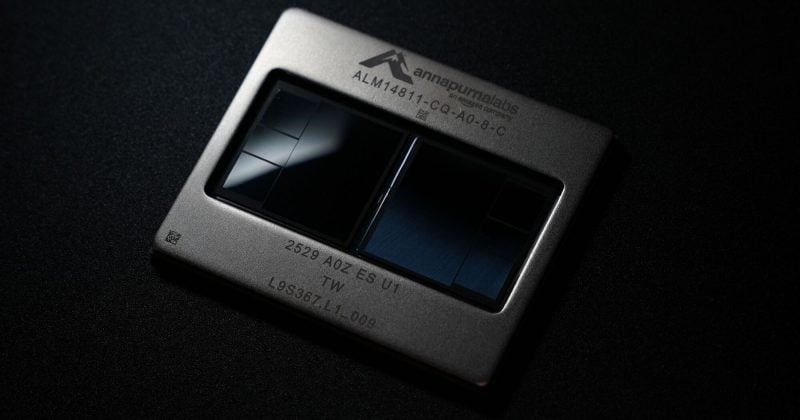
Amazon’s Trainium and Inferentia chips gain traction as firms seek Nvidia alternatives
AWS custom silicon is quietly building momentum as companies chase dramatic cost savings on AI workloads
AWS reports growing interest in its custom-designed Trainium and Inferentia chips as organizations look to cut costs and reduce their dependence on Nvidia GPUs. The numbers backing that interest are starting to look less like a side project and more like a real business.
Organizations migrating inference tasks from Nvidia GPUs to Inferentia instances are reporting cost reductions in the range of 80-90%. That’s not a marginal improvement. That’s the difference between a viable AI product and one that bleeds money at scale.
On the training side, Trainium chips are carving out their own niche. They lack the raw ecosystem depth of Nvidia’s CUDA platform, which remains the industry’s default software layer for GPU programming. But for organizations willing to optimize their workloads around Amazon’s hardware, the price-performance ratio is compelling enough to justify the switch.
Anthropic, the AI safety lab behind the Claude model family, operates a cluster of roughly 500,000 Trainium chips as part of a project called Rainier. That deployment reportedly delivers a fivefold increase in compute capability compared to the company’s previous AI models. Amazon has invested a total of $8 billion in Anthropic, designating AWS as its primary cloud and training partner.
Then there’s OpenAI. The company behind ChatGPT is planning to implement approximately 2 gigawatts of Trainium capacity, with ramp-up expected to begin in 2027. AWS’s custom silicon business, which includes Trainium, Inferentia, and the Graviton processor line for general compute, surpassed a $20 billion annualized run rate by early 2026.
AI, tech, and the markets they move—in one daily briefing.
Daily. Free. Join 34,000+ readers across crypto, finance, and policy.
Nvidia still dominates AI training workloads and maintains a massive advantage through CUDA, its proprietary software ecosystem that developers have spent years building around. Nvidia’s latest GPU architectures also continue to push the ceiling on peak performance, which matters enormously for frontier model training where raw throughput is the bottleneck.
The broader pattern here is that all three major cloud providers, Amazon, Google, and Microsoft, are investing heavily in custom silicon. Google has its TPU line, now in its sixth generation. Microsoft is developing its Maia chips.
Major capacity ramp-ups are planned for 2027, which means the next 18 months will determine whether Amazon’s custom silicon ambitions translate into sustained market share gains or hit manufacturing and software bottlenecks.