
Small-reactor startup Antares Nuclear achieves self-sustaining nuclear reaction at Idaho lab
The first privately developed advanced reactor to reach criticality under a DOE program still faces years of testing before commercial deployment
A startup that didn’t exist three years ago just pulled off something the US nuclear industry has struggled with for decades: getting a new reactor design to sustain a nuclear chain reaction on its own.
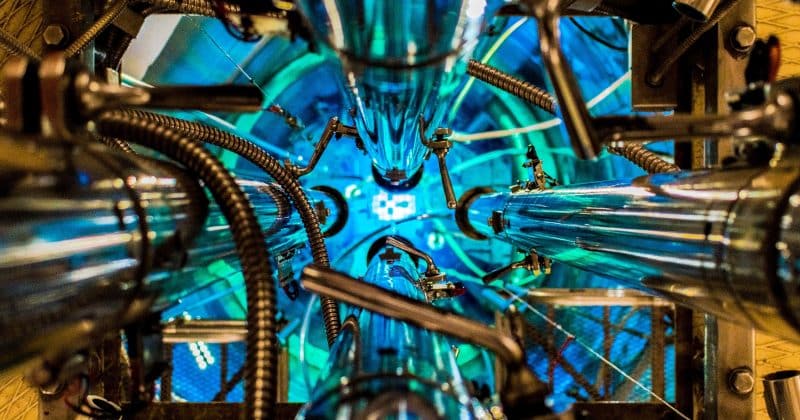
Antares Nuclear Inc. announced that its Mark-0 microreactor achieved initial criticality on June 4-5 at Idaho National Laboratory’s Reactor and Critical Experiment (RACE) facility. In English: the reactor maintained a self-sustaining nuclear fission reaction, the foundational step that proves a reactor design actually works in the real world, not just on paper.
It’s the first time a privately developed advanced reactor has reached criticality under the Department of Energy’s Reactor Pilot Program, which launched in 2025. But before anyone gets too excited, this was a zero-power demonstration. No electricity was generated. The test focused entirely on reactor physics and safety validation.
What Antares actually built
The Mark-0 reactor uses sodium heat-pipe cooling and high-assay low-enriched uranium (HALEU) TRISO fuel. Think of TRISO fuel particles as tiny armored capsules, each kernel of uranium coated in multiple layers of ceramic and carbon that can withstand extreme temperatures. The sodium heat pipes passively transfer heat without pumps, which reduces mechanical complexity and, theoretically, the number of things that can go wrong.
Founded in 2023, Antares has raised over $140 million to develop its microreactor technology. The company’s roadmap calls for generating electricity from an advanced reactor design in 2027, followed by initial production deployments to US military installations by 2028.
The partnership ecosystem backing this effort includes the DOE, Idaho National Laboratory, BWX Technologies, and the US Army, which has a clear interest in compact power sources for remote operations.
The US is playing catch-up
Here’s the uncomfortable context. As of 2026, only China and Russia have operational commercial small modular reactors. The US, which essentially invented civilian nuclear power, has watched its competitors deploy next-generation systems while domestic projects have languished under regulatory bottlenecks, cost overruns, and political indecision.
The DOE’s Reactor Pilot Program was created specifically to address this gap. By providing infrastructure, expertise, and a streamlined pathway at national laboratories like INL, the program aims to compress timelines that have historically stretched into the absurd. The fact that Antares went from founding to criticality in roughly three years suggests the approach might be working, at least at the early experimental stage.
The HALEU fuel supply chain deserves particular attention. HALEU, the enriched uranium that fuels most advanced reactor designs, has extremely limited commercial availability in the US. Russia has been the dominant supplier, which creates obvious geopolitical complications. Domestic HALEU production is ramping up but remains a bottleneck that could constrain the entire advanced nuclear sector regardless of how well individual reactor designs perform.
BWX Technologies, which partnered with Antares on this project, is one of the few companies positioned across multiple parts of the nuclear value chain, from fuel fabrication to reactor components.