
Nexo Earn with Nexo
Anthropic introduces Opus 4.8 with dynamic workflow for Claude Code

Anthropic introduces Opus 4.8 with dynamic workflow for Claude Code

The latest model upgrade lets Claude orchestrate hundreds of parallel subagents, migrating a 750,000-line codebase in 11 days with a 99.8% test pass rate.

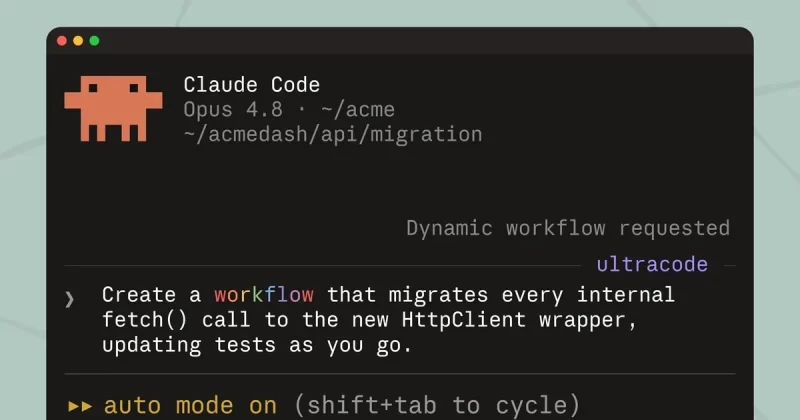
Anthropic just shipped Claude Opus 4.8, and the headline feature is something called Dynamic Workflow. In practical terms, it means Claude Code can now plan a complex task, spin up hundreds of subagents to execute it in parallel, verify its own outputs, and deliver finished results, all within a single session.

What dynamic workflows actually do

The core innovation in Opus 4.8 is the ability to orchestrate hundreds of parallel subagents. In English: instead of Claude tackling a massive coding project one step at a time, it can now break a project into pieces, assign each piece to a specialized subprocess, and manage the whole operation simultaneously.

Anthropic demonstrated this with a benchmark that’s hard to ignore. A 750,000-line codebase was migrated in just 11 days, hitting a 99.8% test pass rate.

Advertisement

The model doesn’t just execute blindly, either. Self-verification is baked into the workflow, meaning Claude checks its own work before delivering results. The default effort control for Opus 4.8 is set to “high,” which signals Anthropic is positioning this as a tool for serious, production-grade work rather than quick-and-dirty prototyping.

This builds on the foundation laid by Opus 4.7, which arrived in mid-April 2026 and brought its own round of improvements to coding performance and professional task handling. Opus 4.8 extends that trajectory with a particular emphasis on judgment and the model’s ability to admit when it doesn’t know something.

Pricing and availability

Anthropic kept the pricing unchanged from Opus 4.7. The model runs at $5 per million input tokens and $25 per million output tokens. A fast mode is available at double those rates, but Anthropic notes it’s still cheaper than previous model generations.

Opus 4.8 is available immediately in research preview on Max, Team, and Enterprise plans. It’s also accessible through the Claude API and major cloud platforms including Amazon Bedrock and Google Vertex AI.

The research preview designation means the model is production-accessible but Anthropic is still collecting feedback and may refine behavior before a full general availability launch.

The competitive landscape is getting interesting

Anthropic’s release lands in an AI coding market that’s becoming increasingly crowded. OpenAI has been pushing its own code-generation capabilities aggressively, and Google has invested heavily in making Gemini competitive for developer workflows.

The 750,000-line migration benchmark tells enterprise CTOs exactly what they want to hear: this model can handle large-scale code migration work. A 99.8% test pass rate on a project that large is a concrete result that speaks directly to enterprise procurement conversations.

Disclosure: This article was edited by Editorial Team. For more information on how we create and review content, see our Editorial Policy.

Anthropic introduces Opus 4.8 with dynamic workflow for Claude Code

Anthropic introduces Opus 4.8 with dynamic workflow for Claude Code

The latest model upgrade lets Claude orchestrate hundreds of parallel subagents, migrating a 750,000-line codebase in 11 days with a 99.8% test pass rate.

Anthropic just shipped Claude Opus 4.8, and the headline feature is something called Dynamic Workflow. In practical terms, it means Claude Code can now plan a complex task, spin up hundreds of subagents to execute it in parallel, verify its own outputs, and deliver finished results, all within a single session.

What dynamic workflows actually do

The core innovation in Opus 4.8 is the ability to orchestrate hundreds of parallel subagents. In English: instead of Claude tackling a massive coding project one step at a time, it can now break a project into pieces, assign each piece to a specialized subprocess, and manage the whole operation simultaneously.

Anthropic demonstrated this with a benchmark that’s hard to ignore. A 750,000-line codebase was migrated in just 11 days, hitting a 99.8% test pass rate.

Advertisement

The model doesn’t just execute blindly, either. Self-verification is baked into the workflow, meaning Claude checks its own work before delivering results. The default effort control for Opus 4.8 is set to “high,” which signals Anthropic is positioning this as a tool for serious, production-grade work rather than quick-and-dirty prototyping.

This builds on the foundation laid by Opus 4.7, which arrived in mid-April 2026 and brought its own round of improvements to coding performance and professional task handling. Opus 4.8 extends that trajectory with a particular emphasis on judgment and the model’s ability to admit when it doesn’t know something.

Pricing and availability

Anthropic kept the pricing unchanged from Opus 4.7. The model runs at $5 per million input tokens and $25 per million output tokens. A fast mode is available at double those rates, but Anthropic notes it’s still cheaper than previous model generations.

Opus 4.8 is available immediately in research preview on Max, Team, and Enterprise plans. It’s also accessible through the Claude API and major cloud platforms including Amazon Bedrock and Google Vertex AI.

The research preview designation means the model is production-accessible but Anthropic is still collecting feedback and may refine behavior before a full general availability launch.

The competitive landscape is getting interesting

Anthropic’s release lands in an AI coding market that’s becoming increasingly crowded. OpenAI has been pushing its own code-generation capabilities aggressively, and Google has invested heavily in making Gemini competitive for developer workflows.

The 750,000-line migration benchmark tells enterprise CTOs exactly what they want to hear: this model can handle large-scale code migration work. A 99.8% test pass rate on a project that large is a concrete result that speaks directly to enterprise procurement conversations.

Disclosure: This article was edited by Editorial Team. For more information on how we create and review content, see our Editorial Policy.