
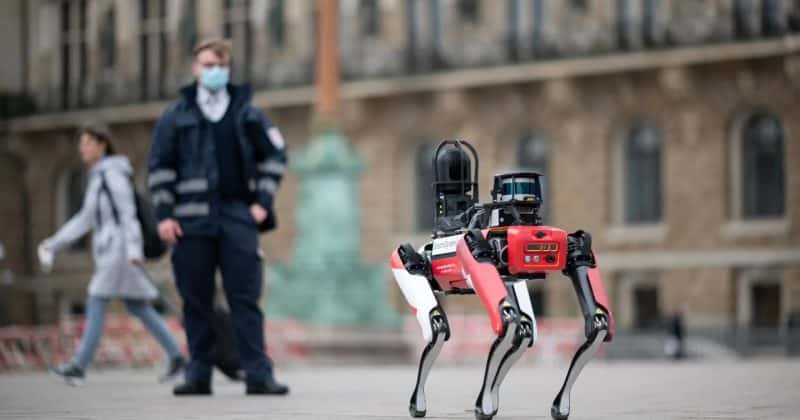
Anthropic’s Project Fetch shows Claude-assisted team finishing robodog coding in fraction of the time
Non-robotics experts using Claude completed complex hardware interfacing tasks while the unassisted team needed organizer intervention just to keep going


Anthropic said Claude Opus 4.7 completed several robotics tasks far faster than human teams in a follow up to Project Fetch, an internal experiment using an off the shelf robotic quadruped.
The original experiment, run in August 2024, tested whether Anthropic employees who were not robotics experts could use Claude to perform tasks with a robodog. One team had access to Claude, while another relied only on the internet and their own problem solving.
The Claude assisted team performed better in that first test. But Anthropic said its state of the art model at the time, Claude Opus 4.1, could not complete the tasks on its own and became stuck while trying to connect to the robot.
The company has now rerun parts of the experiment with Claude Opus 4.7 operating through Claude Code. Anthropic said the newer model completed every task finished by at least one human team at least 10 times faster.
For the four tasks completed by both human teams, Claude Opus 4.7 finished in 9 minutes and 35 seconds. The team without Claude took 361 minutes, while the Claude assisted team took 181 minutes. That made Opus 4.7 about 37.7 times faster than the team without Claude and 18.9 times faster than the Claude assisted team.
AI, tech, and the markets they move—in one daily briefing.
Daily. Free. Join 34,000+ readers across crypto, finance, and policy.
The tasks included connecting to the robodog’s video camera, connecting to its lidar sensor, writing software to control the robot, monitoring its movement and detecting a beach ball. Anthropic said Opus 4.7 was quicker at choosing the right technical approach and produced almost 10 times less code than the Claude assisted human team.
The results do not mean Claude has solved robotics. Anthropic said the model still struggled with the final fetching task, which required the robot to precisely move a beach ball back to a starting point. That kind of closed loop control remains difficult because it requires fast perception, correction and physical adjustment.
Anthropic said the test points to a broader pattern in AI progress. Models first act as tools that help humans, then humans assist models, and eventually models begin completing parts of the task themselves.
The company compared the trend to what has already happened in cybersecurity and software development, where AI systems have moved from assisting users to operating more independently inside existing tools.
Anthropic framed the result as an early sign of physical agentic AI, where models can use existing hardware tools for limited tasks. The company said more research is needed before models can reliably design control policies or adapt robotic systems, but warned that large capability gaps can close quickly as general models improve.