
Apple just handed Broadcom a $30B chip deal, and it matters beyond semiconductors

Apple just handed Broadcom a $30B chip deal, and it matters beyond semiconductors

The largest commitment under Apple's American Manufacturing Program signals a broader reshoring trend that crypto-adjacent chipmakers should watch closely.

Apple CEO Tim Cook announced a multi-year agreement with Broadcom valued at more than $30 billion, making it the single largest commitment under Apple’s American Manufacturing Program. The deal aims to produce over 15 billion chips on US soil by 2031.

The agreement, announced on July 8, includes a $1.5 billion investment to expand and modernize Broadcom’s manufacturing facility in Fort Collins, Colorado. The chips being produced are advanced radio frequency components, specifically FBAR filters, that are critical for iPhone connectivity and wireless performance.

Advertisement

The partnership extends through 2031 and supports hundreds of US jobs at the Colorado facility. Cook framed the deal as a continuation of Apple’s mission to strengthen American manufacturing and innovation.

The Broadcom agreement sits inside Apple’s broader pledge to invest $600 billion in US manufacturing over four years, a commitment the company initiated in 2025. The $30 billion Broadcom deal represents roughly 5% of that total figure, concentrated on a single supplier.

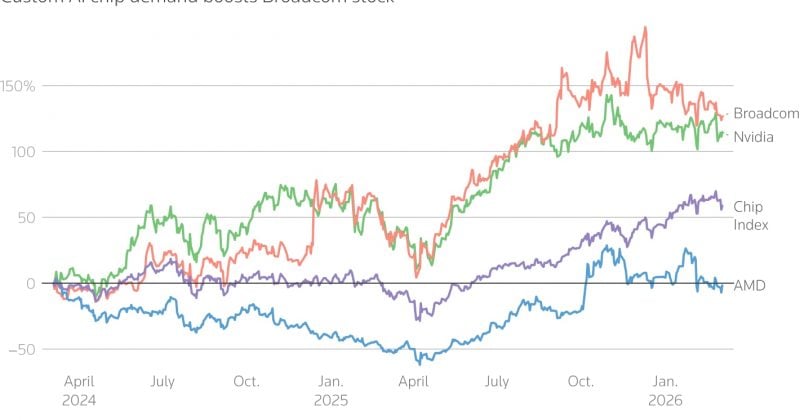
Broadcom’s stock reaction reflects something deeper than a single contract win. The market is pricing in the strategic value of being Apple’s preferred domestic manufacturing partner. The deal also reinforces Broadcom’s competitive moat in RF technology. Apple has historically been willing to design its own chips, as it did when it replaced Intel processors with its own M-series silicon. The fact that Apple is doubling down on Broadcom’s RF components rather than bringing that capability in-house suggests Broadcom’s technology lead in this specific domain is substantial enough to make vertical integration unattractive.

Disclosure: This article was edited by Editorial Team. For more information on how we create and review content, see our Editorial Policy.

Apple just handed Broadcom a $30B chip deal, and it matters beyond semiconductors

Apple just handed Broadcom a $30B chip deal, and it matters beyond semiconductors

The largest commitment under Apple's American Manufacturing Program signals a broader reshoring trend that crypto-adjacent chipmakers should watch closely.

Apple CEO Tim Cook announced a multi-year agreement with Broadcom valued at more than $30 billion, making it the single largest commitment under Apple’s American Manufacturing Program. The deal aims to produce over 15 billion chips on US soil by 2031.

The agreement, announced on July 8, includes a $1.5 billion investment to expand and modernize Broadcom’s manufacturing facility in Fort Collins, Colorado. The chips being produced are advanced radio frequency components, specifically FBAR filters, that are critical for iPhone connectivity and wireless performance.

Advertisement

The partnership extends through 2031 and supports hundreds of US jobs at the Colorado facility. Cook framed the deal as a continuation of Apple’s mission to strengthen American manufacturing and innovation.

The Broadcom agreement sits inside Apple’s broader pledge to invest $600 billion in US manufacturing over four years, a commitment the company initiated in 2025. The $30 billion Broadcom deal represents roughly 5% of that total figure, concentrated on a single supplier.

Broadcom’s stock reaction reflects something deeper than a single contract win. The market is pricing in the strategic value of being Apple’s preferred domestic manufacturing partner. The deal also reinforces Broadcom’s competitive moat in RF technology. Apple has historically been willing to design its own chips, as it did when it replaced Intel processors with its own M-series silicon. The fact that Apple is doubling down on Broadcom’s RF components rather than bringing that capability in-house suggests Broadcom’s technology lead in this specific domain is substantial enough to make vertical integration unattractive.

Disclosure: This article was edited by Editorial Team. For more information on how we create and review content, see our Editorial Policy.