
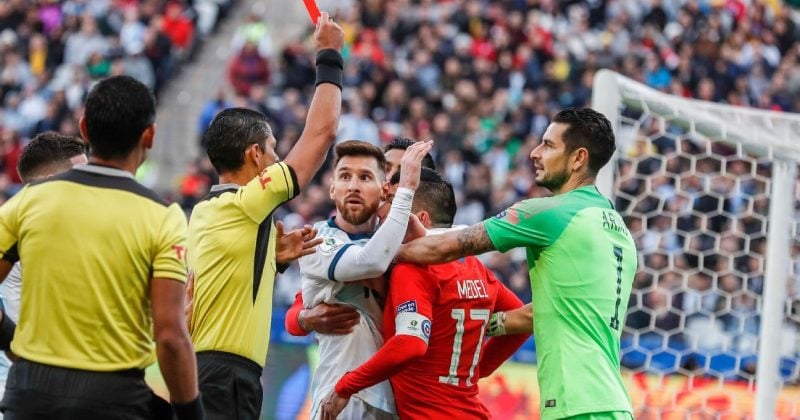
Argentina and Messi benefit from unprecedented World Cup red card controversy

Argentina and Messi benefit from unprecedented World Cup red card controversy

Officiating decisions at the 2026 World Cup are raising serious questions about consistency, star power, and who FIFA's rules actually apply to

Two separate incidents at this tournament have collided into a single, uncomfortable conversation about whether the world’s most-watched sporting event applies its rules equally to everyone on the pitch.

What happened in Argentina vs. Algeria

On June 17, 2026, Argentina faced Algeria in a group-stage fixture that ended 3-0.

The moment that has since consumed soccer analysis circles came in the 31st minute. Lionel Messi went in studs-up on Algeria’s Aïssa Mandi in a challenge that analysts from ESPN publicly labeled as “100% a red card.”

Advertisement

The referee saw it differently. Messi stayed on the pitch and scored a hat-trick. Argentina won 3-0.

FIFA’s unprecedented move on Balogun’s ban

Folarin Balogun, the US striker, received a red card during the tournament that would have triggered an automatic suspension. FIFA suspended Balogun’s red-card ban following direct intervention from then-President Donald Trump, allowing Balogun to continue playing into the knockout stage. FIFA itself has described the ruling as unprecedented.

The two incidents are structurally different. The Messi situation involves a referee’s on-field judgment call that was never corrected. The Balogun situation involves a post-match disciplinary process being overturned by political pressure. Both cases point in the same direction: the rules at the 2026 World Cup appear to be more flexible for some participants than others.

FIFA has not offered a detailed public explanation for the mechanism by which a head of state’s intervention translates into a reversed suspension. The organization has confirmed the ruling is unprecedented.

Why consistency matters more than any single call

What distinguishes this moment is the combination: a missed red card for the sport’s most globally marketed athlete, followed by a politically-motivated disciplinary reversal for the host nation’s star forward, at a World Cup being held in the United States.

A player of Messi’s quality remaining on the pitch in the 31st minute of a group-stage match is worth more than most teams’ entire attacking contributions. A hat-trick from that point only amplifies how much the non-call shaped the result.

Disclosure: This article was edited by Editorial Team. For more information on how we create and review content, see our Editorial Policy.

Argentina and Messi benefit from unprecedented World Cup red card controversy

Argentina and Messi benefit from unprecedented World Cup red card controversy

Officiating decisions at the 2026 World Cup are raising serious questions about consistency, star power, and who FIFA's rules actually apply to

Two separate incidents at this tournament have collided into a single, uncomfortable conversation about whether the world’s most-watched sporting event applies its rules equally to everyone on the pitch.

What happened in Argentina vs. Algeria

On June 17, 2026, Argentina faced Algeria in a group-stage fixture that ended 3-0.

The moment that has since consumed soccer analysis circles came in the 31st minute. Lionel Messi went in studs-up on Algeria’s Aïssa Mandi in a challenge that analysts from ESPN publicly labeled as “100% a red card.”

Advertisement

The referee saw it differently. Messi stayed on the pitch and scored a hat-trick. Argentina won 3-0.

FIFA’s unprecedented move on Balogun’s ban

Folarin Balogun, the US striker, received a red card during the tournament that would have triggered an automatic suspension. FIFA suspended Balogun’s red-card ban following direct intervention from then-President Donald Trump, allowing Balogun to continue playing into the knockout stage. FIFA itself has described the ruling as unprecedented.

The two incidents are structurally different. The Messi situation involves a referee’s on-field judgment call that was never corrected. The Balogun situation involves a post-match disciplinary process being overturned by political pressure. Both cases point in the same direction: the rules at the 2026 World Cup appear to be more flexible for some participants than others.

FIFA has not offered a detailed public explanation for the mechanism by which a head of state’s intervention translates into a reversed suspension. The organization has confirmed the ruling is unprecedented.

Why consistency matters more than any single call

What distinguishes this moment is the combination: a missed red card for the sport’s most globally marketed athlete, followed by a politically-motivated disciplinary reversal for the host nation’s star forward, at a World Cup being held in the United States.

A player of Messi’s quality remaining on the pitch in the 31st minute of a group-stage match is worth more than most teams’ entire attacking contributions. A hat-trick from that point only amplifies how much the non-call shaped the result.

Disclosure: This article was edited by Editorial Team. For more information on how we create and review content, see our Editorial Policy.