
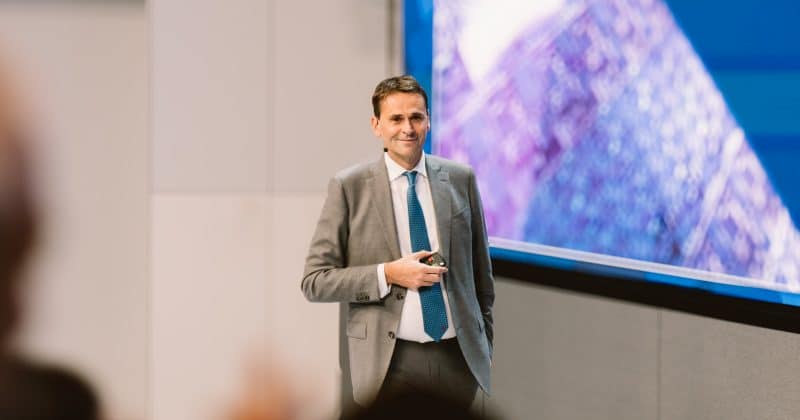
ASML CEO warns Europe is ‘quite behind’ in AI race as US buys 80% of advanced chips

ASML CEO warns Europe is ‘quite behind’ in AI race as US buys 80% of advanced chips

Christophe Fouquet says Europe is a mere consumer of AI technology and calls for regulatory reform to close the gap

The company that makes the machines that make the world’s most advanced chips just delivered a blunt diagnosis of Europe’s AI ambitions: the continent is barely in the game.

ASML CEO Christophe Fouquet has called Europe “very weak” in the AI ecosystem, pointing to a staggering imbalance in where the most cutting-edge semiconductors actually end up. According to Fouquet, 80% of the most advanced AI chips are purchased in the United States. Europe, meanwhile, accounts for just 1-2% of ASML’s shipments of high-end lithography systems over the last decade.

Here’s the thing about ASML’s position. It is arguably the most strategically important company in the global semiconductor supply chain. Its EUV machines, which cost hundreds of millions of dollars apiece, are the only tools capable of printing the tiny transistor patterns needed for the most advanced processors. Every leading chipmaker, from TSMC to Samsung to Intel, depends on them.

Advertisement

Fouquet described the region as functioning primarily as a consumer of AI technology rather than a producer or innovator. Europe buys the finished products but doesn’t build the infrastructure, train the models, or design the silicon.

Europe has its own version, the EU Chips Act, which aims to boost domestic semiconductor production and reduce dependence on foreign suppliers. But critics have argued that the continent’s regulatory environment actively works against the kind of rapid scaling that AI demands.

The regulatory problem

Fouquet hasn’t been shy about naming what he sees as the core obstacle. In a May 2026 commentary, he reiterated his concerns and explicitly called for Europe to ease AI regulations to boost competitiveness.

Fouquet co-signed an opinion piece with other European tech leaders, including Mistral AI CEO Arthur Mensch, urging governments to act swiftly to protect Europe’s technology leadership.

ASML puts its money where its mouth is

ASML has invested approximately €1.3-1.4 billion in Mistral AI, the French AI startup, giving ASML roughly an 11% stake in the company, as part of a broader funding round totaling approximately €1.7 billion.

Fouquet also flagged potential supply limitations in the global chip market driven by surging AI demand. Even if Europe wanted to rapidly scale up its AI capabilities, the physical chips needed to do so are in short supply, and the existing supply is overwhelmingly flowing to American hyperscalers like Microsoft, Google, Amazon, and Meta.

Disclosure: This article was edited by Editorial Team. For more information on how we create and review content, see our Editorial Policy.

ASML CEO warns Europe is ‘quite behind’ in AI race as US buys 80% of advanced chips

ASML CEO warns Europe is ‘quite behind’ in AI race as US buys 80% of advanced chips

Christophe Fouquet says Europe is a mere consumer of AI technology and calls for regulatory reform to close the gap

The company that makes the machines that make the world’s most advanced chips just delivered a blunt diagnosis of Europe’s AI ambitions: the continent is barely in the game.

ASML CEO Christophe Fouquet has called Europe “very weak” in the AI ecosystem, pointing to a staggering imbalance in where the most cutting-edge semiconductors actually end up. According to Fouquet, 80% of the most advanced AI chips are purchased in the United States. Europe, meanwhile, accounts for just 1-2% of ASML’s shipments of high-end lithography systems over the last decade.

Here’s the thing about ASML’s position. It is arguably the most strategically important company in the global semiconductor supply chain. Its EUV machines, which cost hundreds of millions of dollars apiece, are the only tools capable of printing the tiny transistor patterns needed for the most advanced processors. Every leading chipmaker, from TSMC to Samsung to Intel, depends on them.

Advertisement

Fouquet described the region as functioning primarily as a consumer of AI technology rather than a producer or innovator. Europe buys the finished products but doesn’t build the infrastructure, train the models, or design the silicon.

Europe has its own version, the EU Chips Act, which aims to boost domestic semiconductor production and reduce dependence on foreign suppliers. But critics have argued that the continent’s regulatory environment actively works against the kind of rapid scaling that AI demands.

The regulatory problem

Fouquet hasn’t been shy about naming what he sees as the core obstacle. In a May 2026 commentary, he reiterated his concerns and explicitly called for Europe to ease AI regulations to boost competitiveness.

Fouquet co-signed an opinion piece with other European tech leaders, including Mistral AI CEO Arthur Mensch, urging governments to act swiftly to protect Europe’s technology leadership.

ASML puts its money where its mouth is

ASML has invested approximately €1.3-1.4 billion in Mistral AI, the French AI startup, giving ASML roughly an 11% stake in the company, as part of a broader funding round totaling approximately €1.7 billion.

Fouquet also flagged potential supply limitations in the global chip market driven by surging AI demand. Even if Europe wanted to rapidly scale up its AI capabilities, the physical chips needed to do so are in short supply, and the existing supply is overwhelmingly flowing to American hyperscalers like Microsoft, Google, Amazon, and Meta.

Disclosure: This article was edited by Editorial Team. For more information on how we create and review content, see our Editorial Policy.