
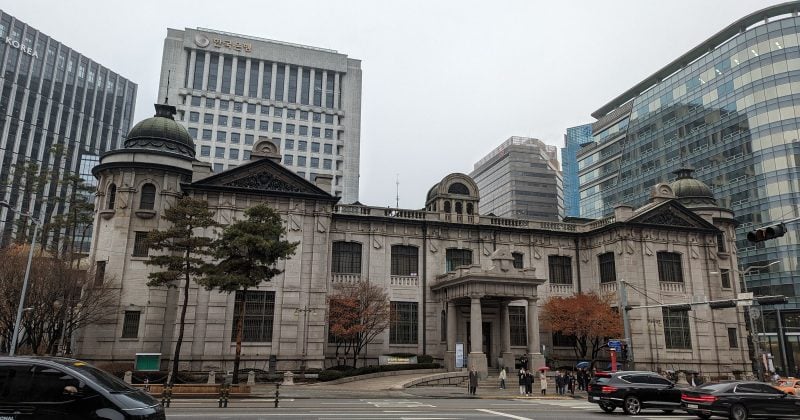
Bank of Korea raises rates for first time in over three years on July 16
South Korea's central bank moves to cool inflation running well above its 2% target, with markets pricing in near-certainty of the hike
South Korea’s central bank is done waiting. The Bank of Korea is set to raise its benchmark interest rate on July 16 for the first time since January 2023, ending a multi-year stretch of policy stability as inflation refuses to cooperate.
The expected move: a 25 basis point increase, lifting the seven-day repurchase rate from 2.50% to 2.75%. Markets have largely made up their minds already, pricing in roughly an 89% probability of the hike heading into the Monetary Policy Committee meeting.
Why now
The short answer is inflation. South Korea’s consumer price growth hit 3.1% in May 2026, a meaningful distance above the BOK’s 2% target.
Two forces are driving that number. Global oil prices have climbed on the back of ongoing Middle East tensions, feeding through to energy costs across the economy. Meanwhile, South Korea’s export sector has held up well, supporting domestic demand and keeping price pressures alive.
Governor Shin Hyun-song, who took over the central bank in late April 2026, has stressed the need to act decisively against inflation, which the BOK expects to remain above its 2% target through 2027.
The BOK also revised its GDP growth forecast for 2026 to 2.6%.
A longer view on the rate cycle
South Korea, like most of the developed world, went through an aggressive rate-hiking cycle starting in 2022 to fight post-pandemic inflation. The BOK last raised its benchmark rate in January 2023, then held it steady and eventually cut as growth concerns took priority in the years that followed.
Macro, rates, and crypto—what moved markets and what matters next.
Daily. Free. Join 34,000+ readers across crypto, finance, and policy.
The rate was maintained at 2.50% from early 2026 onward while the committee watched incoming data. What the data started showing was that inflation wasn’t headed back to target fast enough.
What this means for investors and crypto markets
For investors with exposure to Korean financial assets, the July 16 decision carries a few distinct implications worth tracking.
First, the Korean won. Higher rates make KRW-denominated assets more attractive to yield-seeking capital. Markets have already begun pricing this in, with early movement visible in both KRW and Korean bond yields ahead of the meeting.
Second, Korean equities. Export-oriented industries, which make up a substantial share of South Korea’s listed market, tend to benefit from a stronger won only up to a point. Currency strength that erodes export competitiveness is the risk.
Third, the broader emerging markets picture. South Korea’s decision runs counter to what has been a general global drift toward rate cuts through much of 2025 and into 2026.
The rate decision also arrives against a backdrop of South Korea being one of the world’s most active crypto trading markets. Korean retail participation in digital assets is historically high. When domestic borrowing costs rise, the marginal capital available for speculative assets tends to compress, and Korean retail has historically been a meaningful source of demand in altcoin markets.
The number to watch after July 16 is not the rate itself, which is already priced. It’s Governor Shin’s language around the path ahead.