
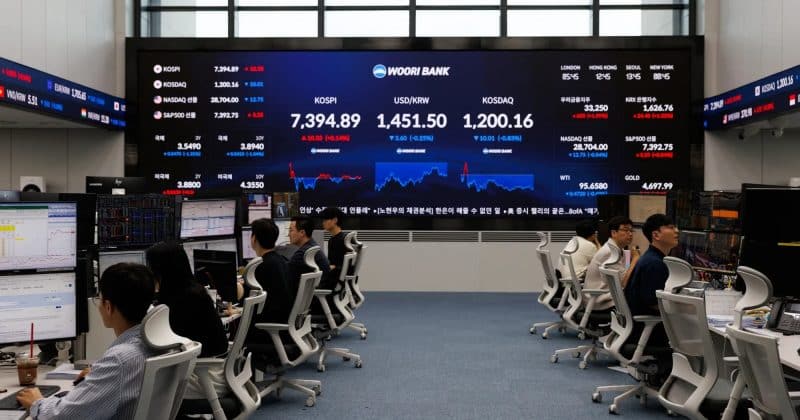
Bank of Korea warns single-stock leveraged ETFs tied to Samsung and SK Hynix are rattling markets
South Korea's central bank flags concentration risk, retail losses, and one-way trading flows as $9B piles into semiconductor ETFs
South Korea built a product designed to pull retail investors back into domestic markets. Six weeks later, the central bank is warning that the same product might be destabilizing those markets.
The Bank of Korea has issued a formal warning over single-stock leveraged ETFs linked to Samsung Electronics and SK Hynix, flagging that the products are amplifying volatility, deepening sector concentration, and creating lopsided trading flows that favor one-directional bets.
From zero to $9B in weeks
These are 2x daily leveraged products, meaning they aim to deliver twice the daily return of a single underlying stock. In English: if Samsung rises 3% on Tuesday, the ETF targets a 6% gain. If Samsung falls 3%, the ETF falls 6.
The ETFs were approved in April 2026, and the market’s appetite was immediate. Assets under management grew from roughly $3B at launch to approximately 14 trillion won, around $9.1B, by mid-June 2026.
The problem is that 92% of holders in these ETFs are retail investors, many experiencing steep losses during market downturns.
Regulators having second thoughts
The Financial Supervisory Service, South Korea’s financial watchdog, built in a protective layer from the start. Investors are required to complete hours of educational training and pass an exam before they can access these products.
The news moving money, markets, and the world—before your day starts.
Daily. Free. Join 34,000+ readers across crypto, finance, and policy.
FSS Governor Lee Chan-jin acknowledged as much in mid-June, expressing regret over the speed at which these ETFs were approved and noting that the negative consequences had become clearly visible by that point.
The BOK’s warning centers on what happens to Samsung and SK Hynix as underlying assets when billions of dollars in daily-rebalancing leveraged products are tracking them. Leveraged ETFs must rebalance at the end of each trading session to maintain their target exposure. When markets fall, these funds become forced sellers into declining prices. When markets rise, they become forced buyers into climbing prices.
The margin debt picture makes this more complicated
South Korean retail margin debt reached 60 trillion won, approximately $39B, by the end of May 2026. That figure represents the amount investors have borrowed to fund trading positions, and it is a record level. The demand for leveraged ETFs is one of the factors cited in that acceleration.
The BOK’s warning, coming alongside a record margin debt figure, suggests the central bank sees this compounding risk as something worth flagging publicly before a stress event occurs rather than after.
What this means for investors watching South Korean equities
South Korea designed these products specifically to compete with foreign investment vehicles and retain retail capital domestically. The strategy worked, at least in terms of asset accumulation, attracting $9B into leveraged single-stock bets on two semiconductor companies.
Retail investors who passed the required exam and still experienced steep losses during market downturns are a data point that product disclosure and investor education, while necessary, are not sufficient substitutes for product design that limits systemic harm from the start.