
Base44 launches proprietary AI model to enhance coding platform

Base44 launches proprietary AI model to enhance coding platform

The Wix-owned vibe coding platform becomes the first app-creation tool to deploy its own large language model in production

Base44, the AI-powered app-creation platform that Wix snapped up last year, has rolled out its own proprietary large language model called Base 1. The move makes it the first vibe coding platform to deploy a homegrown model in production, a bet that building in-house will eventually outperform the frontier models everyone else is renting.

For a platform that went from zero to $100 million in annual recurring revenue within roughly a year of launching, the ambition tracks. But the real play here isn’t just about better code generation. It’s about controlling the economics of AI inference, the single biggest cost eating into margins across the entire AI application layer.

From bootstrapped side project to Wix’s AI crown jewel

Base44’s trajectory reads like a Silicon Valley fever dream compressed into fast-forward. Founded in late 2024 by Maor Shlomo, the platform was bootstrapped with a skeleton crew before attracting hundreds of thousands of users who wanted to build functional applications using plain English prompts.

Advertisement

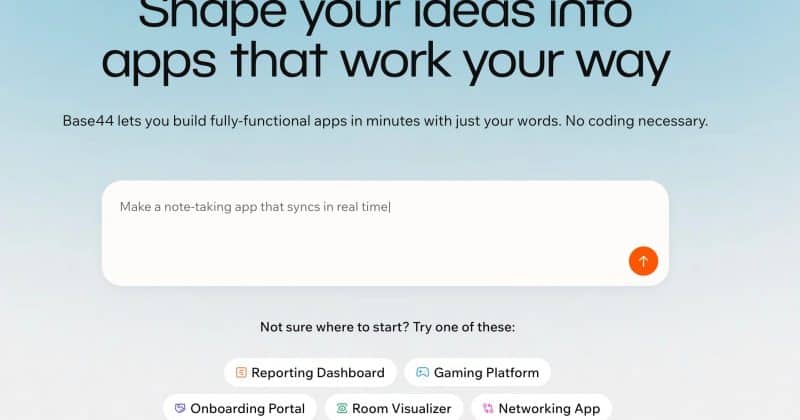
The pitch is straightforward: describe what you want your app to do, and Base44 handles the backend, frontend, data models, and logic automatically. No technical expertise required.

Wix acquired Base44 in June 2025 for approximately $80 million in cash, with additional earn-outs extending through 2029. At the time, the platform’s user base and revenue growth made it one of the more eye-catching acquisitions in the AI tools space.

Since the acquisition, Base44 has kept shipping aggressively. In March 2026, the platform launched a ChatGPT integration alongside “Superagents,” a feature enabling autonomous AI agents to handle complex multi-step tasks within user-built applications. The platform also supports third-party models like GPT-5, giving users flexibility to choose which AI backbone powers their projects.

What this means for investors and the broader market

Base44 itself has no direct cryptocurrency or blockchain integrations. The platform does offer templates for various application types, including digital asset trading interfaces, but these are standard app templates rather than crypto-native functionality. There is an unrelated Solana-based meme token that shares the Base44 name, which is worth noting primarily so you don’t confuse the two and make a regrettable financial decision.

Look at the competitive landscape. Platforms like Replit, Bolt, and Lovable are all competing in the AI-assisted development space, but none have deployed a proprietary model in production. Base44 claiming that first-mover position gives it a potential structural advantage, particularly on cost.

The $80 million acquisition price now looks like a bargain given the $100 million ARR the platform achieved. Wix’s earn-out structure through 2029 suggests both parties expect substantial growth ahead.

Disclosure: This article was edited by Editorial Team. For more information on how we create and review content, see our Editorial Policy.

Base44 launches proprietary AI model to enhance coding platform

Base44 launches proprietary AI model to enhance coding platform

The Wix-owned vibe coding platform becomes the first app-creation tool to deploy its own large language model in production

Base44, the AI-powered app-creation platform that Wix snapped up last year, has rolled out its own proprietary large language model called Base 1. The move makes it the first vibe coding platform to deploy a homegrown model in production, a bet that building in-house will eventually outperform the frontier models everyone else is renting.

For a platform that went from zero to $100 million in annual recurring revenue within roughly a year of launching, the ambition tracks. But the real play here isn’t just about better code generation. It’s about controlling the economics of AI inference, the single biggest cost eating into margins across the entire AI application layer.

From bootstrapped side project to Wix’s AI crown jewel

Base44’s trajectory reads like a Silicon Valley fever dream compressed into fast-forward. Founded in late 2024 by Maor Shlomo, the platform was bootstrapped with a skeleton crew before attracting hundreds of thousands of users who wanted to build functional applications using plain English prompts.

Advertisement

The pitch is straightforward: describe what you want your app to do, and Base44 handles the backend, frontend, data models, and logic automatically. No technical expertise required.

Wix acquired Base44 in June 2025 for approximately $80 million in cash, with additional earn-outs extending through 2029. At the time, the platform’s user base and revenue growth made it one of the more eye-catching acquisitions in the AI tools space.

Since the acquisition, Base44 has kept shipping aggressively. In March 2026, the platform launched a ChatGPT integration alongside “Superagents,” a feature enabling autonomous AI agents to handle complex multi-step tasks within user-built applications. The platform also supports third-party models like GPT-5, giving users flexibility to choose which AI backbone powers their projects.

What this means for investors and the broader market

Base44 itself has no direct cryptocurrency or blockchain integrations. The platform does offer templates for various application types, including digital asset trading interfaces, but these are standard app templates rather than crypto-native functionality. There is an unrelated Solana-based meme token that shares the Base44 name, which is worth noting primarily so you don’t confuse the two and make a regrettable financial decision.

Look at the competitive landscape. Platforms like Replit, Bolt, and Lovable are all competing in the AI-assisted development space, but none have deployed a proprietary model in production. Base44 claiming that first-mover position gives it a potential structural advantage, particularly on cost.

The $80 million acquisition price now looks like a bargain given the $100 million ARR the platform achieved. Wix’s earn-out structure through 2029 suggests both parties expect substantial growth ahead.

Disclosure: This article was edited by Editorial Team. For more information on how we create and review content, see our Editorial Policy.