
Nexo Earn with Nexo
Bittensor activates dynamic TAO, restructuring emission model around real-time staking flows

Bittensor activates dynamic TAO, restructuring emission model around real-time staking flows

The AI-focused blockchain now rewards subnets based on actual capital inflows, not token price, creating a Darwinian competition for emissions.

Bittensor just rewired how its network decides who gets paid. The protocol’s new Taoflow emission system, activated in November 2025, replaced a price-based allocation model with one that tracks net real-time staking inflows, meaning the difference between TAO being staked and TAO being unstaked. Subnets that attract genuine capital get rewarded. Those that don’t can get nothing at all.

From price signals to flow signals

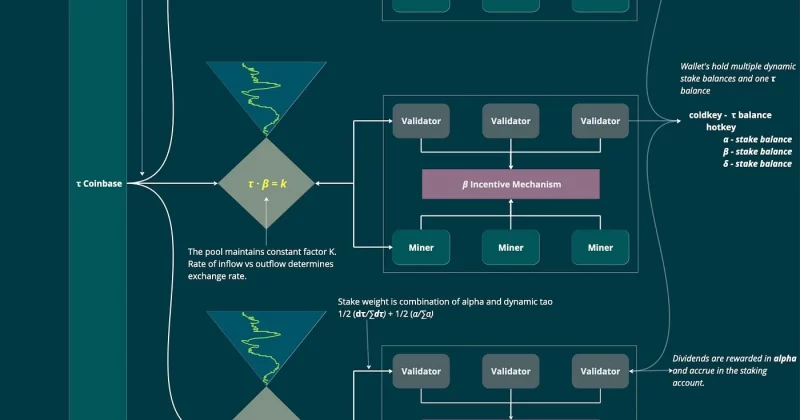
The groundwork for this shift was laid back in February 2025, when Bittensor deployed Dynamic TAO (dTAO) to mainnet around February 13. That upgrade introduced per-subnet alpha tokens and automated market maker pools, giving TAO holders the ability to stake directly into specific subnets rather than the network as a whole.

Taoflow built on that foundation by changing what actually determines emission distribution. Previously, the allocation was tied to price-based signals. Now, it’s purely about net staking flows. A subnet with sustained negative net TAO flows, where more people are unstaking than staking, can receive 0% emissions. That also means 0% APY for alpha token holders in that subnet.

Advertisement

The network by the numbers

By early 2026, Bittensor’s network had grown to over 128 active subnets. The collective market valuation of subnet tokens reached close to $1.5 billion.

The protocol also hit a structural milestone on December 14, 2025, when it underwent its first halving. Like Bitcoin’s halving events, this cut the base emission rate of TAO in half, reducing the rate at which new tokens enter circulation.

The combination of reduced emissions and a flow-based allocation model creates a double filter on TAO distribution. Less TAO is being created overall, and the TAO that is created flows disproportionately toward subnets that demonstrate genuine traction.

What this means for investors

The shift to flow-based emissions changes the calculus for anyone holding or considering TAO. Instead of parking tokens and collecting passive yield, stakers now need to actively evaluate which subnets are attracting capital and why.

With the base emission rate now cut in half since December 2025, the total TAO available for distribution is shrinking. If Bittensor’s subnet ecosystem continues growing toward and beyond 128 active subnets, competition for a smaller pool of emissions could intensify considerably.

Disclosure: This article was edited by Editorial Team. For more information on how we create and review content, see our Editorial Policy.

Bittensor activates dynamic TAO, restructuring emission model around real-time staking flows

Bittensor activates dynamic TAO, restructuring emission model around real-time staking flows

The AI-focused blockchain now rewards subnets based on actual capital inflows, not token price, creating a Darwinian competition for emissions.

Bittensor just rewired how its network decides who gets paid. The protocol’s new Taoflow emission system, activated in November 2025, replaced a price-based allocation model with one that tracks net real-time staking inflows, meaning the difference between TAO being staked and TAO being unstaked. Subnets that attract genuine capital get rewarded. Those that don’t can get nothing at all.

From price signals to flow signals

The groundwork for this shift was laid back in February 2025, when Bittensor deployed Dynamic TAO (dTAO) to mainnet around February 13. That upgrade introduced per-subnet alpha tokens and automated market maker pools, giving TAO holders the ability to stake directly into specific subnets rather than the network as a whole.

Taoflow built on that foundation by changing what actually determines emission distribution. Previously, the allocation was tied to price-based signals. Now, it’s purely about net staking flows. A subnet with sustained negative net TAO flows, where more people are unstaking than staking, can receive 0% emissions. That also means 0% APY for alpha token holders in that subnet.

Advertisement

The network by the numbers

By early 2026, Bittensor’s network had grown to over 128 active subnets. The collective market valuation of subnet tokens reached close to $1.5 billion.

The protocol also hit a structural milestone on December 14, 2025, when it underwent its first halving. Like Bitcoin’s halving events, this cut the base emission rate of TAO in half, reducing the rate at which new tokens enter circulation.

The combination of reduced emissions and a flow-based allocation model creates a double filter on TAO distribution. Less TAO is being created overall, and the TAO that is created flows disproportionately toward subnets that demonstrate genuine traction.

What this means for investors

The shift to flow-based emissions changes the calculus for anyone holding or considering TAO. Instead of parking tokens and collecting passive yield, stakers now need to actively evaluate which subnets are attracting capital and why.

With the base emission rate now cut in half since December 2025, the total TAO available for distribution is shrinking. If Bittensor’s subnet ecosystem continues growing toward and beyond 128 active subnets, competition for a smaller pool of emissions could intensify considerably.

Disclosure: This article was edited by Editorial Team. For more information on how we create and review content, see our Editorial Policy.