
Blockstream implements quantum resistance in Liquid Network and hardware wallets

Blockstream implements quantum resistance in Liquid Network and hardware wallets

Adam Back's firm has run post-quantum transactions on a live Bitcoin sidechain, years before most of the industry has even started worrying about the problem.

The quantum computing threat to crypto has been a background hum for years, mostly dismissed as a distant problem. Blockstream just made it a present-tense engineering project.

In March 2026, Blockstream executed the first post-quantum-signed transactions on the Liquid mainnet, a production Bitcoin sidechain used by exchanges and institutions. That is not a testnet demo. That is real, live infrastructure running cryptography designed to survive computers that do not yet exist.

What Blockstream actually built

The implementation relies on a signature scheme called SHRINCS, a hash-based approach that does not depend on the mathematical problems classical computers and quantum computers share a weakness on.

Here is the translation: most crypto signatures today, including Bitcoin’s ECDSA, are secured by the difficulty of solving elliptic curve math. A sufficiently powerful quantum computer could theoretically crack that. Hash-based signatures use a different kind of math, one where quantum speedups provide far less advantage.

Advertisement

Blockstream deployed SHRINCS through Simplicity smart contracts on Liquid, and here is what matters most about the execution: they did it without changing the network’s consensus rules. In a live blockchain, avoiding consensus changes means no forced upgrade, no community fight, no hard fork drama. Users can opt in to quantum-resistant spending for their Liquid Bitcoin holdings at their own pace.

The company also ran five post-quantum transactions on Liquid mainnet, marking the first time such signatures have appeared on any production Bitcoin sidechain.

Alongside the mainnet execution, Blockstream proposed SHRIMPS, a complementary protocol designed to make hardware wallet management more practical at scale. SHRIMPS can support up to 1,024 devices with signatures weighing in at 2.5 KB, which matters because post-quantum signatures are generally larger than classical ones, and hardware wallets have limited memory and processing headroom.

The Jade wallet gets an upgrade path

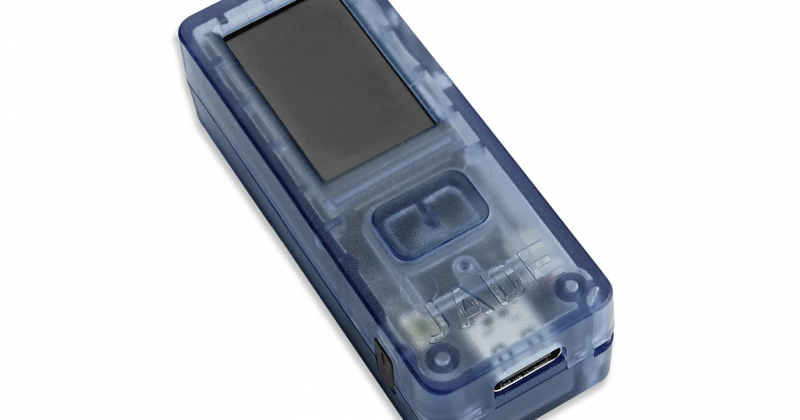
Blockstream’s own Jade hardware wallet will receive firmware updates adding per-UTXO opt-in support for post-quantum protection. The per-UTXO framing is deliberate. Rather than a wholesale migration that breaks existing wallet setups, users can selectively apply quantum-resistant protection to specific outputs while leaving the rest of their wallet architecture intact.

This approach reflects a broader philosophy from Adam Back about the migration timeline. Back estimates that cryptographically relevant quantum computers, meaning machines powerful enough to break ECDSA in a meaningful timeframe, are still 20 to 40 years away. His suggested response is not panic but a roughly ten-year migration window for Bitcoin users to move toward quantum-resistant setups.

The logic is sound. If you wait until the threat is imminent, you are already behind. If you force everyone to migrate today, you create disruption for a problem that has not materialized. A decade-long on-ramp splits the difference, and using Liquid as the live testing ground lets the ecosystem build confidence before anything touches the Bitcoin mainnet.

Why this matters for the broader market

Liquid is not Bitcoin. It is a federated sidechain, mostly used by trading desks and exchanges for faster settlement of large Bitcoin positions. Its user base is smaller and more sophisticated than Bitcoin’s general population, which makes it an ideal staging environment for cryptographic experiments that are not ready for mainnet deployment.

Blockstream is explicitly treating Liquid as a laboratory. That strategy has two advantages. First, it generates real-world data on how post-quantum schemes perform under live conditions, data that a testnet simply cannot replicate. Second, it creates a usable product for institutions that are already thinking about long-term custody risk.

The SHRIMPS proposal adds another layer of practical relevance. Hardware wallets are the preferred custody solution for a wide range of holders, from individual Bitcoin holders to corporate treasury operations. A protocol that can manage post-quantum signatures across more than a thousand devices while keeping signature sizes manageable addresses a real operational constraint, not a theoretical one.

Disclosure: This article was edited by Editorial Team. For more information on how we create and review content, see our Editorial Policy.

Blockstream implements quantum resistance in Liquid Network and hardware wallets

Blockstream implements quantum resistance in Liquid Network and hardware wallets

Adam Back's firm has run post-quantum transactions on a live Bitcoin sidechain, years before most of the industry has even started worrying about the problem.

The quantum computing threat to crypto has been a background hum for years, mostly dismissed as a distant problem. Blockstream just made it a present-tense engineering project.

In March 2026, Blockstream executed the first post-quantum-signed transactions on the Liquid mainnet, a production Bitcoin sidechain used by exchanges and institutions. That is not a testnet demo. That is real, live infrastructure running cryptography designed to survive computers that do not yet exist.

What Blockstream actually built

The implementation relies on a signature scheme called SHRINCS, a hash-based approach that does not depend on the mathematical problems classical computers and quantum computers share a weakness on.

Here is the translation: most crypto signatures today, including Bitcoin’s ECDSA, are secured by the difficulty of solving elliptic curve math. A sufficiently powerful quantum computer could theoretically crack that. Hash-based signatures use a different kind of math, one where quantum speedups provide far less advantage.

Advertisement

Blockstream deployed SHRINCS through Simplicity smart contracts on Liquid, and here is what matters most about the execution: they did it without changing the network’s consensus rules. In a live blockchain, avoiding consensus changes means no forced upgrade, no community fight, no hard fork drama. Users can opt in to quantum-resistant spending for their Liquid Bitcoin holdings at their own pace.

The company also ran five post-quantum transactions on Liquid mainnet, marking the first time such signatures have appeared on any production Bitcoin sidechain.

Alongside the mainnet execution, Blockstream proposed SHRIMPS, a complementary protocol designed to make hardware wallet management more practical at scale. SHRIMPS can support up to 1,024 devices with signatures weighing in at 2.5 KB, which matters because post-quantum signatures are generally larger than classical ones, and hardware wallets have limited memory and processing headroom.

The Jade wallet gets an upgrade path

Blockstream’s own Jade hardware wallet will receive firmware updates adding per-UTXO opt-in support for post-quantum protection. The per-UTXO framing is deliberate. Rather than a wholesale migration that breaks existing wallet setups, users can selectively apply quantum-resistant protection to specific outputs while leaving the rest of their wallet architecture intact.

This approach reflects a broader philosophy from Adam Back about the migration timeline. Back estimates that cryptographically relevant quantum computers, meaning machines powerful enough to break ECDSA in a meaningful timeframe, are still 20 to 40 years away. His suggested response is not panic but a roughly ten-year migration window for Bitcoin users to move toward quantum-resistant setups.

The logic is sound. If you wait until the threat is imminent, you are already behind. If you force everyone to migrate today, you create disruption for a problem that has not materialized. A decade-long on-ramp splits the difference, and using Liquid as the live testing ground lets the ecosystem build confidence before anything touches the Bitcoin mainnet.

Why this matters for the broader market

Liquid is not Bitcoin. It is a federated sidechain, mostly used by trading desks and exchanges for faster settlement of large Bitcoin positions. Its user base is smaller and more sophisticated than Bitcoin’s general population, which makes it an ideal staging environment for cryptographic experiments that are not ready for mainnet deployment.

Blockstream is explicitly treating Liquid as a laboratory. That strategy has two advantages. First, it generates real-world data on how post-quantum schemes perform under live conditions, data that a testnet simply cannot replicate. Second, it creates a usable product for institutions that are already thinking about long-term custody risk.

The SHRIMPS proposal adds another layer of practical relevance. Hardware wallets are the preferred custody solution for a wide range of holders, from individual Bitcoin holders to corporate treasury operations. A protocol that can manage post-quantum signatures across more than a thousand devices while keeping signature sizes manageable addresses a real operational constraint, not a theoretical one.

Disclosure: This article was edited by Editorial Team. For more information on how we create and review content, see our Editorial Policy.