
Blue Origin seeks $130 billion valuation, more than double Rocket Lab’s market cap
Jeff Bezos's space company is raising $10 billion in its first external funding round, signaling a new era for private aerospace investment
For more than two decades, Blue Origin had exactly one investor: Jeff Bezos. The Amazon founder funded his rocket company the old-fashioned way, selling Amazon stock in chunks ranging from hundreds of millions to billions of dollars annually. Now, for the first time, he’s letting other people write checks.
Blue Origin is targeting a pre-money valuation of $130 billion in a $10 billion funding round. That figure puts Bezos’s space venture at more than double the market capitalization of Rocket Lab, which has traded between $50B and $62B recently.
Inside the funding round
Coatue Management is leading the charge with a $4 billion commitment, making it one of the largest single investments in a private space company. Bezos himself is kicking in $2 billion. The remaining $4 billion is expected to come from a mix of institutional investors.
The timing is not accidental. SpaceX’s IPO in June 2026 acted like a starting pistol for the entire aerospace investment sector.
What Blue Origin is actually building
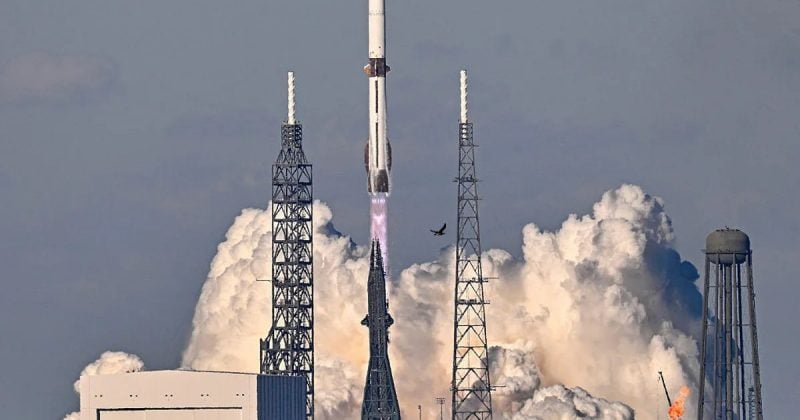
The centerpiece of Blue Origin’s competitive pitch is New Glenn, its heavy-lift rocket designed to compete directly with SpaceX’s Falcon 9 and Falcon Heavy. New Glenn is the vehicle that’s supposed to transform Blue Origin from a company that mostly flies tourists to the edge of space into a serious contender for commercial and government launch contracts.
AI, tech, and the markets they move—in one daily briefing.
Daily. Free. Join 34,000+ readers across crypto, finance, and policy.
Blue Origin’s launch frequency has historically been limited compared to SpaceX, which has turned rocket launches into something resembling a weekly bus schedule. SpaceX dominates the commercial launch market with a cadence that no competitor has come close to matching.
What this means for investors
The $130 billion valuation creates an interesting benchmark for the entire aerospace sector. If institutional investors are willing to value Blue Origin, a company with limited launch history and no public financial disclosures, at more than twice Rocket Lab’s market cap, it says something about how the market is pricing future potential versus current operations.
Rocket Lab has built a track record of successful launches with its Electron rocket and is developing its larger Neutron vehicle. It generates revenue, has government contracts, and trades on public markets where investors can scrutinize its financials quarterly.
Investors watching this space should track New Glenn’s launch cadence, contract wins, and whether Blue Origin can close the operational gap with SpaceX, because that gap is currently measured in years, not months.