
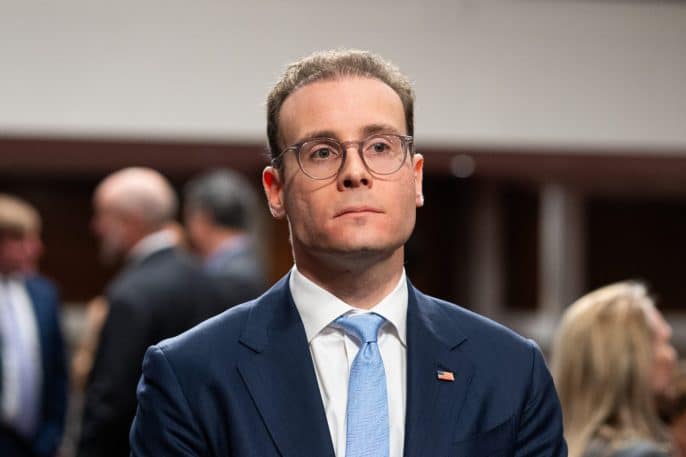
UNITED STATES - NOVEMBER 19: Michael Selig, nominee to be Chairman and Commissioner of the Commodity Futures Trading Commission, waits to testify during his confirmation hearing in the Senate Agriculture, Nutrition, and Forestry Committee in the Dirksen Senate Office Building on Wednesday, November 19, 2025. (Bill Clark/CQ Roll Call)
CFTC Chair Selig criticizes Illinois’ 0.2% crypto transaction tax as a brake on innovation
The nation's top derivatives regulator says Illinois just enacted a discriminatory 'sin tax' on blockchain technology that could push businesses out of the state


The chairman of the Commodity Futures Trading Commission is not mincing words about Illinois’ new crypto tax. In an op-ed published July 1 in the Washington Times, CFTC Chair Michael S. Selig accused Illinois lawmakers of having “slammed the brakes on technological progress” by passing the nation’s first-ever privilege tax on digital asset transactions.
The tax in question: a 0.2% levy on crypto transactions, enacted through SB 3019 as part of the state’s FY2027 budget bill. Governor J.B. Pritzker signed it into law on June 16, 2026, after the Illinois General Assembly passed it on June 1. It takes effect January 1, 2027.
A tax on transactions, not profits
The 0.2% rate applies broadly to digital asset exchanges, transfers, and even custody services involving Illinois customers. The critical detail that has Selig and others alarmed is that this tax hits transactions regardless of whether the user actually made any money.
Selig characterized this asymmetry as a discriminatory “sin tax” against blockchain technology. Traditional financial activities that look functionally identical, like stock trades or foreign currency exchanges, don’t face anything comparable at the state level.
Digital asset brokers operating in Illinois, or those generating more than $100,000 in gross receipts from Illinois customers, are responsible for collecting the tax. They must register with the Illinois Department of Revenue by January 1, 2027, the same day the tax kicks in.
The news moving money, markets, and the world—before your day starts.
Daily. Free. Join 34,000+ readers across crypto, finance, and policy.
Illinois’ innovation paradox
Selig’s critique carries extra weight because of Illinois’ history. Chicago has long been one of the most important financial centers in the world, home to the Chicago Mercantile Exchange and the Chicago Board Options Exchange. The CFTC chair argued that this heritage makes the new tax particularly self-defeating. A state that built its reputation on financial innovation is now singling out the newest form of financial technology for punitive treatment.
The state vs. federal tension
Selig’s public opposition also highlights a growing rift between state and federal approaches to crypto regulation. Illinois took the opposite approach to federal regulators. Rather than building a regulatory framework that attracts crypto businesses and generates tax revenue through economic growth, the state opted for direct extraction.
For crypto businesses currently headquartered in Illinois, they have six months to decide whether to absorb the tax, pass it to customers, or relocate. States like Wyoming, Texas, and Florida have spent years building crypto-friendly regulatory environments specifically to attract the kind of businesses Illinois is now pushing away.
For retail investors in Illinois, the immediate impact is likely higher trading fees on platforms that choose to stay and serve the state’s residents. Some smaller platforms may simply geo-fence Illinois customers rather than deal with the compliance burden, reducing the options available to local users.