
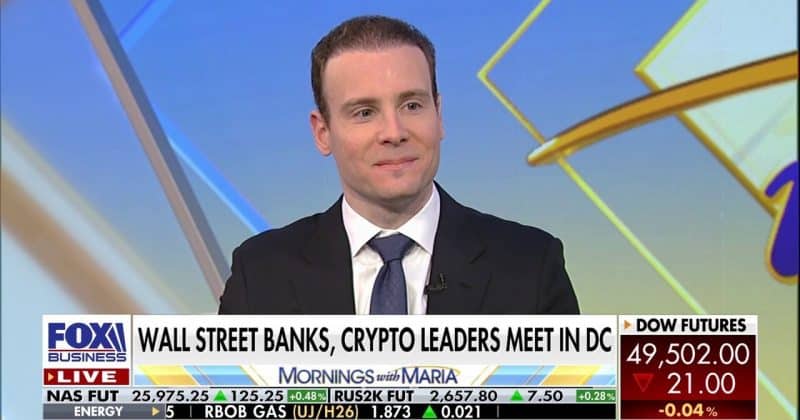
CFTC chairman confirms the US will not pursue a CBDC under Trump
Mike Selig's comments reinforce an administration-wide rejection of central bank digital currencies, with Congress now codifying the ban into law.
CFTC Chairman Mike Selig has stated plainly that the United States will not have a central bank digital currency under President Trump.
The remarks land at a moment when the legislative branch is actively catching up to the executive branch’s position. The Senate passed a housing bill in June 2026 that includes a four-year ban on Federal Reserve issuance of CBDCs, effectively turning Trump’s executive order into something with real statutory teeth.
From executive order to legislative reality
The anti-CBDC posture isn’t new. Trump signed Executive Order 14178 on January 23, 2025, prohibiting federal agencies from establishing or promoting any central bank digital currency.
Selig, who was confirmed as CFTC Chairman on December 18, 2025, and sworn in four days later, has spent his tenure focused on regulatory clarity for digital assets and expanding the CFTC’s influence over the sector. His confirmation of the no-CBDC stance isn’t a new policy announcement. It’s a reaffirmation that the administration’s position has only hardened with time.
The Senate’s June 2026 housing bill, which tucked a four-year CBDC ban into its provisions, signals that Congress is willing to enshrine this position beyond any single presidency. Executive orders can be reversed by the next president with a pen stroke. Legislation is a different animal entirely.
Why the US chose stablecoins over state-issued digital dollars
The Trump administration’s logic is straightforward. A CBDC, by definition, would give the Federal Reserve direct visibility into, and potentially control over, individual transactions. The privacy implications alone have united an unusual coalition of civil libertarians, crypto advocates, and small-government conservatives.
Macro, rates, and crypto—what moved markets and what matters next.
Daily. Free. Join 34,000+ readers across crypto, finance, and policy.
Instead of a government-issued digital dollar, the administration has actively promoted private-sector stablecoins. The calculus is that dollar-pegged tokens issued by regulated companies can provide the efficiency benefits of digital money without concentrating surveillance power in a central bank.
The stablecoin sector has become a significant buyer of US Treasury securities, and a thriving private stablecoin market effectively extends dollar dominance abroad without requiring the Fed to build new infrastructure.
China’s digital yuan has been in various stages of rollout for years, and the European Central Bank continues working on a digital euro. The US decision to sit this one out is a deliberate bet that private innovation will outperform government-led design.
Selig’s CFTC and the broader regulatory picture
Under Selig’s leadership, the CFTC has been expanding its footprint in digital asset regulation. The agency has approved new products like perpetual futures, a category that was previously confined to offshore exchanges and represented one of crypto’s largest unregulated markets.
The CFTC’s growing role matters because it represents a specific regulatory philosophy. The agency traditionally oversees commodities and derivatives markets, where participants are assumed to be relatively sophisticated. Contrast that with the SEC’s investor-protection mandate, which tends toward more restrictive rules. By channeling more digital asset oversight through the CFTC, the administration is effectively choosing a lighter-touch regulatory framework.
For investors, the policy landscape creates a few clear dynamics to watch. Private stablecoin issuers are the most obvious beneficiaries of the CBDC ban. Without a government competitor, companies operating in the stablecoin space face one fewer existential threat.
Traditional cryptocurrencies like Bitcoin and Ethereum also benefit indirectly. When policymakers explicitly reject centralized digital currencies, it removes a category of competitive risk that has loomed over the market for years.