
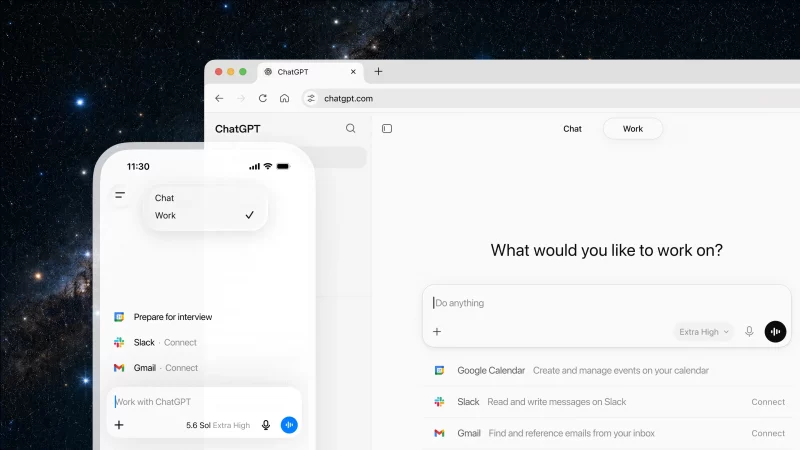
ChatGPT Work launches with GPT-5.6 as OpenAI merges Codex into desktop app
The new agent can work across connected apps, files, browsers, and desktop tools to create finished materials and keep longer projects moving in the background.
OpenAI is rolling out ChatGPT Work, a new agent inside ChatGPT designed to handle longer and more complex workplace tasks across apps, files, and workflows.
The company said ChatGPT Work can gather information from connected tools and turn it into finished materials such as spreadsheets, slide decks, documents, web apps, dashboards, campaign briefs, and project trackers.
Unlike a normal chat request, the agent is built to stay with complex projects for hours by breaking them into smaller steps and completing parts of the work independently.
The launch pushes ChatGPT further beyond question answering and into execution. OpenAI said ChatGPT Work uses Codex technology, the same agentic system that began as a coding tool for developers.
More than 5 million people use Codex every week, and more than 1 million now use it for non software work, according to the company.
ChatGPT Work is powered by GPT-5.6, OpenAI’s latest frontier model, which the company says improves reasoning across multi step tasks and can create materials that follow templates and reference files.
OpenAI’s official GPT 5.6 preview describes the model family as focused on stronger agentic capabilities in coding, science, cybersecurity, and long horizon work.
AI, tech, and the markets they move—in one daily briefing.
Daily. Free. Join 34,000+ readers across crypto, finance, and policy.
The product is meant to sit across tools workers already use. OpenAI said users can connect plugins for Slack, Microsoft Teams, Google Drive, SharePoint, email, calendars, CRMs, project trackers, and other internal systems. ChatGPT can then pull context from those tools, create or update work materials, and ask for guidance or approval when needed.
OpenAI is also introducing Sites in ChatGPT in public beta. Sites lets users turn work or ideas into interactive sites or web apps that can be shared through a URL, including live dashboards, launch calendars, internal portals, prototypes, and interactive reports.
Scheduled Tasks are another core part of the launch. OpenAI said ChatGPT Work can perform one time or recurring actions, such as refreshing meeting agendas from Slack updates, checking websites and dashboards each morning, summarizing changes, monitoring customer feedback, or updating a presentation when new email feedback arrives.
The desktop app is becoming more central to the workflow. OpenAI said ChatGPT on desktop can use local files and apps, while a built in browser lets it gather information from websites, online tools, and cloud files.
The standalone Codex app is also merging into the new ChatGPT desktop app, while the older ChatGPT desktop app will be renamed ChatGPT Classic. OpenAI’s Codex page describes the product as an AI coding agent available on macOS and Windows.
OpenAI said ChatGPT Work is rolling out on web and mobile first for Pro, Enterprise, and Edu users, with Plus and Business access following over the next few days. The updated desktop app is available globally for Mac and Windows, with Chat, Work, and Codex available on every plan, including Free.
For organizations, OpenAI is positioning ChatGPT Work as an enterprise controlled system rather than an unmanaged agent. Admins can manage access to plugins, connected tools, browser use, network access, local desktop capabilities, and sensitive actions.
OpenAI also said auto review blocked 100% of red team attempts to extract protected data during adversarial testing.