
China’s rare ballistic missile test sends ripple through risk markets

China’s rare ballistic missile test sends ripple through risk markets

Beijing's submarine-launched missile test in the South Pacific is the kind of geopolitical shock that historically moves crypto markets, and traders are already watching.

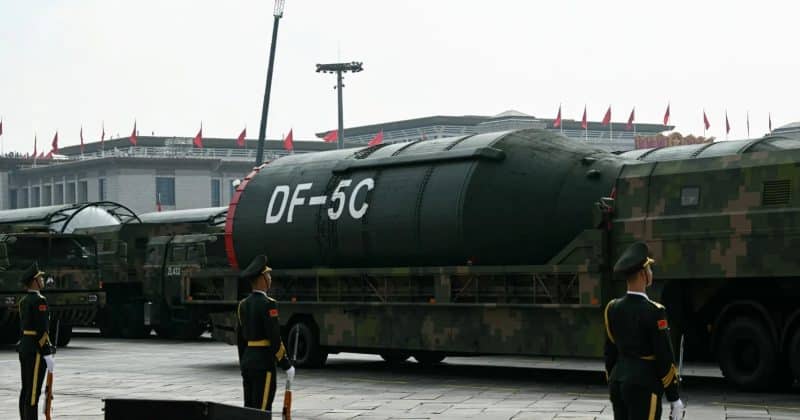
China just test-fired a submarine-launched ballistic missile into the South Pacific, and the list of countries that are unhappy about it reads like a UN roll call. Australia, New Zealand, the US, Japan, and Taiwan all issued condemnations, calling the launch destabilizing. For crypto markets, which have increasingly traded like a barometer for global risk appetite, this is exactly the kind of event that tends to move the needle.

The test took place on July 6, with the People’s Liberation Army Navy launching what analysts believe was a JL-3 missile from a nuclear-powered submarine at 12:01 p.m. local time. The missile carried a dummy warhead and landed in designated high-seas waters.

What happened and why it matters

This was China’s first submarine-launched ballistic missile test in the Pacific region in roughly two years. The previous test occurred in late 2024.

Regional powers reportedly received as little as 90 minutes of advance notice.

Advertisement

The timing was conspicuous, too. The test coincided with two other significant military-diplomatic events: Australia signing a mutual defense pact with Fiji, and the kickoff of annual naval drills between China and Russia.

The suspected JL-3 missile system represents a meaningful upgrade in China’s second-strike nuclear capability. A second-strike capability means a country can absorb a nuclear attack and still retaliate. It’s the backbone of nuclear deterrence theory, and expanding it into the Pacific signals that Beijing is thinking about scenarios that make defense planners lose sleep.

The crypto and macro risk connection

When Russia invaded Ukraine in early 2022, Bitcoin initially dropped alongside equities before partially recovering as some investors treated it as a hedge against sovereign risk. When US-China tensions flared over Taiwan in mid-2022, crypto markets saw elevated volatility and increased trading volumes.

Bitcoin has at times behaved as a safe-haven asset during localized geopolitical crises, particularly in regions where capital controls or currency instability are concerns. But during broader, systemic risk events, it tends to sell off with everything else first.

Regional implications and what to watch

Australia’s new defense pact with Fiji signals that Pacific Island nations, long courted by both China and Western allies, are being pulled more firmly into security alliances.

The concurrent China-Russia naval exercises add another layer. Coordinated military activity between the two countries has been increasing in frequency and scope, and the timing of this missile test alongside those drills sends a message that’s hard to misinterpret.

Conversely, if tensions push certain Asian markets toward capital flight, crypto could see inflows from investors looking to move money outside traditional banking channels. That dynamic played out during previous periods of heightened cross-strait tension and during Hong Kong’s political crisis in 2019-2020.

The 90-minute notice window suggests either a deliberate choice to minimize advance warning or a breakdown in communication channels between Beijing and its neighbors.

Disclosure: This article was edited by Editorial Team. For more information on how we create and review content, see our Editorial Policy.

China’s rare ballistic missile test sends ripple through risk markets

China’s rare ballistic missile test sends ripple through risk markets

Beijing's submarine-launched missile test in the South Pacific is the kind of geopolitical shock that historically moves crypto markets, and traders are already watching.

China just test-fired a submarine-launched ballistic missile into the South Pacific, and the list of countries that are unhappy about it reads like a UN roll call. Australia, New Zealand, the US, Japan, and Taiwan all issued condemnations, calling the launch destabilizing. For crypto markets, which have increasingly traded like a barometer for global risk appetite, this is exactly the kind of event that tends to move the needle.

The test took place on July 6, with the People’s Liberation Army Navy launching what analysts believe was a JL-3 missile from a nuclear-powered submarine at 12:01 p.m. local time. The missile carried a dummy warhead and landed in designated high-seas waters.

What happened and why it matters

This was China’s first submarine-launched ballistic missile test in the Pacific region in roughly two years. The previous test occurred in late 2024.

Regional powers reportedly received as little as 90 minutes of advance notice.

Advertisement

The timing was conspicuous, too. The test coincided with two other significant military-diplomatic events: Australia signing a mutual defense pact with Fiji, and the kickoff of annual naval drills between China and Russia.

The suspected JL-3 missile system represents a meaningful upgrade in China’s second-strike nuclear capability. A second-strike capability means a country can absorb a nuclear attack and still retaliate. It’s the backbone of nuclear deterrence theory, and expanding it into the Pacific signals that Beijing is thinking about scenarios that make defense planners lose sleep.

The crypto and macro risk connection

When Russia invaded Ukraine in early 2022, Bitcoin initially dropped alongside equities before partially recovering as some investors treated it as a hedge against sovereign risk. When US-China tensions flared over Taiwan in mid-2022, crypto markets saw elevated volatility and increased trading volumes.

Bitcoin has at times behaved as a safe-haven asset during localized geopolitical crises, particularly in regions where capital controls or currency instability are concerns. But during broader, systemic risk events, it tends to sell off with everything else first.

Regional implications and what to watch

Australia’s new defense pact with Fiji signals that Pacific Island nations, long courted by both China and Western allies, are being pulled more firmly into security alliances.

The concurrent China-Russia naval exercises add another layer. Coordinated military activity between the two countries has been increasing in frequency and scope, and the timing of this missile test alongside those drills sends a message that’s hard to misinterpret.

Conversely, if tensions push certain Asian markets toward capital flight, crypto could see inflows from investors looking to move money outside traditional banking channels. That dynamic played out during previous periods of heightened cross-strait tension and during Hong Kong’s political crisis in 2019-2020.

The 90-minute notice window suggests either a deliberate choice to minimize advance warning or a breakdown in communication channels between Beijing and its neighbors.

Disclosure: This article was edited by Editorial Team. For more information on how we create and review content, see our Editorial Policy.