
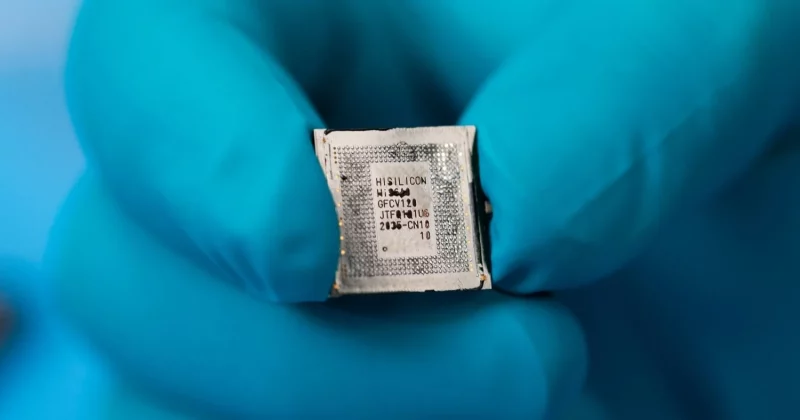
Chinese semiconductor stocks rise on optimism over Huawei’s chip plans
SMIC and Hua Hong shares surged after Huawei unveiled a novel chip architecture designed to sidestep US sanctions.
Huawei just told the semiconductor world it found a different door. And Hong Kong’s chip stocks responded like someone rang the opening bell twice.
Shares of Semiconductor Manufacturing International Corporation (SMIC) jumped more than 17% on May 26, while Hua Hong Semiconductor climbed over 16%. The catalyst: Huawei’s semiconductor president He Tingbo took the stage at the IEEE International Symposium on Circuits and Systems in Shanghai and introduced two concepts that have the market buzzing, the “LogicFolding” architecture and the “Tau Scaling Law.”
What Huawei actually announced
LogicFolding is, in simple terms, an architectural approach that achieves greater transistor density without relying solely on shrinking the physical size of each transistor. Think of it like fitting more people into a building by redesigning the floor plan rather than making the people smaller.
Huawei projects that chips built on these principles could reach transistor density equivalent to 1.4 nanometers by 2031. For context, the most advanced commercially available chips today operate at the 3nm node.
The company also claims this isn’t vaporware. According to He Tingbo’s presentation, Huawei has designed and mass-produced 381 chips based on these new principles over the past six years. The first LogicFolding-based Kirin smartphone chips are expected to hit commercial devices by Fall 2026.
Why sanctions created the pressure cooker
Washington has systematically restricted the company’s access to advanced semiconductor manufacturing equipment, particularly the extreme ultraviolet (EUV) lithography machines made by ASML that are essential for producing cutting-edge chips at the smallest nodes.
The news moving money, markets, and the world—before your day starts.
Daily. Free. Join 34,000+ readers across crypto, finance, and policy.
The LogicFolding approach essentially argues that equivalent performance can be achieved through clever system-level and architectural design, even when manufactured on less advanced equipment.
The company’s Ascend AI chip lineup, including the upcoming 950 series, is reportedly gaining traction domestically as Chinese firms seek alternatives to restricted foreign suppliers like Nvidia.
What this means for investors
A 17% jump in one session tells you something about how starved the market has been for a credible narrative around Chinese semiconductor self-sufficiency.
Investors betting on the China self-sufficiency narrative need to watch whether Huawei’s Fall 2026 Kirin chips actually deliver competitive performance benchmarks, not just impressive-sounding specifications.
SMIC and Hua Hong stand to benefit as the primary domestic manufacturers capable of scaling production, but they’ll also face intense pressure to deliver on timelines that are, frankly, aggressive.