
Coinbase’s x402 protocol surpasses 100 million agentic transactions on Base
Machine-to-machine payments built on a resurrected HTTP status code are quietly becoming one of crypto's fastest-growing use cases.
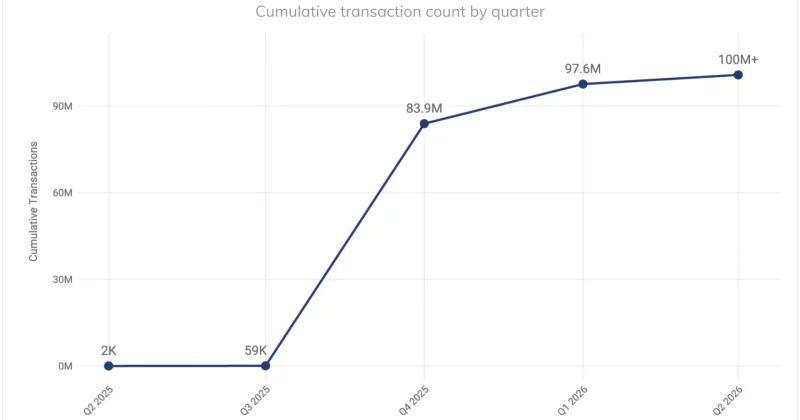
Nine months. That’s all it took for Coinbase’s x402 protocol to cross the 100 million transaction mark on Base, according to a new report from Chainalysis. For a protocol that essentially repurposes a dusty, never-implemented internet standard to let AI agents pay for things autonomously, that’s a trajectory worth paying attention to.
The x402 protocol, launched in May 2025, uses USDC as its primary settlement currency and enables machine-to-machine payments without traditional payment accounts or intermediaries.
From zero to 100 million in under a year
Activity on wallets interacting with x402 went from essentially nothing in mid-2025 to more than 100 million transactions by the first quarter of 2026. Late 2025 saw a transaction surge of over 10,000% as the protocol gained traction among developers and AI-focused applications.
Recent data from x402.org paints an even more granular picture. Over the most recent 30-day period, the protocol recorded 72.41 million transactions and $24.24 million in volume.
How a forgotten HTTP code became crypto infrastructure
HTTP 402 is a status code that was defined decades ago but never actually implemented. It was reserved for “Payment Required,” a placeholder for a future where the web would have native payment capabilities. Coinbase decided to build it on crypto rails instead.
The protocol works by embedding payment logic directly into web requests. When an AI agent hits an API endpoint that requires payment, x402 handles the USDC transfer automatically. No sign-ups, no API keys tied to billing accounts, no invoices. Just a seamless stablecoin transfer that settles onchain.
The news moving money, markets, and the world—before your day starts.
Daily. Free. Join 34,000+ readers across crypto, finance, and policy.
The institutional validation has been swift and notable. In September 2025, Coinbase co-launched the x402 Foundation alongside Cloudflare. By February 2026, Stripe integrated the protocol for USDC payments on Base. Then in April 2026, x402 transitioned to the Linux Foundation, a move that brought neutral governance and backing from Circle, Google, Microsoft, Stripe, and Visa.
The protocol has also expanded beyond Base to include Solana. Batch settlement options introduced in May 2026 further improved efficiency for high-volume use cases.
Why this matters for investors and the broader market
For USDC and its issuer Circle, x402 represents a distribution channel where every agentic transaction flowing through the protocol is a stablecoin use case that has nothing to do with trading or DeFi yield farming.
The $24.24 million in 30-day volume might seem modest compared to DeFi’s billions, but context matters here. These are primarily micropayments, meaning the transaction count is the more relevant metric. And 72.41 million transactions in a single month suggests the protocol is handling serious throughput.
The risk to watch is concentration. If the majority of x402 activity comes from a small number of large-scale AI deployments, a single client pulling out could crater the metrics. Investors should also monitor whether the Linux Foundation governance structure leads to meaningful multi-chain expansion or if Base retains an outsized share of activity, which would make x402’s success more tightly coupled to Base’s own trajectory than the broader market might assume.