
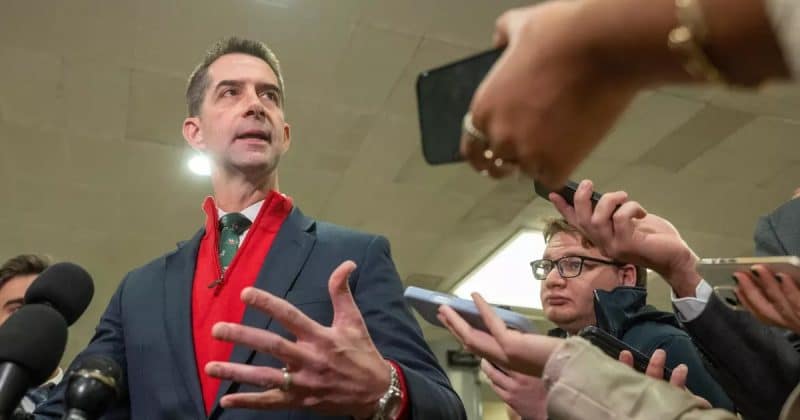
Sen. Tom Cotton urges DOJ to investigate Chinese influence on US AI infrastructure
The Arkansas Republican wants federal investigators to examine whether Beijing-linked campaigns are sabotaging America's data center buildout, citing a Bitcoin Policy Institute report.
Senator Tom Cotton is asking the Department of Justice to look into what he describes as a covert Chinese campaign designed to “kneecap” America’s artificial intelligence infrastructure. The Arkansas Republican sent a letter to Acting Attorney General Todd Blanche on June 9, calling for a formal investigation into foreign actors allegedly working to shape US public opinion against data centers and AI development.
The case Cotton is building
Cotton’s letter points to what he sees as a coordinated effort by the Chinese Communist Party to undermine the expansion of US data centers. The core allegation: Beijing is financing or encouraging campaigns that criticize American data centers for their energy consumption and environmental impact, all while subsidizing its own AI operators’ electricity costs by up to 50%.
The senator’s case draws heavily on a report published by the Bitcoin Policy Institute on May 18, which identified three distinct vectors of influence: Chinese state media, allied US nonprofits, and foreign billionaires. According to the report, Chinese state media outlets have amplified narratives about US data centers driving up electricity prices for ordinary Americans.
This isn’t Cotton’s first move in this space. He previously sponsored the DATA Act of 2026, legislation designed to promote independent power infrastructure for data centers, essentially enabling them to go off-grid and sidestep the energy debates entirely. In May, Cotton and Senator Jim Banks also pressed intelligence officials to more closely track Chinese AI capabilities and operations.
The news moving money, markets, and the world—before your day starts.
Daily. Free. Join 34,000+ readers across crypto, finance, and policy.
Why crypto should be paying attention
The Bitcoin Policy Institute’s involvement here is not accidental. Data centers and Bitcoin mining operations share the same fundamental challenge: they consume enormous amounts of electricity, and they face the same political headwinds from communities and advocacy groups concerned about energy costs and environmental impact.
Several publicly traded Bitcoin miners have pivoted to offering AI computing services, recognizing that the same facilities and power contracts that run mining rigs can host GPU clusters for machine learning workloads.
China effectively banned crypto mining in 2021, pushing miners to relocate to the US, Kazakhstan, and other jurisdictions. If Beijing is simultaneously subsidizing its own AI energy costs while undermining American energy infrastructure expansion, the strategic calculus extends to maintaining the US share of global computing power across both AI and crypto.