
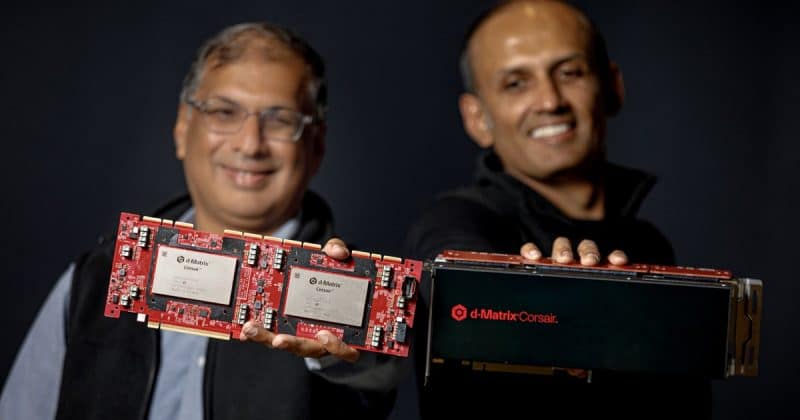
D-Matrix launches Corsair AI inference platform, challenging Nvidia’s GPU dominance
The startup's new chip claims 10x faster inference than Nvidia GPUs, backed by $275 million in Series C funding and a $2 billion valuation.
D-Matrix, an AI inference hardware startup, has entered full production with its Corsair platform, manufactured through TSMC’s N6 fabrication process. The chip claims performance figures that should make Nvidia investors pause: up to 10x faster AI inference and 5x better energy efficiency compared to Nvidia’s standalone GPUs for generative AI workloads.
What D-Matrix is actually building
The Corsair platform uses an architecture called 3DIMC, which stands for digital in-memory compute. Traditional GPUs have to constantly shuttle data between memory and processing units, creating a bottleneck. D-Matrix’s approach essentially puts the pantry inside the kitchen.
The result, according to the company’s benchmarks, is the ability to process 30,000 tokens per second at 2 milliseconds per token for Meta’s Llama 70B model.
D-Matrix raised $275 million in a Series C funding round in November 2025, pushing the company’s valuation to $2 billion. Microsoft’s venture arm M12 participated in the round.
The company’s partnership ecosystem includes collaborations with Arista, Broadcom, Supermicro, and Gimlet Labs, with Alchip and TSMC handling fabrication.
AI, tech, and the markets they move—in one daily briefing.
Daily. Free. Join 34,000+ readers across crypto, finance, and policy.
Why crypto markets should care
D-Matrix isn’t positioning itself as a complete GPU replacement. The company’s strategy involves heterogeneous deployments that integrate both its accelerators and traditional GPUs, targeting the inference market specifically rather than AI training.
The distinction between training and inference matters enormously. Training is the expensive, compute-heavy process of teaching an AI model. Inference is the ongoing cost of actually running that model in production. As AI applications scale, inference costs increasingly dominate the total cost of ownership.
Market implications and competitive pressure
For investors in AI-adjacent crypto tokens, the competitive dynamics in the hardware layer create both risks and opportunities. Projects built on the assumption of GPU scarcity could see their thesis weakened if specialized inference chips expand the supply of compute. Projects that can orchestrate workloads across different chip architectures could benefit from a more diverse and competitive hardware market.
Watch for how decentralized compute protocols respond. If networks like Akash, Render, or io.net begin integrating non-GPU accelerators into their infrastructure, it would signal that the hardware diversification thesis is real and not just a whitepaper promise.