
D-Matrix claims Corsair chip outperforms Nvidia GPUs in AI inference
The Silicon Valley startup says its in-memory compute architecture delivers 10x faster inference at a fraction of the energy cost, and it just entered volume production.
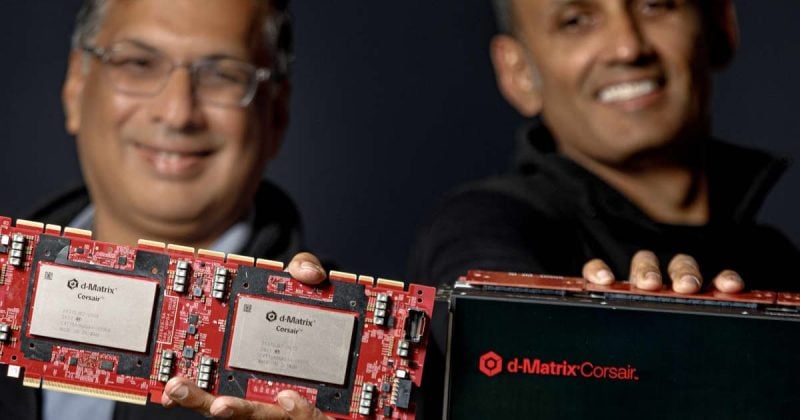
A startup most people have never heard of just walked into Nvidia’s house and claimed it can do inference better. D-Matrix, a Silicon Valley AI hardware company founded in 2019, says its Corsair inference accelerator platform runs AI workloads up to 10 times faster than standalone Nvidia GPUs while consuming up to five times less energy.
The kicker: the Corsair platform entered volume production in June 2026, meaning these aren’t vaporware slides at a conference. They’re shipping hardware.
What the Corsair actually does
D-Matrix is attacking what engineers call the “memory wall.” The biggest slowdown in inference isn’t computation, it’s moving data around. The chip spends more time fetching information from memory than it does actually doing math.
The Corsair platform tackles this with an in-memory computing architecture. Instead of shuttling data back and forth between processors and memory, the computation happens where the data already lives.
The technical specs back up the ambition. Each Corsair PCIe card packs 6,400 mm² of silicon with 4 GB of what D-Matrix calls “Performance Memory,” offering bandwidth of 300 TB/s. The platform also supports up to 512 GB of capacity memory per card.
AI, tech, and the markets they move—in one daily briefing.
Daily. Free. Join 34,000+ readers across crypto, finance, and policy.
In a dual-card configuration, the platform hits peak compute figures of 4,800 TFLOPs for MXINT8 and 19,200 TFLOPs for MXINT4 precision formats.
The business play
D-Matrix has designed Corsair to work both standalone and in hybrid configurations alongside Nvidia’s Blackwell GPUs. Rather than asking data center operators to rip and replace their entire GPU infrastructure, D-Matrix is positioning Corsair as a complement.
The cards are priced in the tens of thousands of dollars. The value proposition isn’t a cheaper card. It’s a card that delivers dramatically more inference throughput per dollar and per watt.
D-Matrix raised $275 million in Series C funding, with Microsoft’s M12 venture arm and Temasek, Singapore’s sovereign wealth fund, among the investors.
CEO Sid Sheth, who has led the company since its founding, previously showcased the underlying technology at Hot Chips 2025. Volume production began in June 2026 in response to demand from hyperscalers and neoclouds.