

DApps Took In More Money Than App Store In First Year
Steem dApps made a surprisingly good showing among the leading blockchains, with more loyal wallet users than ETH or EOS.
There’s no clear winner in the race for a killer app, but there’s no shortage of contenders. Decentralized applications (dApps) were put on the map in last year, generating$6.7 billion in 2018, according to a study by Dapp.com. Ten years ago, when the App Store completed its first full year in operation, iOS boasted more than 65,000 apps that produced $4.2 billion in revenue, placing dApps ahead by 37% for early performance.
“This is a major benefit for the next phase of blockchain adoption,” Dapp.com’s Kyle Lu told Crypto Briefing. The figures validate the blockchain’s utility beyond being simply a mechanism for fundraising, placing a spotlight on features such as “transparency, fairness and proof of ownership,” he explained.
Returning to the present, the App Store generated $12 billion in revenue in the third quarter of 2018 alone. Decentralized applications, meanwhile, are still hunting mainstream adoption. According to State of the Dapps, decentralized apps have about 56,000 daily active users across a little more than 2,400 dApps. Transaction volume over the last 24 hours hovers at $15.7 million.
The comparison comes with a few caveats; App Store revenues tend to go to the creators of the applications, while decentralized applications have fewer intermediary fees- meaning more of that $6.7bn returns to users’ wallets. All the same, dApps appear to have a running start out of the gate. Assuming developers can arrive at the Netflix or WhatsApp of the blockchain, the tables could once again turn.
In fact, Dapp.com’s Lu expects that the market’s “rapid growth” to “stimulate content producers to join the industry.”
There has already been a paradigm shift from 2017, when it was mostly individuals building dApps. By the latter part of last year, “larger corporates and public companies started building customer-facing products on the blockchain,” Lu added.
The news moving money, markets, and the world—before your day starts.
Daily. Free. Join 34,000+ readers across crypto, finance, and policy.
The Little Blockchain That Could
One of the blockchains with momentum on its side is Steem, whose community has proven to be more loyal than the market cap would suggest. Nearly half, or 44% of Steem “wallet (account) owners are actual dApp users,” according to Dapp.com. This compares to 2% for Ethereum (ouch) and 27% for EOS.
That may have something to do with the perks of dApps like Steemit, which allows users to get paid for creating content. With more than 5,500 users, it’s the most popular dApp on the Steem blockchain. Steem Monsters, which is ranked No. 3 on State of the Dapps, is a digital collectible card game somewhere between Pokemon and Blizzard’s World of Warcraft. Perhaps the Steem devs are onto something; rather than reinvent the wheel, use what works.
Steem’s dApps are also fairly easy to use, given their similarity to the mainstream of social media sites. For instance, Steemhunt is a play on Product Hunt, only it is powered by the Steem blockchain and it puts the power of earning in the hands of contributors instead of the company. DTube, another Steem dApp, is a decentralized version of YouTube, a key feature of which is being “resistant to censorship.”
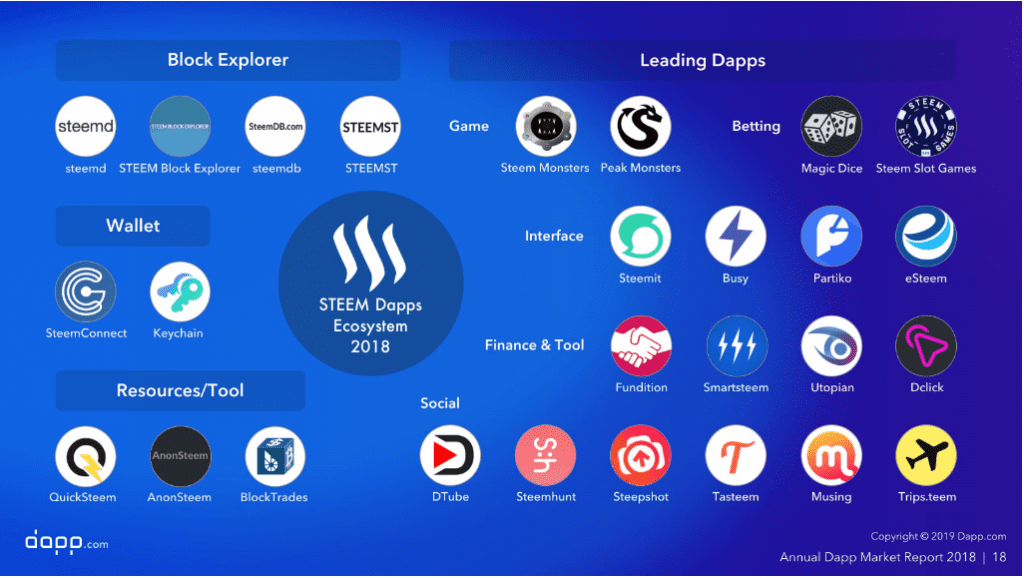
Steem has a total of a few dozen dApps across gaming, video sharing, crowdfunding and more. This compares to 2,287 and 159 for Ethereum and EOS, respectively.
Incidentally, one creative dad hacked his tot’s LEGO Duplo train to put it on the Steem blockchain. Dutch entrepreneur and Steem block producer “RoelandP” designed the train to be fueled by the number of Steem transactions on the blockchain, accelerating and slowing down in response to the block size. If this isn’t an early sign of mainstream adoption, we don’t know what is.
The author is invested in digital assets, but none mentioned in this article.