
Egypt’s VAR heartbreak against Argentina highlights the growing role of tech-driven officiating in global sports

Egypt’s VAR heartbreak against Argentina highlights the growing role of tech-driven officiating in global sports

A disallowed goal and a stoppage-time comeback in the World Cup Round of 16 reignite debates about technology, fairness, and the billions of dollars tied to sporting outcomes.

Argentina survived a 2-0 deficit to beat Egypt 3-2 in the 2026 FIFA World Cup Round of 16, but the scoreline tells roughly half the story. The other half belongs to a VAR review that disallowed an Egyptian goal, flipped the match’s momentum, and launched a firestorm about how technology-assisted officiating actually works in practice.

The disallowed goal, scored by midfielder Mostafa Zico around the hour mark, was chalked off after video review determined that teammate Marawan Attia had committed a foul on Argentina’s Lisandro Martinez in the buildup. What followed was a full Argentine comeback capped by an Enzo Fernandez stoppage-time winner. Egypt went from controlling a knockout match to watching their World Cup end in the span of about 30 minutes.

Advertisement

What actually happened on the pitch

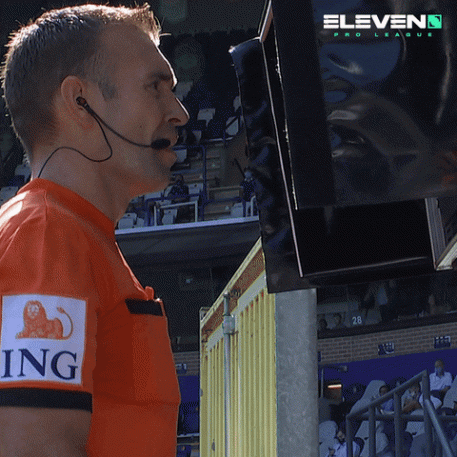
Egypt came out swinging in the July 7 match and built a commanding 2-0 lead. Then came the Zico goal that would have made it 3-0. VAR intervened, referee Francois Letexier reviewed the footage, and the goal was wiped off the board. The reasoning: Attia’s challenge on Martinez constituted a foul in the buildup to the goal.

Egypt’s head coach Hossam Hassan did not mince words afterward. He called the VAR decision an “injustice,” pointing to what he viewed as a glaring double standard in how the technology was applied throughout the match. His central complaint: no VAR review took place for a potential foul involving Alexis Mac Allister during the sequence that led to Argentina’s winning goal. Hassan also asserted that the tournament appeared “directed towards Argentina.”

The Egyptian Football Association went further, filing an official complaint and demanding that Letexier be excluded from officiating any remaining tournament matches. The EFA’s language around “improper use of VAR” signals they view this as more than a one-off bad call, with allegations that decisions have skewed in favor of more prominent footballing nations.

The bigger picture on tech-assisted officiating

VAR has been part of the World Cup since 2018. The technology was introduced to eliminate clear and obvious errors, but its implementation has consistently generated debates about what constitutes “clear” and what qualifies as “obvious.”

The Egypt-Argentina match crystallizes the core tension. VAR caught a foul in one sequence but apparently did not flag a potentially similar infraction in another. The inconsistency, rather than any single decision, is what drives the loudest criticism. If a system is supposed to ensure fairness through comprehensive review, selective application of that review undermines the entire premise.

Disclosure: This article was edited by Editorial Team. For more information on how we create and review content, see our Editorial Policy.

Egypt’s VAR heartbreak against Argentina highlights the growing role of tech-driven officiating in global sports

Egypt’s VAR heartbreak against Argentina highlights the growing role of tech-driven officiating in global sports

A disallowed goal and a stoppage-time comeback in the World Cup Round of 16 reignite debates about technology, fairness, and the billions of dollars tied to sporting outcomes.

Argentina survived a 2-0 deficit to beat Egypt 3-2 in the 2026 FIFA World Cup Round of 16, but the scoreline tells roughly half the story. The other half belongs to a VAR review that disallowed an Egyptian goal, flipped the match’s momentum, and launched a firestorm about how technology-assisted officiating actually works in practice.

The disallowed goal, scored by midfielder Mostafa Zico around the hour mark, was chalked off after video review determined that teammate Marawan Attia had committed a foul on Argentina’s Lisandro Martinez in the buildup. What followed was a full Argentine comeback capped by an Enzo Fernandez stoppage-time winner. Egypt went from controlling a knockout match to watching their World Cup end in the span of about 30 minutes.

Advertisement

What actually happened on the pitch

Egypt came out swinging in the July 7 match and built a commanding 2-0 lead. Then came the Zico goal that would have made it 3-0. VAR intervened, referee Francois Letexier reviewed the footage, and the goal was wiped off the board. The reasoning: Attia’s challenge on Martinez constituted a foul in the buildup to the goal.

Egypt’s head coach Hossam Hassan did not mince words afterward. He called the VAR decision an “injustice,” pointing to what he viewed as a glaring double standard in how the technology was applied throughout the match. His central complaint: no VAR review took place for a potential foul involving Alexis Mac Allister during the sequence that led to Argentina’s winning goal. Hassan also asserted that the tournament appeared “directed towards Argentina.”

The Egyptian Football Association went further, filing an official complaint and demanding that Letexier be excluded from officiating any remaining tournament matches. The EFA’s language around “improper use of VAR” signals they view this as more than a one-off bad call, with allegations that decisions have skewed in favor of more prominent footballing nations.

The bigger picture on tech-assisted officiating

VAR has been part of the World Cup since 2018. The technology was introduced to eliminate clear and obvious errors, but its implementation has consistently generated debates about what constitutes “clear” and what qualifies as “obvious.”

The Egypt-Argentina match crystallizes the core tension. VAR caught a foul in one sequence but apparently did not flag a potentially similar infraction in another. The inconsistency, rather than any single decision, is what drives the loudest criticism. If a system is supposed to ensure fairness through comprehensive review, selective application of that review undermines the entire premise.

Disclosure: This article was edited by Editorial Team. For more information on how we create and review content, see our Editorial Policy.