
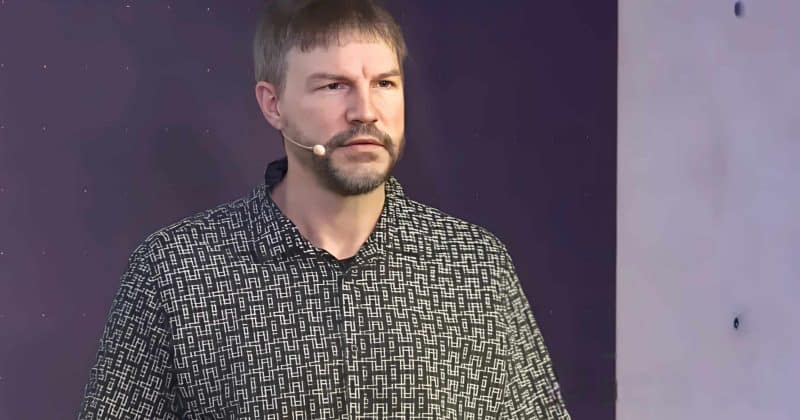
Elon Musk credits Nick Szabo for Bitcoin’s foundational ideas
The Tesla CEO pointed to the cryptographer's decades-old work as the intellectual bedrock beneath the world's largest cryptocurrency
Elon Musk has a habit of moving markets with a single sentence. But one of his more interesting crypto remarks had nothing to do with Dogecoin memes or laser eyes. It was about a quiet cryptographer named Nick Szabo.
In a conversation on the Lex Fridman podcast, Musk said Szabo is “probably more than anyone else responsible for the evolution of those ideas” behind Bitcoin. The comment has since taken on a life of its own, resurfacing across social media platforms as recently as mid-2025, reigniting a debate that’s older than Bitcoin itself: who really laid the groundwork for decentralized money?
The man behind the ideas
Nick Szabo is not a household name. He doesn’t run a publicly traded company or post to hundreds of millions of followers. But within cryptography and computer science circles, his contributions are hard to overstate.
In 1998, Szabo proposed a decentralized digital currency system called Bit Gold. If that sounds familiar, it should. Bit Gold required participants to dedicate computing power to solve cryptographic puzzles, with solutions then chained together. In English: it was a proof-of-work system linking blocks of data, years before Bitcoin’s 2009 launch.
Szabo also coined the term “smart contracts” in the mid-1990s. That concept, the idea that agreements could be self-executing code rather than paper enforced by lawyers, became the entire foundation for Ethereum and every programmable blockchain that followed.
The parallels between Bit Gold and Bitcoin are so striking that speculation has swirled for years about whether Szabo is actually Satoshi Nakamoto, the pseudonymous creator of Bitcoin. Linguistic analysis of Szabo’s academic writing and the Bitcoin white paper has fueled this theory. Szabo, for his part, has publicly and consistently denied being Satoshi.
AI, tech, and the markets they move—in one daily briefing.
Daily. Free. Join 34,000+ readers across crypto, finance, and policy.
Why Musk’s comment keeps resurfacing
The remark originally came during a December 2021 podcast appearance, but it hasn’t stayed in 2021. Discussions linking Szabo to Bitcoin’s origins have continued circulating on platforms including Binance Square and Facebook well into 2026. The persistence of these conversations reflects something deeper than celebrity gossip. There’s a genuine hunger in the crypto community to understand where these ideas came from, and whether the people behind them got the credit they deserved.
Bitcoin didn’t emerge from a vacuum. Before the Satoshi white paper landed in a cryptography mailing list in 2008, there were decades of prior work. David Chaum’s DigiCash in the 1980s, Adam Back’s Hashcash, Wei Dai’s b-money, and Szabo’s Bit Gold all contributed pieces of the puzzle. What Musk effectively did was point to Szabo and say: this guy assembled more of those pieces than anyone.
What this means for investors
Szabo’s ideas also serve as a useful lens for evaluating which projects have staying power. Smart contracts and decentralization weren’t buzzwords he threw around for venture capital decks. They were carefully reasoned proposals about how trust could be minimized in economic transactions.
Investors watching the broader landscape should also note a pattern: whenever Bitcoin’s origin story becomes a trending topic, trading activity around Bitcoin tends to pick up. Renewed interest in foundational figures like Szabo creates speculative momentum.
The risk, as always, is that narrative energy gets confused with fundamental value. Musk crediting Szabo doesn’t change Bitcoin’s code, its supply cap, or its network hashrate. What it does change is the story people tell themselves about why Bitcoin matters, and in a market where conviction drives holding behavior, that story is not nothing.