
Exponent Finance goes live with v2 upgrade on Solana, adds new yield management features
The yield exchange protocol overhauls its smart contracts and interface while introducing automated strategy vaults and improved liquidity tools.
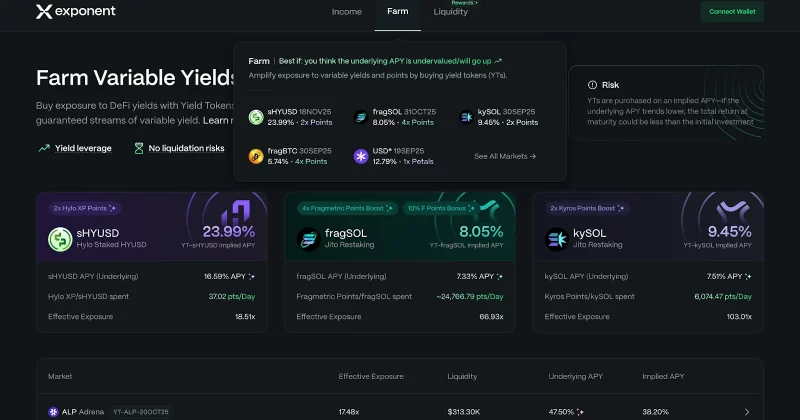
Exponent Finance, the Solana-based yield exchange protocol, has shipped its v2 upgrade. The release brings a full smart contract and interface overhaul alongside new tools designed to make on-chain yield management less of a chore for both retail users and institutions.
Think of Exponent as a marketplace where you can trade interest rates instead of tokens. If you want a guaranteed fixed yield on your Solana DeFi positions, or you want to bet that variable rates will go higher, Exponent lets you do both.
What the v2 upgrade actually changes
The centerpiece of the new release is automated strategy vaults. These let users build customized investment strategies without manually rebalancing positions.
The upgrade also introduces enhanced liquidity primitives. These are the underlying mechanisms that determine how efficiently capital flows through the protocol.
For existing users, Exponent built seamless migration options from v1 to v2.
The protocol has also partnered with Titan Exchange to improve swap capabilities and integrated routing.
The crypto and markets news you actually need—every morning.
Daily. Free. Join 34,000+ readers across crypto, finance, and policy.
The numbers behind Exponent’s growth
Exponent’s trajectory since its mainnet launch gives some context for why the v2 upgrade matters. The protocol has facilitated over $1.92 billion in traded yield volume. It has also settled more than $250 million in actual yield. The platform has attracted over 35,000 unique users, with approximately $79 million in total value locked.
The protocol’s funding history also reflects institutional confidence. RockawayX led a $2.1 million seed round in November 2024, with participation from Solana Ventures and Cherry Ventures.
Exponent has also built integrations with established Solana DeFi protocols like Kamino and Marginfi.
What this means for investors
The institutional angle is also significant. Fixed-rate yields are one of the most requested features from traditional finance participants exploring DeFi. Exponent’s core product, the ability to lock in fixed yields through its Income Token mechanism, directly addresses that demand.
The risk side of the equation deserves attention too. Smart contract risk applies to any protocol, but yield markets also face liquidity risk if not enough counterparties exist on both sides of a trade. A v2 smart contract overhaul, while bringing new features, also introduces fresh code that hasn’t been battle-tested in production. Users migrating from v1 should understand that newer contracts inherently carry more uncertainty than mature ones.