
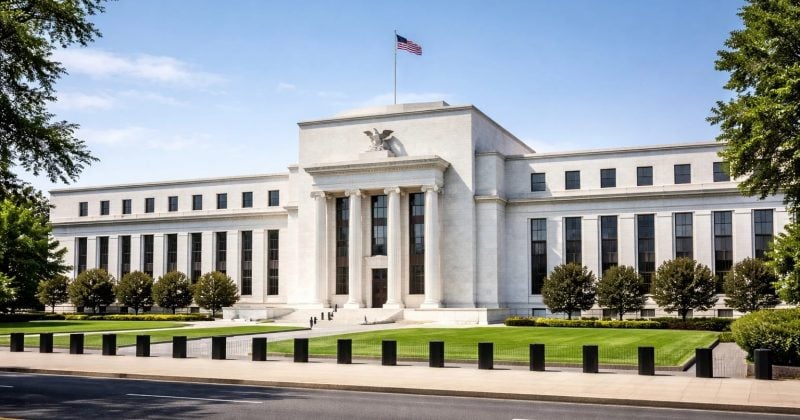
Via thehotelwashington.com
Federal Reserve dissenters warn of inflation taming challenges, signaling trouble for risk assets
Three regional Fed presidents pushed for a rate hike in a rare hawkish revolt that has crypto markets on edge
The Federal Reserve held interest rates steady on July 29, but the real story was who didn’t agree. Three regional bank presidents dissented from the 9-3 vote to maintain the federal funds rate at 3.5% to 3.75%, each pushing for a 25-basis-point increase instead.
That kind of organized hawkish revolt hasn’t happened since 2016. And for crypto investors who’ve spent the past year watching Bitcoin dance to the Fed’s tune, the implications are hard to ignore.
Three hawks, one message
Beth M. Hammack of the Cleveland Fed, Neel Kashkari of the Minneapolis Fed, and Lorie K. Logan of the Dallas Fed all voted for tighter policy. Their reasoning centered on a stubborn reality: inflation remains above the Fed’s 2% target, and it’s not budging fast enough for their comfort.
The dissenters pointed to ongoing supply shocks as the primary culprit. Energy sector disruptions tied to conflicts in the Middle East have kept price pressures elevated in ways that monetary policy alone can’t easily fix.
This was also the first FOMC meeting under new Chair Kevin Warsh, making the dissent an early and visible test of his leadership.
The news moving money, markets, and the world—before your day starts.
Daily. Free. Join 34,000+ readers across crypto, finance, and policy.
The hawkish hold and what it means
Analysts have described the outcome as a “hawkish hold,” which is Wall Street’s way of saying: we didn’t raise rates, but don’t get comfortable. The message to markets is that the Fed isn’t ready to ease, and a meaningful faction thinks policy should actually be getting tighter.
The federal funds rate sitting at 3.5% to 3.75% is already restrictive territory by recent historical standards. For context, rates were near zero as recently as early 2022 before the Fed embarked on its aggressive tightening campaign. The fact that three voting members wanted to push even higher tells you something about how seriously parts of the Fed are taking the inflation problem.
Crypto caught in the crossfire
Bitcoin and Ethereum markets reacted with notable sensitivity to the FOMC outcome. The three dissenters’ focus on supply-side inflation, particularly energy costs driven by geopolitical instability, adds another layer of complexity. Supply shocks are notoriously difficult for central banks to address with interest rate tools alone. Raising rates fights demand-driven inflation effectively. But when prices are rising because oil is harder to get, not because consumers are spending recklessly, rate hikes can slow the economy without actually solving the inflation problem.
Traders navigating this environment should be watching two things closely. First, whether the dissent grows at future meetings, which would signal the committee is shifting toward actual rate increases rather than just holding. Second, whether energy-driven inflation pressures ease on their own, which would take some heat off the hawks and potentially open the door for rate cuts later in the cycle.