
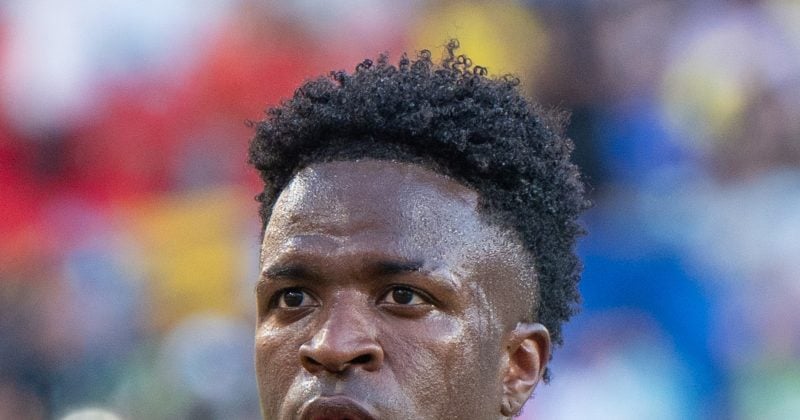
FIFA enacts ‘Vini Jr. Law’ for 2026 World Cup to combat racism with automatic red cards

FIFA enacts ‘Vini Jr. Law’ for 2026 World Cup to combat racism with automatic red cards

Players caught covering their mouths during confrontations now face immediate ejection under a rule born from a Champions League racial abuse incident

FIFA just made hiding your words on the pitch a sendoff offense. The governing body of world football, working with the International Football Association Board (IFAB), approved a new regulation on April 28, 2026, that allows referees to issue a straight red card to any player who covers their mouth during confrontations with opponents at the 2026 World Cup.

The rule, informally dubbed the “Vini Jr. Law,” is designed to strip away the one trick players have used for years to shield racist and abusive language from cameras and lip-readers.

The incident that changed the rules

The catalyst was a Champions League match in February 2026 between Benfica and Real Madrid. During the game, Benfica’s Gianluca Prestianni was accused of directing racial abuse at Real Madrid forward Vinícius Júnior while covering his mouth, a gesture that made it nearly impossible for match officials and VAR operators to determine exactly what was said.

Advertisement

FIFA President Gianni Infantino endorsed the new rule as a mechanism to enhance accountability and transparency on the field. The logic is straightforward: if VAR and match officials can clearly see players’ mouths, they can better monitor behavior and act on abusive language in real time.

How the rule actually works

The regulation is specifically scoped to the 2026 FIFA World Cup, which is being hosted across the US, Mexico, and Canada. It targets players who cover their mouths during confrontations, not casual conversations or tactical discussions with teammates on the sideline.

The penalty is severe by football standards. A straight red card means immediate ejection from the match, leaving the offending team down to ten players. It also typically carries a suspension for subsequent matches. In a World Cup, where teams play a maximum of seven games if they reach the final, losing a player for even one match can be tournament-altering.

The rule has already been tested. Paraguayan midfielder Miguel Almirón became the first player penalized under the new regulation during a World Cup match in June 2026.

It’s worth noting that the rule doesn’t require proof that something racist was actually said. The act of covering the mouth during a confrontation is itself the infraction.

UEFA takes a softer approach

Not everyone in football governance is on the same page. UEFA, which oversees European club and international competitions, has opted not to adopt the red-card version of the regulation. Instead, UEFA will implement yellow cards for mouth-covering infractions in its competitions.

This split approach means a player could cover their mouth during a Champions League match and receive a yellow card, then do the same thing at the World Cup and be immediately ejected.

Disclosure: This article was edited by Editorial Team. For more information on how we create and review content, see our Editorial Policy.

FIFA enacts ‘Vini Jr. Law’ for 2026 World Cup to combat racism with automatic red cards

FIFA enacts ‘Vini Jr. Law’ for 2026 World Cup to combat racism with automatic red cards

Players caught covering their mouths during confrontations now face immediate ejection under a rule born from a Champions League racial abuse incident

FIFA just made hiding your words on the pitch a sendoff offense. The governing body of world football, working with the International Football Association Board (IFAB), approved a new regulation on April 28, 2026, that allows referees to issue a straight red card to any player who covers their mouth during confrontations with opponents at the 2026 World Cup.

The rule, informally dubbed the “Vini Jr. Law,” is designed to strip away the one trick players have used for years to shield racist and abusive language from cameras and lip-readers.

The incident that changed the rules

The catalyst was a Champions League match in February 2026 between Benfica and Real Madrid. During the game, Benfica’s Gianluca Prestianni was accused of directing racial abuse at Real Madrid forward Vinícius Júnior while covering his mouth, a gesture that made it nearly impossible for match officials and VAR operators to determine exactly what was said.

Advertisement

FIFA President Gianni Infantino endorsed the new rule as a mechanism to enhance accountability and transparency on the field. The logic is straightforward: if VAR and match officials can clearly see players’ mouths, they can better monitor behavior and act on abusive language in real time.

How the rule actually works

The regulation is specifically scoped to the 2026 FIFA World Cup, which is being hosted across the US, Mexico, and Canada. It targets players who cover their mouths during confrontations, not casual conversations or tactical discussions with teammates on the sideline.

The penalty is severe by football standards. A straight red card means immediate ejection from the match, leaving the offending team down to ten players. It also typically carries a suspension for subsequent matches. In a World Cup, where teams play a maximum of seven games if they reach the final, losing a player for even one match can be tournament-altering.

The rule has already been tested. Paraguayan midfielder Miguel Almirón became the first player penalized under the new regulation during a World Cup match in June 2026.

It’s worth noting that the rule doesn’t require proof that something racist was actually said. The act of covering the mouth during a confrontation is itself the infraction.

UEFA takes a softer approach

Not everyone in football governance is on the same page. UEFA, which oversees European club and international competitions, has opted not to adopt the red-card version of the regulation. Instead, UEFA will implement yellow cards for mouth-covering infractions in its competitions.

This split approach means a player could cover their mouth during a Champions League match and receive a yellow card, then do the same thing at the World Cup and be immediately ejected.

Disclosure: This article was edited by Editorial Team. For more information on how we create and review content, see our Editorial Policy.