
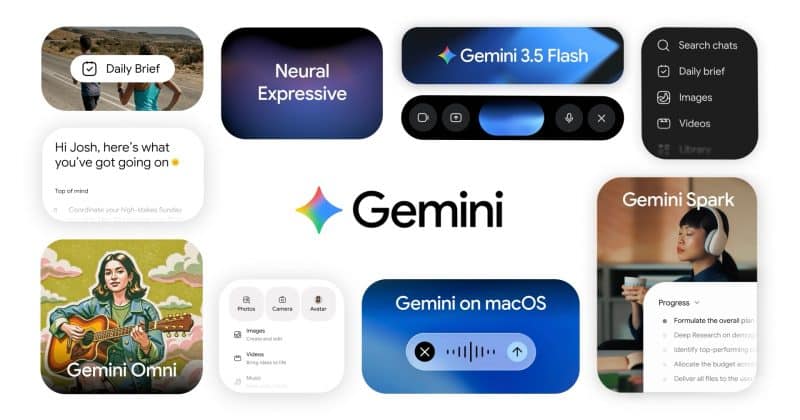
Gemini 3.5 Flash integrates computer use for enhanced automation
Google's latest AI model can navigate screens and click buttons like a human, scoring 78.4% on the industry's toughest computer-use benchmark
Google just gave its AI model a mouse and keyboard. Gemini 3.5 Flash, announced on May 19, 2026, is the company’s first production model built to actually use computers the way humans do: clicking through interfaces, reading screenshots, and executing multi-step workflows across browsers and desktops.
The model scored 78.4% on OSWorld-Verified, the benchmark that measures how well an AI can navigate real operating systems and applications.
What computer use actually means
Gemini 3.5 Flash can look at what’s on screen via screenshots, identify UI elements like buttons and text fields, and then take actions: clicking, typing, scrolling, switching tabs.
The model ships with a 1 million token context window. It also supports function calling and structured outputs, the technical plumbing that lets developers wire it into existing systems.
Pricing lands at $1.50 per million input tokens and $9 per million output tokens, with caching options to bring costs down further.
Enterprise adoption is already underway
Salesforce is weaving Gemini 3.5 Flash into its Agentforce platform, where it powers multi-subagent enterprise tasks.
AI, tech, and the markets they move—in one daily briefing.
Daily. Free. Join 34,000+ readers across crypto, finance, and policy.
Xero, the accounting software giant, is deploying it for autonomous workflows that include supplier identification and tax form processing.
Shopify and Ramp are also adapting the model for their platforms, targeting everything from data analysis to OCR (optical character recognition, the technology that reads text from images and documents).
Google’s own Antigravity platform serves as the primary development environment for building agents that can execute tasks in parallel.
What this means for crypto and finance
Gemini 3.5 Flash doesn’t have any direct crypto integration. There’s no on-chain component, no token, no DeFi hook.
At $1.50 per million input tokens, the cost of running sophisticated automation is dropping fast enough that it won’t remain an enterprise-only capability for long. Smaller crypto teams and individual developers will increasingly be able to deploy agent-level automation that previously required dedicated engineering resources.