
Humanoid robots perform surgery successfully for the first time, and the implications extend beyond the operating room

Humanoid robots perform surgery successfully for the first time, and the implications extend beyond the operating room

Teleoperated humanoid robots just completed seven medical procedures at UCSD, opening a new frontier that could reshape healthcare, labor markets, and the tech investment landscape

A humanoid robot just helped remove a gallbladder from a living patient.

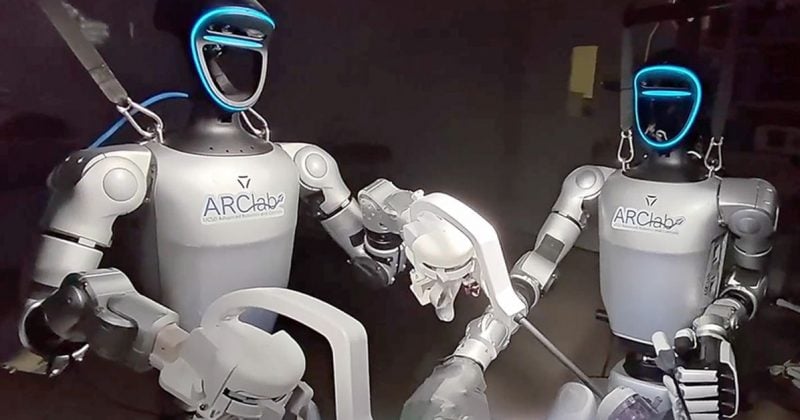
Researchers at the University of California San Diego successfully used teleoperated humanoid robots to assist in live surgical procedures for the first time in documented history. The trials, conducted in early July 2026 at UCSD’s Advanced Robotics and Controls Lab (ARCLab), involved seven different medical procedures ranging from general examinations to complex operations like gallbladder removal.

Advertisement

What actually happened in the operating room

The robots in question were Unitree G1 humanoid models, controlled remotely by human operators using motion capture technology, foot pedals, and trackers. The system enabled what researchers call “bimanual teleoperation,” meaning the robot could use both arms simultaneously with the kind of coordination required for delicate surgical work — the robot could hold tissue with one hand and cut with the other, mimicking the way an actual surgeon operates.

Professor Michael Yip led the project alongside surgeons Charles Goldberg and Preetham Suresh from the UC San Diego School of Medicine. The multidisciplinary team emphasized that these were not autonomous surgeries. A human was in control the entire time, with the humanoid serving as an extension of the surgeon’s own body.

Why this matters beyond medicine

A perspective article published in Science Robotics in July 2025 argued that humanoid robotics is necessary to address scalable medical assistance and labor shortages in healthcare. The UCSD work also builds on a March 2025 preprint that discussed adopting humanoids in healthcare settings.

The competitive landscape is worth monitoring. Johns Hopkins University has been advancing autonomous surgical systems using non-humanoid robots, taking a fundamentally different approach to the same problem. The UCSD team’s decision to use humanoid form factors is deliberate: humanoid robots can theoretically operate in environments designed for humans without requiring expensive infrastructure modifications.

The key risk for investors watching this space is the gap between demonstration and deployment. Seven successful procedures at a university research lab is genuinely impressive. Scaling that to thousands of hospitals across dozens of regulatory jurisdictions is a completely different challenge, one that will require years of clinical trials, FDA-equivalent approvals globally, and the kind of insurance frameworks that don’t yet exist for robot-assisted humanoid surgery.

Disclosure: This article was edited by Editorial Team. For more information on how we create and review content, see our Editorial Policy.

Humanoid robots perform surgery successfully for the first time, and the implications extend beyond the operating room

Humanoid robots perform surgery successfully for the first time, and the implications extend beyond the operating room

Teleoperated humanoid robots just completed seven medical procedures at UCSD, opening a new frontier that could reshape healthcare, labor markets, and the tech investment landscape

A humanoid robot just helped remove a gallbladder from a living patient.

Researchers at the University of California San Diego successfully used teleoperated humanoid robots to assist in live surgical procedures for the first time in documented history. The trials, conducted in early July 2026 at UCSD’s Advanced Robotics and Controls Lab (ARCLab), involved seven different medical procedures ranging from general examinations to complex operations like gallbladder removal.

Advertisement

What actually happened in the operating room

The robots in question were Unitree G1 humanoid models, controlled remotely by human operators using motion capture technology, foot pedals, and trackers. The system enabled what researchers call “bimanual teleoperation,” meaning the robot could use both arms simultaneously with the kind of coordination required for delicate surgical work — the robot could hold tissue with one hand and cut with the other, mimicking the way an actual surgeon operates.

Professor Michael Yip led the project alongside surgeons Charles Goldberg and Preetham Suresh from the UC San Diego School of Medicine. The multidisciplinary team emphasized that these were not autonomous surgeries. A human was in control the entire time, with the humanoid serving as an extension of the surgeon’s own body.

Why this matters beyond medicine

A perspective article published in Science Robotics in July 2025 argued that humanoid robotics is necessary to address scalable medical assistance and labor shortages in healthcare. The UCSD work also builds on a March 2025 preprint that discussed adopting humanoids in healthcare settings.

The competitive landscape is worth monitoring. Johns Hopkins University has been advancing autonomous surgical systems using non-humanoid robots, taking a fundamentally different approach to the same problem. The UCSD team’s decision to use humanoid form factors is deliberate: humanoid robots can theoretically operate in environments designed for humans without requiring expensive infrastructure modifications.

The key risk for investors watching this space is the gap between demonstration and deployment. Seven successful procedures at a university research lab is genuinely impressive. Scaling that to thousands of hospitals across dozens of regulatory jurisdictions is a completely different challenge, one that will require years of clinical trials, FDA-equivalent approvals globally, and the kind of insurance frameworks that don’t yet exist for robot-assisted humanoid surgery.

Disclosure: This article was edited by Editorial Team. For more information on how we create and review content, see our Editorial Policy.