
Nexo Earn with Nexo
Hyperliquid drives growth of real-world asset perps, capturing 44% of total volume

Hyperliquid drives growth of real-world asset perps, capturing 44% of total volume

The decentralized exchange's RWA perpetual futures open interest hit $2.65 billion, doubling in two months as traders flock to 24/7 commodity and equity index markets.

Perpetual futures tied to real-world assets like oil, gold, and equity indices are having a moment. And Hyperliquid is the platform eating most of the pie.

By late March 2026, the decentralized exchange captured 44% of all perpetual DEX trading volume, up from 36.4% in January. That makes it the only major decentralized perpetual exchange to actually grow its market share during a period when the broader on-chain perps market was already expanding.

The numbers behind the surge

As of May 21, 2026, Hyperliquid’s open interest in RWA perpetual futures reached a record $2.65 billion. That figure doubled in roughly two months.

The platform’s total value locked sits at approximately $650 million, supporting that open interest at around 4x leverage.

Advertisement

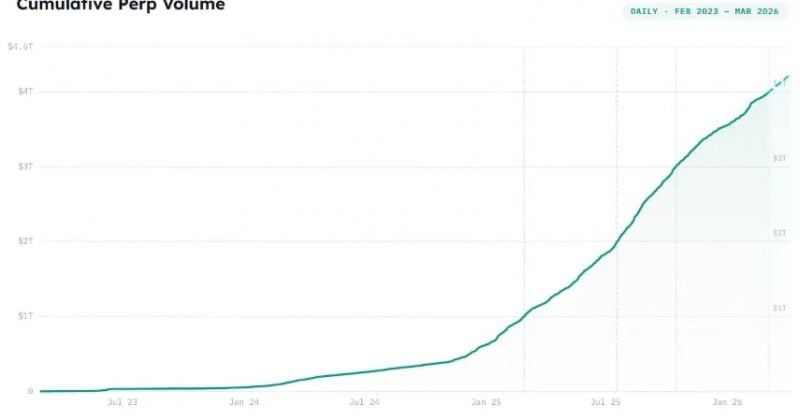
Daily trading volumes on Hyperliquid frequently exceed $7 billion, with weekly figures averaging around $50 billion in early 2026. Cumulative volume has crossed into the trillions.

RWA trading pairs have accounted for as much as 44% of the platform’s total volume. Commodities, in particular, have seen heightened activity during periods of geopolitical tension, when traders want exposure to assets like oil and gold but don’t want to wait for traditional markets to open.

Perpetual futures tied to real-world assets trade 24/7. When geopolitical events break on a Sunday evening, crypto-native traders can immediately position themselves in gold or crude oil perps while traditional markets sit idle until Monday morning.

How HIP-3 changed the game

The catalyst for much of this growth was HIP-3, a market framework Hyperliquid introduced in October 2025. It allows the community to deploy permissionless markets for real-world assets, meaning anyone can create a new perpetual futures pair without needing approval from a central authority.

TradeXYZ, a leading contributor within the Hyperliquid ecosystem, has driven much of the volume generated through HIP-3 markets. The permissionless nature of the framework has enabled rapid expansion into assets like silver, various commodities, and equity indices including the S&P 500.

Institutional interest is creeping in

Grayscale recently filed an S-1 for a potential spot HYPE ETF.

HYPE serves multiple functions within the ecosystem. It’s used for governance, staking, fee payments, and incentive programs. If an ETF were approved, it would give traditional investors a regulated vehicle to gain exposure to the infrastructure token powering the largest decentralized perps exchange by market share.

Disclosure: This article was edited by Editorial Team. For more information on how we create and review content, see our Editorial Policy.

Hyperliquid drives growth of real-world asset perps, capturing 44% of total volume

Hyperliquid drives growth of real-world asset perps, capturing 44% of total volume

The decentralized exchange's RWA perpetual futures open interest hit $2.65 billion, doubling in two months as traders flock to 24/7 commodity and equity index markets.

Perpetual futures tied to real-world assets like oil, gold, and equity indices are having a moment. And Hyperliquid is the platform eating most of the pie.

By late March 2026, the decentralized exchange captured 44% of all perpetual DEX trading volume, up from 36.4% in January. That makes it the only major decentralized perpetual exchange to actually grow its market share during a period when the broader on-chain perps market was already expanding.

The numbers behind the surge

As of May 21, 2026, Hyperliquid’s open interest in RWA perpetual futures reached a record $2.65 billion. That figure doubled in roughly two months.

The platform’s total value locked sits at approximately $650 million, supporting that open interest at around 4x leverage.

Advertisement

Daily trading volumes on Hyperliquid frequently exceed $7 billion, with weekly figures averaging around $50 billion in early 2026. Cumulative volume has crossed into the trillions.

RWA trading pairs have accounted for as much as 44% of the platform’s total volume. Commodities, in particular, have seen heightened activity during periods of geopolitical tension, when traders want exposure to assets like oil and gold but don’t want to wait for traditional markets to open.

Perpetual futures tied to real-world assets trade 24/7. When geopolitical events break on a Sunday evening, crypto-native traders can immediately position themselves in gold or crude oil perps while traditional markets sit idle until Monday morning.

How HIP-3 changed the game

The catalyst for much of this growth was HIP-3, a market framework Hyperliquid introduced in October 2025. It allows the community to deploy permissionless markets for real-world assets, meaning anyone can create a new perpetual futures pair without needing approval from a central authority.

TradeXYZ, a leading contributor within the Hyperliquid ecosystem, has driven much of the volume generated through HIP-3 markets. The permissionless nature of the framework has enabled rapid expansion into assets like silver, various commodities, and equity indices including the S&P 500.

Institutional interest is creeping in

Grayscale recently filed an S-1 for a potential spot HYPE ETF.

HYPE serves multiple functions within the ecosystem. It’s used for governance, staking, fee payments, and incentive programs. If an ETF were approved, it would give traditional investors a regulated vehicle to gain exposure to the infrastructure token powering the largest decentralized perps exchange by market share.

Disclosure: This article was edited by Editorial Team. For more information on how we create and review content, see our Editorial Policy.