
Iran attacks cargo ship in Strait of Hormuz as Bitcoin toll scheme draws US Treasury scrutiny
An IRGC gunboat struck a containership near Oman, part of a broader escalation that has pulled crypto into one of the world's most consequential shipping chokepoints
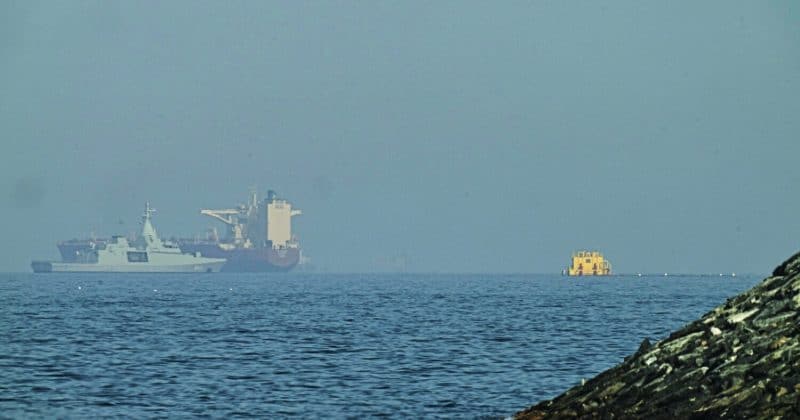
The Islamic Revolutionary Guard Corps attacked a containership in the Strait of Hormuz on April 22, 2026, damaging the vessel’s bridge in an unprovoked strike roughly 15 nautical miles northeast of Oman. The ship, which had already received transit permission, was hit by an IRGC gunboat without prior challenge.
That last detail matters. Transit permission offered no protection. For the hundreds of vessels that pass through the Strait of Hormuz daily, that’s a significant shift in the threat calculus.
A chokepoint on fire
The April 22 attack was not an isolated incident. It came during a stretch of escalating maritime confrontations in late April and early May 2026, with strikes also reported on the Mediterranean Shipping Company’s vessel Francesca and the Greek-owned Epaminondas. Combined with earlier incidents, the total count of maritime attacks tied to the ongoing conflict has surpassed two dozen.
Iran’s leverage over that bottleneck has taken a new form beyond gunboats. The country began mandating a $1-per-barrel Bitcoin toll for Hormuz transit, a mechanism designed to collect revenue while sidestepping US-led sanctions. According to reporting from the Wall Street Journal and others, actual payments under this scheme were made.
Iran’s broader crypto economy carries a valuation cited at over $7.78 billion, which gives the toll scheme a credible institutional backbone rather than the look of an improvised workaround.
The US Treasury response
Washington did not treat the Bitcoin toll scheme as a curiosity. The US Treasury froze approximately $344 million in Bitcoin connected to wallets linked to the IRGC, citing the toll collections and broader sanctions evasion activity.
Macro, rates, and crypto—what moved markets and what matters next.
Daily. Free. Join 34,000+ readers across crypto, finance, and policy.
That number, $344 million, is significant for a few reasons. It signals that US agencies have developed meaningful on-chain forensics capability, the kind needed to trace and freeze funds held in pseudonymous wallets tied to a sovereign adversary. It also confirms that the sanctions evasion use case for crypto, long theorized and occasionally documented in smaller cases, has now been tested at state-actor scale.
What this means for crypto markets and investors
Bitcoin’s price briefly dipped below $80,000 during the peak of the Hormuz tensions, a move that reflected both broad risk-off sentiment and specific anxiety about regulatory blowback on crypto tied to sanctioned entities.
For investors, the core risk is regulatory contagion. When Bitcoin appears in the same sentence as IRGC sanctions evasion and oil toll collection, it invites legislative attention. Congressional hearings, expanded OFAC guidance on crypto, and tighter exchange compliance requirements are all plausible downstream effects of this episode.
The competitive landscape for compliant exchanges and custody providers could actually benefit from this dynamic. Platforms that have invested heavily in blockchain analytics and sanctions screening are better positioned to weather a regulatory tightening than those that have not.
Watch for further Treasury designations. The $344 million freeze may be the opening move rather than the conclusion of the US government’s response to Iran’s Bitcoin toll infrastructure.