
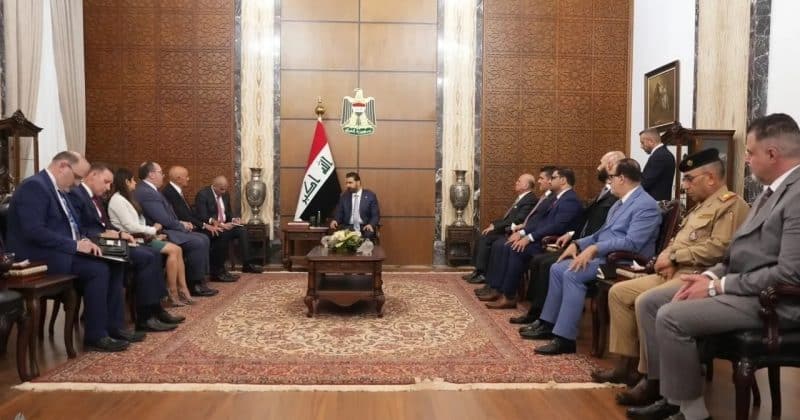
Iraq government sets September 30 deadline for Iran-backed groups to disarm

Iraq government sets September 30 deadline for Iran-backed groups to disarm

Baghdad ties the disarmament timeline to the end of the US-led coalition's mission, signaling a major shift in Iraq's security posture and its balancing act between Washington and Tehran.

Iraq’s government has drawn a line in the sand, and it comes with a calendar date. Iran-backed armed groups operating in the country have until September 30, 2026, to either disarm or fold into Iraq’s official state security forces.

Government spokesman Haydar al-Abudi announced the deadline on June 10, framing it as the natural consequence of a changing security environment. The date isn’t arbitrary. It aligns precisely with the formal conclusion of the US-led International Coalition’s mission against ISIS in Iraq, a withdrawal first outlined in an agreement signed back in September 2024.

The end of justification

The PMF isn’t a single organization so much as an umbrella covering dozens of armed groups, many of which maintain deep operational and ideological ties to Tehran. Some have functioned as de facto extensions of Iranian foreign policy, operating with significant autonomy from Baghdad.

Advertisement

Al-Abudi’s message was pointed. After September 30, “there will be no justification for unregulated weapons.” Prime Minister Ali al-Zaidi has been blunt about this. There will be no justification for armed factions to operate independently once US forces complete their departure.

Washington’s invisible hand

Washington has been leaning heavily on Baghdad to produce a credible and rapid plan for bringing Iran-aligned groups under state control. The pressure comes with teeth, too. The US has warned of economic repercussions if progress proves insufficient.

The broader geopolitical backdrop adds another layer of complexity. Discussions between the US and Iran have been ongoing, and Iraq has long served as the uncomfortable middle ground where those two powers’ interests collide.

What this means for regional stability and markets

This is fundamentally a geopolitical story, not a crypto story. There are no direct, immediate implications for digital asset markets or cryptocurrency investors.

If Baghdad actually succeeds in bringing these groups under state control, it would represent a meaningful reduction in one of the Middle East’s most persistent sources of instability. Iran-backed militias in Iraq have been responsible for attacks on US forces, disruptions to regional commerce, and periodic escalations that ripple through energy markets.

The September 30 date also sits at an interesting intersection with US-Iran relations more broadly. If those discussions produce some kind of framework agreement, disarmament in Iraq becomes more achievable. If they collapse, Iran has every incentive to maintain its proxy network as leverage.

Disclosure: This article was edited by Editorial Team. For more information on how we create and review content, see our Editorial Policy.

Iraq government sets September 30 deadline for Iran-backed groups to disarm

Iraq government sets September 30 deadline for Iran-backed groups to disarm

Baghdad ties the disarmament timeline to the end of the US-led coalition's mission, signaling a major shift in Iraq's security posture and its balancing act between Washington and Tehran.

Iraq’s government has drawn a line in the sand, and it comes with a calendar date. Iran-backed armed groups operating in the country have until September 30, 2026, to either disarm or fold into Iraq’s official state security forces.

Government spokesman Haydar al-Abudi announced the deadline on June 10, framing it as the natural consequence of a changing security environment. The date isn’t arbitrary. It aligns precisely with the formal conclusion of the US-led International Coalition’s mission against ISIS in Iraq, a withdrawal first outlined in an agreement signed back in September 2024.

The end of justification

The PMF isn’t a single organization so much as an umbrella covering dozens of armed groups, many of which maintain deep operational and ideological ties to Tehran. Some have functioned as de facto extensions of Iranian foreign policy, operating with significant autonomy from Baghdad.

Advertisement

Al-Abudi’s message was pointed. After September 30, “there will be no justification for unregulated weapons.” Prime Minister Ali al-Zaidi has been blunt about this. There will be no justification for armed factions to operate independently once US forces complete their departure.

Washington’s invisible hand

Washington has been leaning heavily on Baghdad to produce a credible and rapid plan for bringing Iran-aligned groups under state control. The pressure comes with teeth, too. The US has warned of economic repercussions if progress proves insufficient.

The broader geopolitical backdrop adds another layer of complexity. Discussions between the US and Iran have been ongoing, and Iraq has long served as the uncomfortable middle ground where those two powers’ interests collide.

What this means for regional stability and markets

This is fundamentally a geopolitical story, not a crypto story. There are no direct, immediate implications for digital asset markets or cryptocurrency investors.

If Baghdad actually succeeds in bringing these groups under state control, it would represent a meaningful reduction in one of the Middle East’s most persistent sources of instability. Iran-backed militias in Iraq have been responsible for attacks on US forces, disruptions to regional commerce, and periodic escalations that ripple through energy markets.

The September 30 date also sits at an interesting intersection with US-Iran relations more broadly. If those discussions produce some kind of framework agreement, disarmament in Iraq becomes more achievable. If they collapse, Iran has every incentive to maintain its proxy network as leverage.

Disclosure: This article was edited by Editorial Team. For more information on how we create and review content, see our Editorial Policy.