
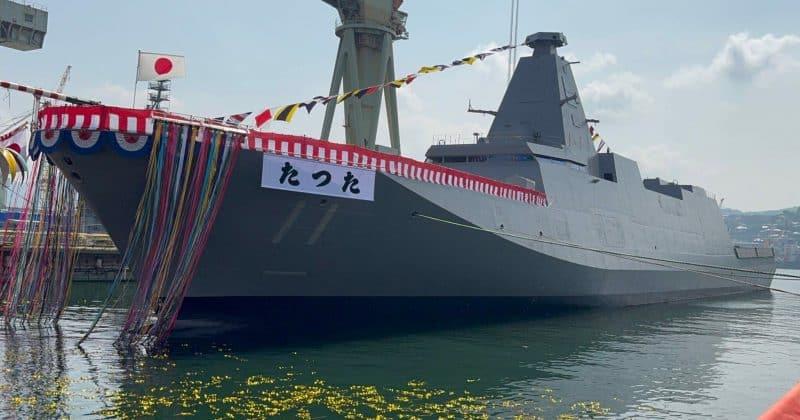
Japan markets Mogami-class frigate with advanced weaponry overseas, signaling historic defense export shift

Japan markets Mogami-class frigate with advanced weaponry overseas, signaling historic defense export shift

A landmark deal with Australia for 11 upgraded frigates marks Japan's largest postwar arms export and opens the door to buyers across the Indo-Pacific

For decades, Japan’s defense industry operated under a simple rule: build weapons, but don’t sell them to anyone. That era is over.

Japan is actively marketing its Mogami-class frigate to international buyers, anchored by a contract signed in April 2026 with Australia for 11 upgraded variants of the vessel. The deal represents Japan’s largest postwar defense export initiative. Mitsubishi Heavy Industries serves as the prime contractor, with the first delivery of three frigates expected by 2029.

What makes the Mogami-class worth buying

The Mogami-class frigate is designed for multi-mission operations spanning anti-submarine warfare, anti-surface engagements, and air defense, all wrapped in a stealth-optimized hull that reduces radar signatures.

The ship can operate with a crew of roughly 90 personnel. For context, comparable frigates from other nations typically require crews well north of 100. Fewer sailors per ship means lower operating costs, easier crew rotation, and faster deployment cycles.

Advertisement

The upgraded Mogami-class boasts an operational reach of up to 10,000 nautical miles. That’s enough to cross the Pacific Ocean without refueling.

From pacifism to the arms market

Japan’s journey to this point has been gradual but deliberate. The country began easing its self-imposed arms export restrictions in 2014, creating guidelines that allowed transfers of lethal equipment under specific conditions. Before that policy shift, Japan’s defense industrial base was essentially a closed loop: domestic manufacturers built for the Japan Maritime Self-Defense Force, and that was it.

The Australia contract incorporates technology transfer and co-production arrangements, meaning later ships in the 11-vessel order will be built in Australian shipyards. Japan’s Defense Minister Shinjiro Koizumi signed the agreement alongside Mitsubishi Heavy Industries, the conglomerate that has built warships for the Japanese navy for over a century.

New Zealand, Indonesia, the Philippines, and Taiwan have all expressed interest in procuring or at least evaluating the Mogami-class design as of mid-2026.

What this means for investors and the defense market

European shipbuilders, particularly firms like Babcock, Fincantieri, and Naval Group, have historically dominated the frigate export market in the Indo-Pacific. Japan’s Mogami offering introduces a new competitor with a distinct advantage: geographic proximity.

The co-production element of the Australia deal creates a template for future buyers. Australian shipyards gaining the capability to build Mogami-class vessels means those yards could eventually service ships for other regional operators, creating a hub-and-spoke model centered on Japanese naval technology.

Japan’s arms export policies remain politically sensitive domestically. Taiwan’s interest is particularly delicate, given the diplomatic tightrope Japan walks between Taipei and Beijing. Whether Tokyo would actually approve a frigate sale to Taiwan remains an open and highly consequential question.

Disclosure: This article was edited by Editorial Team. For more information on how we create and review content, see our Editorial Policy.

Japan markets Mogami-class frigate with advanced weaponry overseas, signaling historic defense export shift

Japan markets Mogami-class frigate with advanced weaponry overseas, signaling historic defense export shift

A landmark deal with Australia for 11 upgraded frigates marks Japan's largest postwar arms export and opens the door to buyers across the Indo-Pacific

For decades, Japan’s defense industry operated under a simple rule: build weapons, but don’t sell them to anyone. That era is over.

Japan is actively marketing its Mogami-class frigate to international buyers, anchored by a contract signed in April 2026 with Australia for 11 upgraded variants of the vessel. The deal represents Japan’s largest postwar defense export initiative. Mitsubishi Heavy Industries serves as the prime contractor, with the first delivery of three frigates expected by 2029.

What makes the Mogami-class worth buying

The Mogami-class frigate is designed for multi-mission operations spanning anti-submarine warfare, anti-surface engagements, and air defense, all wrapped in a stealth-optimized hull that reduces radar signatures.

The ship can operate with a crew of roughly 90 personnel. For context, comparable frigates from other nations typically require crews well north of 100. Fewer sailors per ship means lower operating costs, easier crew rotation, and faster deployment cycles.

Advertisement

The upgraded Mogami-class boasts an operational reach of up to 10,000 nautical miles. That’s enough to cross the Pacific Ocean without refueling.

From pacifism to the arms market

Japan’s journey to this point has been gradual but deliberate. The country began easing its self-imposed arms export restrictions in 2014, creating guidelines that allowed transfers of lethal equipment under specific conditions. Before that policy shift, Japan’s defense industrial base was essentially a closed loop: domestic manufacturers built for the Japan Maritime Self-Defense Force, and that was it.

The Australia contract incorporates technology transfer and co-production arrangements, meaning later ships in the 11-vessel order will be built in Australian shipyards. Japan’s Defense Minister Shinjiro Koizumi signed the agreement alongside Mitsubishi Heavy Industries, the conglomerate that has built warships for the Japanese navy for over a century.

New Zealand, Indonesia, the Philippines, and Taiwan have all expressed interest in procuring or at least evaluating the Mogami-class design as of mid-2026.

What this means for investors and the defense market

European shipbuilders, particularly firms like Babcock, Fincantieri, and Naval Group, have historically dominated the frigate export market in the Indo-Pacific. Japan’s Mogami offering introduces a new competitor with a distinct advantage: geographic proximity.

The co-production element of the Australia deal creates a template for future buyers. Australian shipyards gaining the capability to build Mogami-class vessels means those yards could eventually service ships for other regional operators, creating a hub-and-spoke model centered on Japanese naval technology.

Japan’s arms export policies remain politically sensitive domestically. Taiwan’s interest is particularly delicate, given the diplomatic tightrope Japan walks between Taipei and Beijing. Whether Tokyo would actually approve a frigate sale to Taiwan remains an open and highly consequential question.

Disclosure: This article was edited by Editorial Team. For more information on how we create and review content, see our Editorial Policy.