
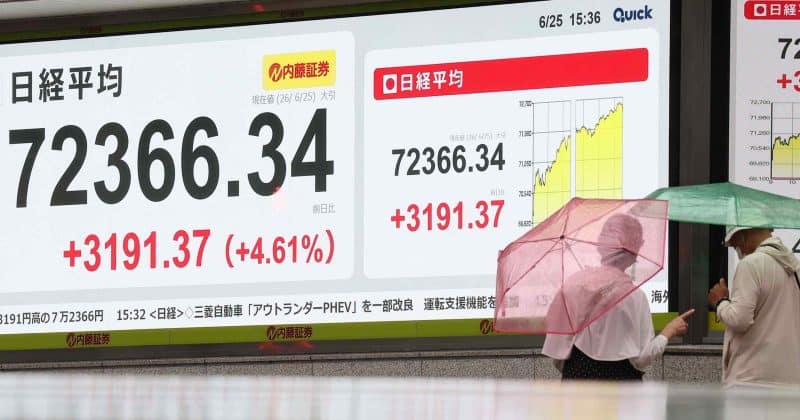
Japanese retail investors boost leveraged stock bets to 30-year high
Margin buying balances on Tokyo exchanges hit ¥6.39 trillion, the highest level since data collection began in 1994
Japan’s retail investors are feeling bold. Margin buying balances on the Tokyo and Nagoya stock exchanges climbed to ¥6.3915 trillion, roughly $40 billion, as of May 29, 2026. That is the highest reading since records began in December 1994.
To put the scale in perspective: Japanese individual investors simultaneously held over 16 trillion yen, around $99 billion, in brokerage accounts as of late June 2026.
What is actually happening here
Japanese retail investors have been piling into this trade with particular enthusiasm in the semiconductor and electronics sectors. Companies like Kioxia Holdings, Murata Manufacturing, and Ibiden attracted concentrated attention during the week of May 25 through 29, when the margin balance peak was recorded.
Margin trading volume rose 39% year-over-year in fiscal 2025, reaching approximately 618 trillion yen, or about $4 trillion.
Retail investors now account for 25% of Japan’s total equity trading value in fiscal 2025, the largest share in 12 years. Younger traders using tax-efficient investment accounts have driven a meaningful portion of that growth.
Why this moment matters
The cash reserve figure reinforces this reading. Over 16 trillion yen sitting in brokerage accounts suggests a population that is engaged, watching, and ready to deploy capital.
Macro, rates, and crypto—what moved markets and what matters next.
Daily. Free. Join 34,000+ readers across crypto, finance, and policy.
When prices fall, brokers issue margin calls, forcing investors to sell positions to cover their borrowings. Those forced sales push prices lower, which triggers more margin calls, which triggers more forced sales.
Market analysts have noted that historical peaks in margin debt in Japan have typically preceded corrections.
What investors should watch
The semiconductor sector concentration is worth monitoring specifically. When margin buying clusters in a handful of names, the unwind risk is not evenly distributed across the market. A sharp move in Kioxia or Murata does not just hurt holders of those stocks. It can force margin liquidations that spill over into adjacent positions as investors sell what they can, not what they want to.
The 39% year-over-year increase in margin trading volume raises a structural question: how much of the fiscal 2025 equity rally was driven by genuine valuation confidence versus leveraged momentum.
The 25% retail share of trading volume means that when sentiment shifts, it shifts at scale.